Paper commentary
SPDMX: Large-Scale Open Stem Audio From Symbolic Music
SPDMX renders public-domain scores into a large openly licensed stem corpus
- Problem Open multitrack audio stays scarce because copyright blocks redistributing recordings. Recorded sets are small or restricted, and synthetic sets rely on proprietary sample libraries.
- Method SPDMX renders public-domain PDMX scores into stems with an open pipeline. FluidSynth renders most parts, while MIDI-DDSP replaces the soundfont for eligible monophonic strings, brass, and winds.
- Results The multitrack subset holds 2,734 song-hours, compared with 145 hours for Slakh2100. The corpus is released under CC BY 4.0 with paired MIDI and PDMX identifiers.
Why open multitrack training data is scarce
Source separation, accompaniment generation, and stem-conditioned synthesis each need separate stems, not finished mixes. Copyright stops anyone from redistributing the recordings that would yield such corpora, so open stem sets stay rare. Recorded sets like MUSDB18, MedleyDB, and MoisesDB offer realistic audio, but they hold few hours or have restricted access.
Slakh2100 is synthetic, yet its sounds come from proprietary sample libraries that can't be redistributed. PDMX gives symbolic scale, but a plain General MIDI render sounds dry and acoustically weak.
Table 1 compares resources by song count, mixture hours, recorded or synthetic type, open download, and synthesis without proprietary instruments. MUSDB18 lists 150 songs and 10 hours, while MoisesDB lists 240 songs and 14.4 hours, both recorded. Slakh2100 lists 2,100 songs and 145 hours, and its footnote points to proprietary VST renderers.
CocoChorales lists 240,000 songs and 1,411 hours, with synthesis that avoids proprietary instruments. No resource in that table combines a score collection of this size with an open rendering stack.
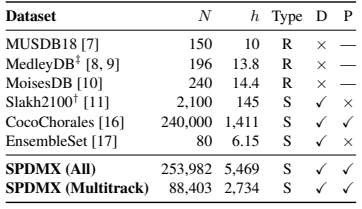
Table 1 . Multitrack resources (N= songs,h= mixture hours; Type: R = recorded, S = synthetic; D = openly-licensed down- load; P = synthesis without proprietary instruments). SPDMX includes single-stem songs. Larger CC mixture corpora with- out stems (e.g., FMA [14], MTG-Jamendo [15]) are omitted.
Original paper · CC BY 4.0Neural synthesizers like MIDI-DDSP improve realism for some monophonic instruments, but EnsembleSet and SynthSOD rely on commercial libraries. SPDMX fills that gap by rendering real public-domain PDMX repertoire with an open FluidSynth and MIDI-DDSP stack.
From public-domain scores to stems
The authors render existing public-domain scores instead of recording performers, so every stem stays tied to its MIDI source. Songs pair their MIDI with PDMX identifiers, so each audio file can be traced back to its score. The pipeline first corrects General MIDI programs from track name aliases, because PDMX programs often disagree with track names.
A named violin, for example, can be encoded as piano, so the program has to follow the track name. Tracks with no note events are dropped, and each remaining track then goes to a renderer chosen for its instrument category.
FluidSynth renders the polyphonic parts and every other General MIDI program. MIDI-DDSP replaces the soundfont only for eligible monophonic strings, brass, and winds. The authors expect this split because short soundfont notes poorly match the acoustic sustain of winds, brass, and strings. Those upsampled stems stay band-limited relative to native 44.1kHz audio, which the authors state openly.
The listening pilot compares a basic soundfont, a varied soundfont set, and MIDI-DDSP over each fallback. Listeners scored 10-second stem excerpts for perceived realism from 0 to 100, with two stems for each of 10 categories. Eight listeners completed the study, so the ratings guide design rather than settle significance. The authors chose the highest mean by default, but kept varied when it sat close to basic, to preserve timbral diversity.
Drums, organ, and guitar use basic, while piano, voice, mallet, and miscellaneous classes use varied. The authors loudness-normalize each stem toward −23 LUFS, then scale it by its track's maximum note-on velocity ratio.
Choosing the render recipe per category
The listening pilot asks whether one renderer stands out for every instrument category. Eight listeners rated 10-second stem excerpts, with two stems representing each of 10 categories. Four families were compared: basic, varied, MIDI-DDSP over basic fallbacks, and MIDI-DDSP over varied fallbacks. The basic soundfont served as the open reference and reappeared among shuffled, unlabeled conditions.
Basic relies on the single SGM-V2.01 GM bank, while varied draws from a shortlist of redistributable soundfonts plus a light reverb.
The varied shortlist includes FluidR3 GM, GeneralUser GS, Arachno, and Airfont, which adds timbral variety without Slakh2100's proprietary libraries. Fig. 3 plots per-listener means for each category, and stars mark the frozen recipe. The authors chose the highest mean by default, because the ratings serve as design guidance rather than a test.
When basic and varied sat close, they kept varied to preserve timbral diversity. That heuristic isn't a significance rule, so the choice is a design judgement rather than a statistical result.
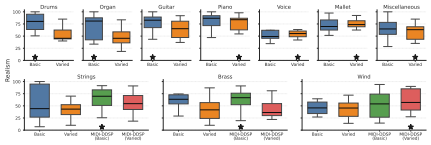
Fig. 3 . Pilot listening ratings of realism (0–100) by instrument category for basic, varied, and MIDI-DDSP hybrids. Boxes are per-listener means (N=8; two stems per category). MIDI- DDSP panels appear only where neural synthesis can apply. Stars mark the frozen SPDMX recipe.
Original paper · CC BY 4.0 · Phillip Long, Eduardo Escoto, Julian McAuley, Zachary Novack · SPDMX: Large-Scale Open Stem Audio From Symbolic Music · Original paper figure · Extracted the figure area from page 3 of the original PDF.MIDI-DDSP applies only to eligible monophonic strings, brass, and winds, while FluidSynth covers polyphonic parts. So the recipe mixes four render paths rather than picking one winning renderer. The pilot didn't establish corpus-wide absolute realism, since it was a small, synthetic-reference study.
Combining stems into a mixture
The mixing step runs only after the render recipe is frozen, so the same rule applies to every cleaned song. Each stem is first loudness-normalized toward −23 LUFS with peak limiting, using a loudness measurement reference. Matching loudness independently for each stem would erase the balance that MIDI velocity sets, so the authors skip that step.
Instead, each stem is scaled by its track's maximum note-on velocity divided by the song's maximum.
A single anti-clip peak gain then applies to the stem sum, not to each stem separately. That keeps the stems linearly summable, so the mixture equals the stem sum, following the convention used for Slakh2100. Each song ships as mono FLAC stems with paired MIDI.
Songs share PDMX identifiers, so downloading PDMX alongside SPDMX lets users join scores to the audio. About 65% of songs are single-stem, and all stems are mono. MIDI comes from engraved scores with quantized timing and dynamics, which limits how much velocity detail the balance can carry.
Those upsampled stems remain band-limited relative to native 44.1kHz audio. The small listening study doesn't establish corpus-wide absolute realism, so the mixing rules remain a design choice.
What the release contains
Every stem and mix ships under CC BY 4.0, and each song pairs with MIDI and a PDMX identifier. Song-hours count each song's mixture once, so the stem count doesn't inflate them.
88,403 songs (34.8%) have two or more stems, and they hold 2,734 song-hours, which is 50.0% of hours.
Fig. 1 sets the multitrack song-hours by stem count against Slakh2100. Slakh2100 has 2,100 tracks and 145 song-hours in full. Even without singles, the multitrack subset exceeds that full Slakh2100 inventory.
Fig. 2 labels piano at 58% of stem count and 43% of non-silent hours. The text gives piano as 57% of stems and 41% of hours, so the figure labels and the text differ slightly. Many piano tracks are sparse or short, which is why piano's hour share trails its stem share.
Limitations of the release and the listening study
Piano dominates the inventory, and many piano tracks are sparse or short. Those sparse piano tracks mean the stem counts overstate how much piano audio the corpus holds.
All stems are mono, and the mix of a multitrack song is also mono. The MIDI comes from engraved scores, with quantized timing and dynamics. Voice tracks use choir or voice soundfonts, because lyric singing synthesis is out of scope.
The listening pilot used 8 listeners, who rated two stems in each of 10 categories on a 0 to 100 realism scale. Its references are synthetic, and the basic soundfont serves as the open reference. The small, synthetic-reference study doesn't establish absolute realism across the whole corpus. The authors treat the ratings as design guidance, and they didn't run a significance test on them.
Separation and transcription checks appear on the project page, and the paper reports them as matched-budget checks indicating usable in-domain audio–label alignment.
Paper info
- Authors
- Phillip Long, Eduardo Escoto, Julian McAuley, Zachary Novack
- Venue
- arXiv · Preprint
- First published
- 2026-11-6
- Added
- 2026-11-9
- Updated
- 2026-11-6
- Version
- v1
- arXiv
- 2611.09140
- Category
- cs.SD · cs.AI · cs.LG · cs.MM · eess.AS
- Original paper terms
- CC BY 4.0
- What we show
- Paper info, commentary and permitted figures from the original paper
AI commentary is a separate explanation from the original paper and may contain errors. The original paper and figures follow each source's terms of use and any rights noted separately.
Abstract
Large public datasets have driven recent progress in machine learning, from text and vision to speech and general audio. Music remains an outlier, as copyright blocks redistribution of training audio, while many modern tasks need individual stems rather than mixtures. Existing multitrack resources trade off realism, scale, and licensing, while synthetic alternatives rely on proprietary VSTs or naive open rendering that yields weak stems. We introduce SPDMX, a listening-guided rendering of public-domain PDMX scores into an openly-licensed stem corpus with aligned scores and an open render pipeline: $253{,}982$ songs, $490{,}159$ mono stems, and $5{,}469$ song-hours at $44.1$ kHz under CC BY 4.0, with paired MIDI and identifiers linking to PDMX metadata. $88{,}403$ songs ($34.8\%$; $2{,}734$ song-hours) provide multitrack supervision. To our knowledge, this is the largest openly-licensed synthetic multitrack subset by song-hours, enabling source separation, stem-conditioned synthesis, MIDI-to-audio, transcription, and joint symbolic-audio modeling. We release the corpus, metadata, and open pipeline for reuse on other symbolic collections. Demos and experimental notes are on the project page.
Quote from the paper
Phillip Long, Eduardo Escoto, Julian McAuley, Zachary Novack (2026). SPDMX: Large-Scale Open Stem Audio From Symbolic Music. arXiv:2611.09140v1. https://arxiv.org/abs/2611.09140v1
BibTeX
@misc{long2026spdmx,
  title = {{SPDMX: Large-Scale Open Stem Audio From Symbolic Music}},
  author = {Phillip Long and Eduardo Escoto and Julian McAuley and Zachary Novack},
  year = {2026},
  eprint = {2611.09140},
  archivePrefix = {arXiv},
  url = {https://arxiv.org/abs/2611.09140v1}
}