Paper commentary
When Does Cross-View Consistency Matter in Multi-View Appearance Augmentation? A Controlled Study for Visuomotor Policies
Controlled tests show which cross-view consistency matters for visuomotor policies
- Problem Multi-view augmentation often aims for consistency across cameras, but joint generators change several things at once. So it stays unclear whether stronger cross-view consistency actually improves downstream robot control.
- Method The authors replay recorded LIBERO states and change only how each camera's perturbations are paired across views. Each camera's perturbation distribution stays fixed, so only the coupling between cameras differs.
- Results Geometrically anti-coupled views lowered Diffusion Policy success by 3.30 percentage points relative to coupled views. Appearance-only changes had small costs, with upper credible endpoints at most 2.55 percentage points.
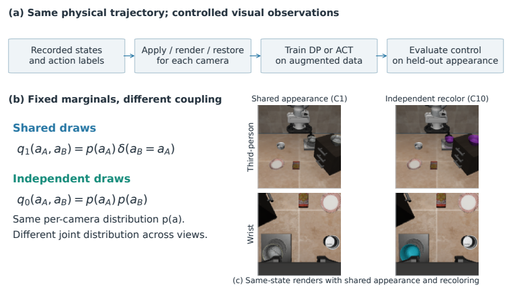
Figure 1 : Controlled visual augmentation.(a) State replay preserves physical trajectories and action labels while rendering each camera under its assigned recipe. (b) Shared and independent joint distributions have the same per-camera marginals. (c) Same-state examples of shared appearance (C1) and independent recoloring (C10), fromspatial_8, demo 0, frame 0, seed 1, variant 1. The historical renders are rotated into policy-input orientation. The matched recoloring experiment compares shared recoloring (C9) with C10.
Original paper · CC BY 4.0 · Zixuan Jiang · When Does Cross-View Consistency Matter in Multi-View Appearance Augmentation? A Controlled Study for Visuomotor Policies · Original paper figure · Extracted the figure area from page 2 of the original PDF.Why consistency is hard to judge
Editing each camera independently is straightforward, but it may yield incompatible observations. Generating views jointly can enforce consistency, but it adds modeling and computational requirements.
Existing comparisons don't isolate the effect of coupling, because joint and independent generators differ in several ways at once. The authors therefore ask whether stronger cross-view consistency necessarily improves downstream control.
The authors answer with a controlled simulation design built on recorded LIBERO states, which are replayed and rendered separately for each camera. Figure 1 shows that a shared draw and an independent draw give the same per-camera distribution p(a) but a different joint distribution across views. This lets the study vary coupling while keeping each camera's perturbation distribution fixed.
Fixing marginals and changing only the pairing
The study keeps each camera's perturbation distribution fixed and changes only how the two cameras' recipe draws are paired. Shared sampling gives q1 as p(aA) times a delta that forces the wrist recipe to equal the third-person recipe. Independent sampling gives q0 as p(aA) times p(aB), so the two recipes are drawn separately. The mixture qρ equals ρ q1 plus (1 minus ρ) q0, with ρ between 0 and 1, and both marginals equal p for every ρ.
Each camera therefore receives the same perturbation mix whichever pairing is used, which isolates the effect of coupling.
State replay restores each recorded simulator state instead of re-executing actions, so the trajectory itself never changes. For each camera in turn, the pipeline applies a recipe, renders that camera, and restores the scene before the next camera. Physical trajectories, collision geometry and recorded action labels stay unchanged, so only visual content differs between conditions.
Target offsets move only the rendered target, so the observation disagrees with the geometry the recorded action was made for.
Recipes stay fixed within a demonstration variant, and training keeps an unmodified copy of every demonstration. The shared original component is identical across augmented conditions, so it doesn't change the marginal-matching property. The primary appearance contrast is Δ equal to SR(q1) minus SR(qρ), where SR is success on a fixed, held-out, mutually consistent appearance set.
A positive Δ means success falls after coupling is reduced, and global appearance uses ρ values of 1, 0.5 and 0. Each other experiment builds its own joint distribution, so the Δ contrast applies to the global-appearance experiment only.
Small average costs for appearance coupling
Reducing appearance coupling under matched marginals doesn't show a large average cost for the DP policy in this task set. The largest 90% upper endpoint across these three contrasts is 2.55 pp, so the authors read the average coupling costs as close to zero. The paper's Figure 2 summarises these three contrasts alongside the photometric jitter control.
These averages depend partly on which tasks are included. Removing 10_9 eliminates the negative global-appearance estimate, and leave-one-task-out upper endpoints reach 3.30 pp for global appearance and 3.25 pp for ghosts. Leave-one-task-out upper endpoints for target color reach 1.89 pp.
Anti-coupled geometry reduces success
Appearance changes leave the geometric case open, because an offset moves the target itself. Both views are offset by 10 cm, and each camera keeps a 50%/50% marginal over the two directions d and d′. Offset-Coupled pairs (d,d) or (d′,d′), while Offset-Anti pairs (d,d′) or (d′,d), with d′ set 90° from d. The 90° separation keeps a nonzero average displacement, so the design doesn't turn a systematic error into zero-mean noise.
Six of seven tasks show a positive descriptive Coupled–Anti difference, and the task-equal descriptive mean is 3.6 pp. The authors attribute the gap to how directions pair across cameras, not to the error each camera carries on its own.
The geometry contrast L = 4.29 [1.61, 7.37] pp uses an older reference batch, so it is only supporting evidence. Retrained C1 anchors differ from base-batch C1 by +5.7 pp on average, with +32.5 pp on 10_9. The same-batch contrast c therefore carries the main evidence for the geometric coupling effect.
Wrist reliance and feature sensitivity
Camera interventions test how much the policy depends on the wrist view, and the answer is a lot. Introducing an unseen 10 cm wrist-view offset at test time costs the same 49 policies 33.3 percentage points. Shared and independent appearance training yield similar wrist-masking losses, so independent augmentation doesn't remove wrist reliance.
Masking is an out-of-distribution manipulation, so these losses describe reliance on the wrist view rather than a normal operating condition.
Feature analysis adds a descriptive view of which appearance factors the policy's visual pathway reacts to. For DP, the global-appearance invariance ratio falls from 0.216 without augmentation to 0.036 with shared and 0.042 with independent appearance training. The authors read this drop as sensitivity that follows the factors randomized during training, which is the claim the ratios support.
A ratio can move through its numerator, its denominator or both, so it doesn't isolate appearance sensitivity on its own.
Co-visibility explains why the appearance results differ by factor. Ghosts reach only 12.1 to 13.4% projected co-visibility, so the ghost result concerns sparse cross-view exposure. Co-visibility alone doesn't show that a policy compares corresponding regions.
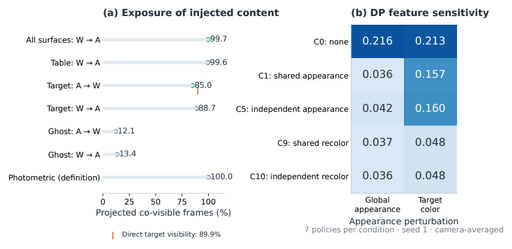
Figure 5 : Co-visibility and factor-specific feature sensitivity.(a) Projected co-visibility by element and direction; A denotes third-person and W wrist. The orange mark gives pooled direct target visibility. Photometric coverage is 100% by definition. (b) DP feature-invariance ratios for two perturbation types, averaged over both cameras and seven seed-1 policies per condition. Lower values indicate smaller appearance- induced changes relative to state-induced changes.
Original paper · CC BY 4.0The ACT comparison and the limits of the study
That makes the comparison one of policy configurations, not an isolated test of attention or fusion. ACT C1 uses seeds 2–5 in the formal runs, and its pilot models are excluded.
The study uses seven selected simulation tasks, 128×128 policy inputs and ResNet18 encoders trained from scratch. The seven tasks were selected with a single-seed, 20-episode screening success range of 40–90%. The task set isn't a representative random sample of robotic manipulation, so current-task averages don't establish low costs for unseen tasks.
The intervention types weren't dose-matched, so the study doesn't give a universal ranking between geometry and appearance. No formal cross-type effect-difference test was performed, which limits any direct comparison of the two kinds of intervention. Masking is an out-of-distribution manipulation, and co-visibility doesn't show that a policy compares corresponding regions.
Paper info
- Authors
- Zixuan Jiang
- Venue
- arXiv · Preprint
- First published
- 2026-11-13
- Added
- 2026-11-16
- Updated
- 2026-11-13
- Version
- v1
- arXiv
- 2611.17751
- Category
- cs.RO · cs.CV
- Original paper terms
- CC BY 4.0
- What we show
- Paper info, commentary and permitted figures from the original paper
AI commentary is a separate explanation from the original paper and may contain errors. The original paper and figures follow each source's terms of use and any rights noted separately.
Abstract
Multi-view visual augmentation often seeks consistency across cameras, but it is unclear which forms of consistency matter for downstream control. We use simulation-state replay to manipulate cross-view coupling while preserving the per-camera perturbation distributions, physical trajectories, and action labels. Across seven LIBERO manipulation tasks, marginal-matched changes in global appearance, ghost injection, and target color have small average costs for a late-fusion Diffusion Policy: point estimates are near zero or negative, and the largest upper endpoint of the 90% posterior credible intervals is 2.55 percentage points. In contrast, geometrically anti-coupled observations reduce success by 3.30 percentage points relative to coupled observations (90% CrI [0.64, 6.28]), with displacement magnitude, direction marginals, and the number of affected views matched. Camera interventions reveal substantial dependence on wrist-view geometry, while feature analysis shows appearance sensitivity patterns associated with the factors randomized during training. ACT shows a higher target-color cost estimate than DP, with uncertainty that includes zero and sensitivity to task composition. Within the tested tasks and policy configurations, these findings motivate selective consistency constraints: appearance coupling can sometimes be relaxed, whereas task-relevant geometry and cross-view spatial correspondence warrant protection.
Quote from the paper
Zixuan Jiang (2026). When Does Cross-View Consistency Matter in Multi-View Appearance Augmentation? A Controlled Study for Visuomotor Policies. arXiv:2611.17751v1. https://arxiv.org/abs/2611.17751v1
BibTeX
@misc{jiang2026when,
  title = {{When Does Cross-View Consistency Matter in Multi-View Appearance Augmentation? A Controlled Study for Visuomotor Policies}},
  author = {Zixuan Jiang},
  year = {2026},
  eprint = {2611.17751},
  archivePrefix = {arXiv},
  url = {https://arxiv.org/abs/2611.17751v1}
}