Paper commentary
Shared Item-Level Error Limits the Aggregation of Small Language Models in Fermi Estimation
Shared item-level error limits how much teams of language models can average away
- Problem Teams of language models are usually justified by averaging, which assumes each agent's errors are unbiased and independent. Fermi estimation lets this be tested directly, but nobody had checked how much error the agents share.
- Method The authors split each answer's log10 error into a model's overall bias, a shared item-level error, and a residual that varies by draw. They estimated these parts from 2.51M answers given by 15 open-weight models before any communication.
- Results The item-level component accounts for a median 0.906 of error variance over items. Teams of thirty reduce a single agent's error by a median 1.7%, compared with 74-79% for unbiased, independent draws.
Why averaging agent answers may stall
Many multi-agent systems of language models rely on an averaging argument borrowed from the wisdom of crowds. If each agent's errors are unbiased and independent, the error of the aggregate falls as 1/√N, so a larger team could stand in for a better agent. The argument is an identity once its premises are granted, so the open question is whether those premises hold.
Sampling-and-voting, debate and committees of different models are all motivated by this argument. Earlier work shows that positively correlated forecasts limit what averaging can buy (Clemen & Winkler, 1986).
Fermi estimation gives a continuous setting in which this premise can be tested directly. The authors measure the error of an answer in orders of magnitude (OOM) and decompose it. Earlier studies looked at agreement among discrete labels or hidden representations, which leaves open how much error is shared in the answer's own units.
Single models score low on realFP and are overconfident in their intervals (Kalyan et al., 2021; Liu et al., 2025; Epstein et al., 2025).
For a fixed model and benchmark, the signed error of draw k on item j is e_jk = log10 ŷ_jk − log10 y_j. The error splits into an overall bias µ, a mean error c_j on item j that all draws share, and a residual u_jk for each draw. The item-level term c_j has mean zero across items, so µ carries the average bias. Averaging can remove the residuals, but the item-level error passes through any rule that shifts with its inputs.
The mean of N independent draws therefore has expected squared error µ² + A + B/N, so µ² + A is a floor for every such rule.
Splitting error into an item part and a residual
Each answer's log10 error is split into a part shared by every draw of a model on an item and a part unique to that draw. The error of draw k on item j is written as e_jk = µ + c_j + u_jk, where µ is the model's overall bias. The term u_jk is the residual of one draw, so each draw adds fresh noise on top of the shared offset. The item means c_j average to zero over the benchmark, so µ holds the overall bias.
The split is estimated from 2.51M answers that 15 open-weight models (3B–72B parameters) gave on 529 realFP items before any communication. Two variance terms summarise the decomposition: A is the between-item variance of the item-mean error. B is the average within-item variance, and ρ = A/(A+B) is the intraclass correlation of draws over items.
A high ρ means most of the error repeats on every draw, so resampling the same model can't average it away. On realFP the item-level component accounts for a median ρ of 0.906 of the error variance over items.
The decomposition also gives the number of independent draws a team is worth, N_eff(N) = N/(1 + (N−1)ρ). That number equals the design effect Kish (1965) gives for an intraclass correlation ρ. Because the residuals are what a team can average, the split tells the authors how much aggregation can remove. The item-level error passes through any shift-equivariant rule such as the mean or median unchanged.
The authors use the split as a test: they check whether teammates' residuals are uncorrelated, not whether draws are identical.
What an aggregation rule can remove
An aggregation rule can only act on the residuals, because the item-level error passes through any rule that shifts with its inputs. The rules that qualify include the mean, the median and a trimmed mean. The authors separate two quantities here: the item-level error c_j and the residuals u_jk, which the rule combines.
The term µ² + A is therefore a floor that every such rule meets, and B/N is the only part a larger team can shrink. A is the between-item variance of the item-mean error, and B is the average within-item variance. Because ρ and A describe the item distribution of a benchmark, they don't show dependence between agents given the item.
Interventions that change the agents themselves also escape the floor, because they can change µ and c_j. The paper reports that a cross-validated linear recalibration removes the overall bias but leaves the item-level component unchanged. So the floor marks what aggregation alone can do, and the rest of the paper tests the other routes.
Single-agent error is mostly shared across draws
Single-agent error on Fermi estimation is mostly a property of the item, not of the draw. They estimated both parts from 2.51M answers given by 15 open-weight models (3B–72B) on the 529 items of realFP, before any communication. The item-level component accounts for a median 0.906 of the error variance over items. Given the item and run, teammates' residuals are uncorrelated, so a team behaves like independent draws.
The shared part is therefore not dependence between agents on one item; it reflects which items all draws of a model miss.
The item-level component measures on which items all draws of a model err, and by how much. Its size sets the limit on what averaging can remove, because the mean error of a model on an item passes through any shift-equivariant rule unchanged. Most of that component is therefore not explained by the compression trend.
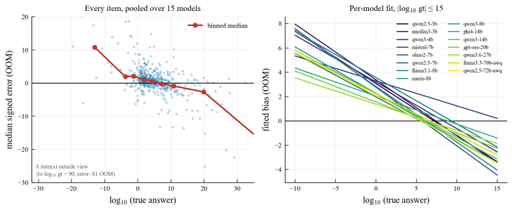
Figure 1 : Round-1 estimates compress toward a central magnitude. Left: per-item median signed error against the true answer, pooled over 15 models, with the binned median. Right: per-model linear fits on |log 10y|≤15.
Original paper · CC BY 4.0How much teams of thirty recover
Real teams of 2 to 30 agents are built from answers that 15 open-weight models gave before any communication. The error of these real teams sits within a median +0.005 OOM of teams resampled independently from each item's draws. The shortfall of aggregation therefore doesn't come from dependence between members of a team.
Teams of thirty cut a single agent's error by a median 1.7%, and by at most 5.4%. Real teams realize a median 2.2% of that reduction, which is the share the independent-draw reference allows them to reach. The item-level component, with a median 0.906 share of the error variance over items, is what limits the gain.
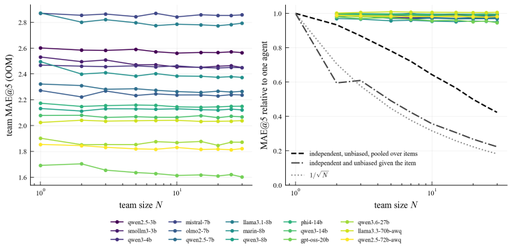
Figure 2 : Left: team MAE@5 againstN(realFP, main sweep). Right: the same relative to one agent, with the median over models of three references: draws independent and unbiased given the item (dash-dot; the kink atN= 2arises because identical draws with opposite signs cancel exactly), draws independent and unbiased across items (dashed), and the1/ √ Nrate (dotted).
Original paper · CC BY 4.0 · Carolina Fortuna, Blaz Bertalanic · Shared Item-Level Error Limits the Aggregation of Small Language Models in Fermi Estimation · Original paper figure · Extracted the figure area from page 7 of the original PDF.Only the residuals of the members get combined, so the team cannot remove the error that all draws share on an item. The term µ² + A works as a floor for every such rule, so adding members lowers only the B/N part.
These shares come from the main corpus on realFP, and the authors state that they hold only for the models and prompts tested. Such a procedure can change µ and c_j, which is why the floor doesn't bind it.
Debate changes dispersion, not the shared error
Debate was tested as a way for agents to share answers across three rounds before settling on a final number. In each round, an agent sees its teammates' answers and revises its own estimate. The key question is whether communication lowers the item-level component, not just the spread of answers. The paper answers this research question with a flat no.
Debate cut within-team dispersion by 93%, so the agents' answers converged onto fewer values. Agreement rose while the error that all draws of a model share on an item stayed where it was. With ρ at a median 0.906, most of the error is shared across draws, so exchanging answers has little to act on.
Revision without peers, where an agent revises only from its own earlier answer, attained at least the same small gain. So the small improvement in team error comes from the revision passes, not from the exchange between agents. This matches earlier work that found the exchange between agents adds little beyond the vote.
Debate works on the residual part of each error, the part that varies between draws on the same item. Changing the item-level error requires interventions that change the agents themselves or add information beyond their answers. The next section tests such interventions, including mixing models and a recalibration on labelled items.
Interventions that change the agents
The aggregation rules studied earlier leave the shared part of the error in place, because they only combine the residuals. The floor of µ² + A holds for any rule that shifts with its inputs, but it doesn't bind for interventions that alter the agents. The authors therefore tested interventions that change the agents themselves, and asked whether any of them lowers the item-level component.
Mixing five models of similar accuracy reduced error by 6.6% relative to their own homogeneous teams. No mixture improved on the most accurate model, so mixing beat each model's own team but didn't beat the best single model.
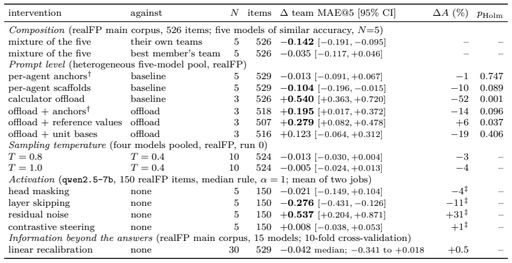
Table 4 : Interventions.∆team: paired change in team MAE@5 (OOM; negative is better) with a 95% item-clustered interval, bold if it excludes zero.∆A: relative change of the item-level component.†Anchor identity is confounded with model identity (Appendix G).‡UnwinsorizedAof the screen, comparable only within the screen. Winsorization lowersAwhenever an arm inflates the within-item spread severalfold (calculator offload,B+6.45OOM 2), so∆Ais not interpretable for those arms. Holm: adjusted over the six prompt-level arms. The recalibration row gives the median and range over models of the change for teams of 30.
Original paper · CC BY 4.0Per-agent scaffold prompts improved team error, but the gain wasn't significant after multiplicity correction. Skipping one layer also improved team error, though this came from a 150-item screen of one model. Contrastive activation steering had no detectable effect on team error. Higher sampling temperature changed team error by about 1% at most.
A cross-validated linear recalibration on labelled items removed the overall bias but left the item-level component unchanged. Recalibration uses information beyond the answers, so the floor doesn't constrain its effect on the shared part of the error. The results hold only for the models, benchmarks, prompts and settings tested.
Where the findings stop
The study didn't test frontier, closed or reasoning models, so the results don't extend to them. The item-level share comes from 529 realFP items, while SciOly and the guesstimation set serve only as replication.
Each finding holds only for the prompts and decoding settings the authors tested. The second corpus uses a single prompt pair, so per-model accuracy and bias may shift under other prompts. Model rankings from one prompt setup aren't a safe guide to how the same models would rank elsewhere.
The debate result describes the three-round protocol the authors ran, which cut within-team dispersion by 93%. A defective parser misread some mantissa-times-power-of-ten answers, so some agents saw peer values that differed from what was written. The temperature result changes team error by about 1% at most, so it doesn't establish a meaningful effect.
The skipping-one-layer result comes from a 150-item screen of one model, so it marks a candidate rather than an established effect. Per-agent scaffold prompts lose significance after multiplicity correction, so their gain remains uncertain.
The item-level share of 0.906 is high on these benchmarks, and that figure doesn't carry over to every task. Teams could gain more on benchmarks where the item-level share is lower than this. Only the prompt-level arms form a confirmatory family, so the other contrasts are exploratory.
Paper info
- Authors
- Carolina Fortuna, Blaz Bertalanic
- Venue
- arXiv · Preprint
- First published
- 2026-11-12
- Added
- 2026-11-13
- Updated
- 2026-11-12
- Version
- v1
- arXiv
- 2611.16315
- Category
- cs.MA · cs.AI
- Original paper terms
- CC BY 4.0
- What we show
- Paper info, commentary and permitted figures from the original paper
AI commentary is a separate explanation from the original paper and may contain errors. The original paper and figures follow each source's terms of use and any rights noted separately.
Abstract
Multi-agent systems of language models are often motivated by an averaging argument: if the agents' errors are unbiased and independent, the error of an aggregate of N answers falls as 1/sqrt(N). Fermi estimation, whose continuous answers are aggregated on the logarithmic scale, permits a direct test. We decompose the log10 error of each answer into the mean error of its model on the item, common to all its draws on the item, and a residual, and estimate both from 2.51M answers given before any communication by 15 open-weight models (3B-72B) on realFP, with replication under a single prompt pair on realFP, Science Olympiad Fermi questions and a guesstimation set. Given the item, teammates' errors are uncorrelated and teams behave as independent draws, but the item-level component accounts for a median 0.906 of the error variance over items. Teams of thirty therefore reduce a single agent's error by a median 1.7% (at most 5.4%), whereas draws that were also unbiased on each item would reduce it by 74-79%. All models compress their estimates toward about 10^6; this trend explains a median 17% of the item-level component, and a cross-validated linear recalibration on labelled items removes the overall bias but not that component. Three rounds of debate reduce within-team dispersion by 93% and leave the item-level component unchanged; revision without peers attains the same small gain. Mixing five models of similar accuracy reduces error by 6.6% relative to their own homogeneous teams, but no mixture improves on the most accurate model. Higher sampling temperature changes team error by about 1% at most, and contrastive activation steering not detectably; per-agent scaffold prompts (not significant after multiplicity correction) and skipping one layer in a single-model screen improve it. The results are conditional on the models, benchmarks, prompts and settings tested.
Quote from the paper
Carolina Fortuna, Blaz Bertalanic (2026). Shared Item-Level Error Limits the Aggregation of Small Language Models in Fermi Estimation. arXiv:2611.16315v1. https://arxiv.org/abs/2611.16315v1
BibTeX
@misc{fortuna2026shared,
  title = {{Shared Item-Level Error Limits the Aggregation of Small Language Models in Fermi Estimation}},
  author = {Carolina Fortuna and Blaz Bertalanic},
  year = {2026},
  eprint = {2611.16315},
  archivePrefix = {arXiv},
  url = {https://arxiv.org/abs/2611.16315v1}
}