Paper commentary
Test-Time Self-Play: Scaling without a Verifier
Test-time self-play lets a model improve on hard problems without a verifier
- Problem Test-time scaling methods need a verifier on the target problem to pick or refine answers. Such a verifier is often unavailable at deployment, and the baselines weaken as it does.
- Method TTSP trains a solver on synthetic problems a proposer writes for the target.
- Results In the no-verifier limit, TTSP gains 35% absolute mean@8 on a difficulty-calibrated LiveCodeBench v6 subset. It is the best method at every verifier strength the paper evaluates.
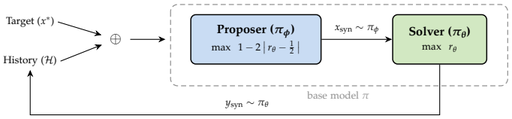
Figure 2 :Overview of Test-Time Self-Play.Given a target problem x⋆ and previously generated synthetic problems, the proposer policyπϕ generates target-conditioned synthetic problems D consisting of a problem statement, tests, and a reference solution. The solver policy is rewarded for correctly solving the synthetic problems, while the proposer is rewarded for generating synthetic problems near the solver’s current learning frontier (both via GRPO; see the red arrows). The synthetic problem history provides context for the proposer and fills a replay buffer B. After a sufficient number of iterations, the test-time trained solver can then attempt the target problem.
Original paper · CC BY 4.0 · Akira Yoshiyama, Akmal Ashirmatov, Jonas Hübotter, Ido Hakimi, Andreas Krause · Test-Time Self-Play: Scaling without a Verifier · Original paper figure · Extracted the figure area from page 2 of the original PDF.Why verifier-based scaling stalls
Test-time scaling spends extra compute at deployment to lift a model's score on one hard target problem. Many of these methods, such as rejection sampling, depend on a verifier that decides whether each attempt is correct. Prompt-optimization methods like ACE also lean on execution feedback to evolve their prompts. When that verifier is weak or missing, the selection signal degrades, and the baselines fall with it.
The authors measure this effect across verifier strengths from v0 to v⋆, where v0 accepts every rollout. Rejection sampling and FMV depend on the verifier for selection, while ACE uses the pass/fail outcome as its reward.
Some methods avoid a target verifier by training on similar problems retrieved from a large corpus. Others aggregate the model's own rollouts through majority voting, which works through the consensus of sampled answers. Majority voting only helps when the correct answer is also the most common one. The gap the authors target is the case where a model could solve the problem in principle but rarely produces the right solution.
That gap is exactly where a verifier-free method has to find a learning signal somewhere other than the target problem.
A self-play curriculum built around one target
The key idea is that the solver learns from problems the model writes about the target, so the learning signal doesn't come from a verifier on the target. TTSP borrows from training-time asymmetric self-play such as Absolute Zero and R-Zero, which learn from self-generated synthetic problems alone. Instead of spreading problems across a benchmark distribution, TTSP concentrates the synthetic problems on a single target problem.
The reference program stays hidden from the solver, and executing it on the held-out inputs produces the ground truth outputs. A solver attempt counts as correct only when it passes all held-out generated tests, so the synthetic verifier is a binary check. The proposer generates each problem in two stages: solution proposal first, then problem refinement that rebuilds the statement and tests from the reference program.
TTSP uses two LoRA adapters over a shared frozen Qwen3-8B backbone, one acting as the proposer and one as the solver. Each role gets its own reward signal, since the proposer policy is conditioned on the target and the training history. The authors observed gradient conflicts when one adapter served both roles, so they separated the adapters.
Both policies are updated with GRPO, while the target problem verifier stays out of the training loop. Algorithm 1 lists the loop, where the proposer generates candidate problems and the solver attempts the new problems together with sampled history problems. The proposer's reward peaks when the solver's mean reward is near one half, so the proposer keeps problems near the solver's frontier.
One TTSP iteration, step by step
Each iteration starts by building the proposer's prompt from earlier synthetic problems, their solve rates, and the target problem. The prompt holds a small sample of previously generated synthetic problems together with their solve rates taken from the solver policy. The first iteration has no earlier problems, so its prompt holds only the target and the instructions.
The proposer first drafts a problem and a Python reference program, conditioned on the target and the recent history. Problem refinement then rebuilds the statement, input/output specification, example I/O, and held-out tests from the reference program. The held-out outputs come from executing the reference program, so the tests and statement match what the program actually does.
Invalid candidates skip the solver batch and receive a fixed proposer penalty. Accepted problems form the fresh set Dt, and the solver batch mixes them with older problems sampled from the history. Sampling favors problems whose solve rate lies in the window 0.1 to 0.8, because already-solved problems give little signal. UPDATEHISTORY overwrites each problem's latest rollouts and solve rate, so the proposer's contexts track the current solver.
The solver's synthetic reward is binary: it equals one only when the rollout passes all held-out generated tests. The proposer is rewarded through the triangular profile rφ(x̂) = 1 − 2|r̄θ(x̂) − 1/2|, which depends on the mean solver reward over rollouts. This profile peaks when the solver passes about half of its rollouts and drops to zero when it passes all or none.
The profile targets the region where sparse Bernoulli rewards give the largest group-relative signal under GRPO. Both adapters are then updated with GRPO, using DAPO-style asymmetric clipping and zero KL regularization.
The two LoRA adapters sit on a shared frozen Qwen3-8B backbone, so the memory cost stays close to a single 8B model. Separate adapters give each role its own reward signal, and the authors report that a single shared adapter caused gradient conflicts. The solver trains on the synthetic problems the proposer writes, so the two adapters learn from each other through this loop.
After enough iterations, the solver attempts the target problem directly, and the target verifier is never used during training. The target problem only shapes the curriculum through the proposer's context.
Setting up the verifier and baseline comparison
The comparison starts from a target set chosen by the base model's own difficulty, not by any external label. The authors keep LiveCodeBench v6 problems where Qwen3-8B's mean@512 lies strictly between 0 and 0.7, calling the result HardLCBv6. They split HardLCBv6 at 0.1, so MidHardLCBv6 holds problems above 0.1 and VeryHardLCBv6 holds problems at or below 0.1.
This split lets the evaluation separate problems the base policy can sometimes solve from ones it almost never solves.
Each method submits eight candidates per target problem, and the evaluation keeps only the candidates the chosen verifier admits. Seven verifier conditions are used, covering a sweep from no verifier to the full public and private test set. The four artificial verifiers v0, v25, v50 and v75 reject set fractions of incorrect sampled solutions.
The verifier v0 accepts every rollout, so it tests the no-verifier case, while v⋆ is the oracle used for scoring. Public tests (vpub), private tests (vpriv) and their union are the three real LiveCodeBench verifiers.
Rejection sampling draws its eight candidates from the unadapted Qwen3-8B policy and filters them with the verifier. Functional Majority Voting first discards candidates that fail the verifier, then clusters the admitted pool by behaviour on target inputs and picks the modal cluster. ACE runs separately at each verifier strength, using the pass or fail outcome as its reward signal.
The authors discuss TTRL but don't use it as a baseline, because it targets benchmark-level adaptation and was evaluated only on math.
Does TTSP hold up as the verifier weakens
TTSP is the best-performing method at every verifier strength the paper evaluates, and its curve stays roughly flat across the sweep. The baselines fall as the verifier weakens, so the gap to TTSP widens with each step down in verifier strength. The authors explain this by noting that the baselines depend on the verifier either for selection or as a reward signal.
Because their performance is bounded by the verifier's discriminative power, the baselines can't escape a weak verifier.
The headline number comes from the no-verifier limit, where TTSP yields a 35% absolute improvement in mean@8. Under v0, the verifier admits every candidate, so mean@8 is just the fraction of the eight submissions that pass the oracle. TTSP never sees the target verifier during training, so its learning signal comes from the synthetic verifier vsyn alone.
Its solver reward is binary and passes only when a rollout clears all held-out generated tests.
The spread between verifier conditions narrows during training, which the authors read as the curricula moving probability toward candidates that survive later filtering. Most of the improvement arrives within the first 10 training steps, and the curves stay stable after that up to checkpoint-to-checkpoint noise.
Rejection sampling improves with more rollouts mainly when the verifier can reject wrong candidates. Under v0, ACE stays at the base-policy level because it receives no verification feedback to optimize against.
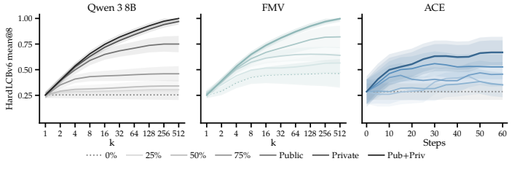
Figure 3 :Baselines performance on HardLCBv6 as compute scales.Each line reports the mean@8 with the indicated evaluation-time verifier applied to the validation problem submissions. Left and middle: Qwen 3 8B and FMV scale on the number of sampled rollouts k. Right: ACE scales on the number of generation–reflection–curation steps.
Original paper · CC BY 4.0Where TTSP stops working: rank and difficulty
FMV is strongest when the correct functional cluster is the modal one, where it slightly exceeds TTSP. When the correct cluster ranks second, FMV drops sharply and TTSP overtakes it. When the correct cluster ranks third or lower, FMV can't find it, while TTSP keeps non-trivial accuracy and degrades more gently.
On VeryHardLCBv6 the gain is close to zero across the sweep, slightly negative at the strongest verifiers and only marginally positive at the weakest. Below mean@512 of about 0.1, the authors argue the proposer cannot build a curriculum that leads back to the target.
The authors place TTSP in a consistency regime, where correct but unreliable target-related behaviour is already present.
Limitations and open directions
TTSP adapts to each target problem separately and doesn't amortize compute across targets. TTSP only addresses the consistency regime, because no curriculum the proposer can synthesize composes back to a target the base policy almost never solves. The authors make this concrete: when base coverage is effectively zero, the curriculum has nothing to bootstrap from.
Below mean@512 ≈ 0.1, the proposer policy can't bootstrap a curriculum that composes back to x⋆. The experiments cover only competitive programming, with Qwen3-8B as the base model.
Training-time stability therefore needs active monitoring, and the authors treat it as a real concern. The authors point to Appendix D for further discussion of these training dynamics.
The authors list several extensions that follow from relaxing TTSP's constraints. Adding that target reward would combine curriculum-driven and target-driven training in one system. The set could also include nearest-neighbor synthetic problems retrieved from external corpora, which keeps the curriculum structure. TTSP could also be applied to other tool-rich domains, such as execution sandboxes, simulation engines, or database engines.
Paper info
- Authors
- Akira Yoshiyama, Akmal Ashirmatov, Jonas Hübotter, Ido Hakimi, Andreas Krause
- Venue
- arXiv · Preprint
- First published
- 2026-11-5
- Added
- 2026-11-6
- Updated
- 2026-11-5
- Version
- v1
- arXiv
- 2611.07367
- Category
- cs.LG · cs.AI
- Original paper terms
- CC BY 4.0
- What we show
- Paper info, commentary and permitted figures from the original paper
AI commentary is a separate explanation from the original paper and may contain errors. The original paper and figures follow each source's terms of use and any rights noted separately.
Abstract
Test-time scaling methods spend additional compute at deployment to improve a large language model's performance on a hard target problem. Most methods rely on a verifier that scores candidate solutions for correctness, using it to select among or refine the model's outputs. In many deployment regimes, however, a strong verifier on the target problem is unavailable. We introduce Test-Time Self-Play (TTSP), an approach to test-time scaling using asymmetric self-play without reliance on a verifier. On a difficulty-calibrated subset of LiveCodeBench v6, TTSP is the best-performing method at every verifier strength we evaluate, and the gap to the strongest baseline widens as the verifier weakens; in the no-verifier limit, TTSP yields a 35\% absolute improvement in mean@8. The gains hold across a range of verifier strengths, except when the base policy has near-zero coverage of the correct answer.
Quote from the paper
Akira Yoshiyama, Akmal Ashirmatov, Jonas Hübotter, Ido Hakimi, Andreas Krause (2026). Test-Time Self-Play: Scaling without a Verifier. arXiv:2611.07367v1. https://arxiv.org/abs/2611.07367v1
BibTeX
@misc{yoshiyama2026test,
  title = {{Test-Time Self-Play: Scaling without a Verifier}},
  author = {Akira Yoshiyama and Akmal Ashirmatov and Jonas Hübotter and Ido Hakimi and Andreas Krause},
  year = {2026},
  eprint = {2611.07367},
  archivePrefix = {arXiv},
  url = {https://arxiv.org/abs/2611.07367v1}
}