Paper commentary
Algorithm Distillation for Safe In-Context Reinforcement Learning
- Problem Safe AD's returns remained negative on HalfCheetah and Ant, and it rarely reached the goal in CarGoal, so its adaptation to unseen constrained tasks fails on these benchmarks.
- Method Distills histories from a two-phase, budget-aware teacher collected under dynamic budgets, then adds a cost head and a per-episode Lagrange multiplier that reweights actions at deployment without retraining.
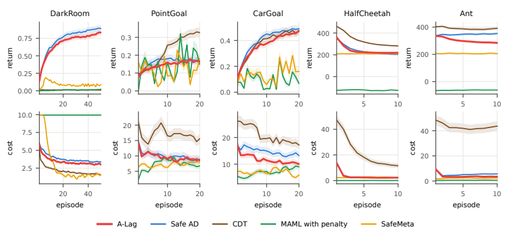
Figure 2 : In-context adaptation on the test tasks. Each curve shows the mean episode return or cost over three seeds, with a shaded band of±2standard errors. A-Lag starts every deployment atλ= 0, andλis adjusted during test time by Eq. (9). In DarkRoom, PointGoal and CarGoal the return of A-Lag and Safe AD rises over the episodes while their cost falls. In HalfCheetah and Ant their cost drops sharply after the first episode, and in HalfCheetah the return falls with it. A-Lag’s Ant return also declines across episodes. A-Lag has a lower cost than Safe AD in DarkRoom, CarGoal and Ant, at a lower return. The mean costs are also slightly lower in PointGoal, at a slightly lower return, and in HalfCheetah, where it ends with a higher return. CDT has a higher cost than both in the navigation and velocity tasks and does not find the goal in DarkRoom.
Original paper · CC BY 4.0 · Minjae Kwon, Amir Moeini, Shangtong Zhang, Lu Feng · Algorithm Distillation for Safe In-Context Reinforcement Learning · Original paper figure · Extracted the figure area from page 9 of the original PDF.Why Safe AD adapts poorly under a budget
Safe in-context reinforcement learning asks a policy with fixed parameters to keep improving on an unseen constrained task from its own interaction history while keeping cost within a budget. Safe Algorithm Distillation trains a Transformer on the learning histories of a safe RL algorithm, and earlier evaluations found that it adapts poorly on some of these benchmarks.
On HalfCheetah and Ant, Safe AD's returns remained negative in every in-context episode, and on CarGoal it rarely reached the goal.
The second source is test-time use of the budget. Safe AD receives the remaining budget as an input at each step, but how it responds to that input is fixed by training, so an episode that overspends can only influence the next episode through what happens to be in the context.
The study therefore changes two things: the teacher whose histories are distilled, and a correction applied to the distilled policy at test time.
A budget-aware teacher and its histories
In the navigation and velocity tasks, a PPO policy trained to reach a position or to hold a speed turns the expert's choice into actions.
Each history draws its starting budget \(B_0\) once. Within every in-context episode the remaining budget restarts from \(B_0\) and then falls with each observed cost, \(B_{k,t+1}=\max(0,B_{kt}-C_{k,t+1})\), so it never goes below zero. Under dynamic budgets, \(B_0\) is drawn uniformly over the environment's budget range. Under fixed budgets, every history uses \(B_0=B_{\max}\).
The remaining budget, which is CTG, is stored at each step together with RTG, the reward still to come in the episode. CTG is the budget left, not the cost still to come.
Expert quality is measured as the mean return after the switching event, divided by the same quantity for Expert1, the highest-return expert in each environment: \(q=\frac{E[\bar G_{\mathrm{post}}]_{\mathrm{Expert}_q}}{E[\bar G_{\mathrm{post}}]_{\mathrm{Expert}_1}}\).
How much of the return and budget space the data covers
A model is most reliable at input pairs that its training data contains, which is why the authors measure how spread the teacher steps are over that plane.
The measurement puts a 20×20 grid over RTG and CTG, with each input rescaled to \([0,1]\) between its 1st and 99th percentiles. Occupied cells count the grid cells that receive at least one step, and occupancy entropy is \(H=-\sum_b p_b\log p_b/\log 400\), where \(p_b\) is the share of steps in cell \(b\). Entropy equals 1 when steps spread evenly over all 400 cells, so a higher value means a more diverse training set.
Sequence model and cost head
The RTG and CTG control inputs are encoded in the same space and added to the state position, so that under causal masking the prediction of an action cannot see that action or its outcome.
Scalar inputs pass through a signed logarithm, \(\psi(z)=\mathrm{sign}(z)\log(1+|z|)\). It keeps the sign and order of a value and reduces the difference in scale between environments.
The action head reads the last-layer representation at the state position. It gives a categorical distribution over logits for discrete actions or a diagonal Gaussian with a mean and a variance in each action dimension for continuous actions.
A second head predicts the immediate cost of each action, scaled by \(c_0\), which is the standard deviation of the immediate cost in the training data. For discrete actions it gives one score per action. For continuous actions it is quadratic in each action dimension. The cost head is fit by regression to the scaled cost of the executed action.
Its input is a stop-gradient of the backbone representation, so the cost loss does not change the backbone, and the cost loss is added to the action loss with the multiplier set to zero throughout training.
Reweighting actions by predicted cost and updating the multiplier
For a multiplier \(\lambda\), the cost-reweighted policy multiplies the base action probabilities by an exponential of the negative multiplier times the predicted cost, and renormalizes: \(\pi_\lambda(A\mid u_p)\propto\pi_\theta(A\mid u_p)\exp(-\lambda\,\hat c(u_p,A))\). For discrete actions this subtracts \(\lambda\hat c\) from each logit.
For continuous actions the reweighted Gaussian has a closed form, and at \(\lambda=0\) the cost-reweighted policy is the base policy.
A deployment starts with \(\lambda_1=0\) and runs \(K\) episodes with one budget \(B_0\). Within each episode, actions are sampled from \(\pi_{\lambda_k}\). After episode \(k\), the multiplier is updated from the realized episode cost, \(\lambda_{k+1}=\Pi_{[0,\lambda_{\max}]}\big(\lambda_k+\eta\,\frac{G_c(\tau_k)-B_0}{B_{\max}}\big)\). The projection \(\Pi\) keeps the multiplier between 0 and \(\lambda_{\max}\).
An episode costing more than \(B_0\) raises the multiplier, and an episode costing less lowers it, down to zero.
The rule for \(\lambda_{\max}\) is the largest tested fixed multiplier whose mean final return stays above 75% of its value at \(\lambda=0\), and \(\eta=\lambda_{\max}\) was chosen once in DarkRoom.
Apart from the growing context, the deployment-time multiplier is the only thing that changes how the trained network acts. The network weights are not retrained at deployment.
What raising the multiplier guarantees
For a fixed representation \(u\), the normalizer of the cost-reweighted policy is finite for every \(\lambda\ge 0\). The cost-reweighted policy is the unique minimizer, over action distributions \(\pi\) with a finite objective, of \(\mathrm{KL}(\pi\|\pi_\theta(\cdot\mid u))+\lambda E_{A\sim\pi}[\hat c(u,A)]\).
Holding the context fixed, the derivative of the expected predicted cost with respect to \(\lambda\) equals the negative variance of the predicted cost under \(\pi_\lambda\): \(\frac{d}{d\lambda}E_{A\sim\pi_\lambda}[\hat c(u_p,A)]=-\mathrm{Var}_{A\sim\pi_\lambda}(\hat c(u_p,A))\le 0\). The expected predicted cost therefore never rises as \(\lambda\) grows.
Combined with the update rule, an episode above the budget does not lower the multiplier, so the next episode's expected predicted cost per step does not rise. An episode below the budget does not raise it, so that expected predicted cost does not fall.
Environments, baselines and evaluation protocol
CDT is an offline safe-RL sequence policy conditioned on RTG and CTG. MAML with a cost penalty and SafeMeta are included as safe meta-RL baselines from a preliminary study. SCARED and latent Q-barrier shielding are not compared, because they are pretrained online.
Main-text comparisons describe observed means, and the shaded bands in the figures show ±2 standard errors over deployments.
What dynamic budgets change at test time
Safe AD and A-Lag were trained on fixed-budget histories with the same settings as the main models, so the comparison isolates the training data. Figure 1 shows the test-task return and cost curves of the dynamic and fixed versions over the episodes of a deployment.
In DarkRoom, fixed-budget data lowers the final return by 0.167 for Safe AD and by 0.123 for A-Lag. It also raises the mean episode cost of both by about 0.8. Both gaps open early in a deployment and last until its end.
In the other environments the dynamic-budget models return more in every case except A-Lag in Ant. The return gap is largest in PointGoal and CarGoal, where the main models return nearly twice as much.
A-Lag against Safe AD and CDT
CDT does not learn to find the goal in DarkRoom, with a final return of 0.010. In PointGoal its final return is 0.326 against 0.173 for Safe AD, and in CarGoal it is 0.468 against 0.489. In the velocity tasks CDT returns 284.9 and 387.0, against 206.7 and 350.9 for Safe AD, and its mean cost is 18.4 and 37.7 above Safe AD's.
How often budgets are exceeded
Excess cost equals the violation rate times the average overrun of violating episodes, \(E[\max(0,G_c-B_0)]=\Pr(G_c>B_0)\,E[G_c-B_0\mid G_c>B_0]\), so a method can violate less often and still match another's excess cost. At \(\lambda=0\) the Ant violation rate is 0.210 and excess cost is 1.56, which the multiplier moves to 0.184 and 2.23.
In HalfCheetah, A-Lag goes over budget more often than Safe AD, 0.158 against 0.123, but each violation is about 13 against 20, so its excess cost is 0.47 lower. In the navigation tasks CDT violates more often than Safe AD, 0.195 and 0.270 against 0.139 and 0.207, with excess costs of 8.5 and 9.5 against 4.2 and 5.8. In the velocity tasks it violates 0.239 and 0.364 times, against 0.123 and 0.356 for Safe AD, and its excess cost is 20.2 and 40.5 against 2.5 and 2.2.
Limitations
The cost head predicts only immediate cost, and it is trained only on the actions the teacher took. The teacher needs environment-specific search behaviour, experts and switching events.
The evidence comes from five benchmarks, three random seeds and the test-task protocol above. In PointGoal the return of every method stays below 0.35, and in HalfCheetah A-Lag violates the budget more often than Safe AD even though its mean cost is lower. Dynamic budgets raise entropy in every environment, but they improve return and cost for both methods only in DarkRoom and HalfCheetah.
Paper info
- Authors
- Minjae Kwon, Amir Moeini, Shangtong Zhang, Lu Feng
- Venue
- arXiv · Preprint
- First published
- 2026-11-16
- Added
- 2026-11-18
- Updated
- 2026-11-16
- Version
- v1
- arXiv
- 2611.21524
- Category
- cs.LG · cs.AI
- Original paper terms
- CC BY 4.0
- What we show
- Paper info, commentary and permitted figures from the original paper
AI commentary is a separate explanation from the original paper and may contain errors. The original paper and figures follow each source's terms of use and any rights noted separately.
Abstract
Safe in-context reinforcement learning (Safe ICRL) asks a policy with fixed parameters to improve on an unseen constrained task from its interaction history while aiming to keep its cost within a budget. Prior work studied Safe ICRL on five benchmarks in three families: a grid world with a hidden goal and obstacles (DarkRoom), continuous navigation where goals and hazards stay invisible until reached (PointGoal, CarGoal), and locomotion with a hidden velocity limit (HalfCheetah, Ant). Safe Algorithm Distillation (Safe AD), trained on the learning histories of a safe RL algorithm, has shown adaptation failures in prior evaluations. For example, in the locomotion tasks its return stays below zero, and it rarely reaches the goal in CarGoal. We revisit two parts of Safe AD. First, we distill a budget-aware teacher with two phases. It searches for the hidden task, exploring more when more budget remains. After its first reward or cost, an expert policy exploits the task within the remaining budget. We collect the teacher's histories under fixed or dynamic budgets. Dynamic budgets increase the occupancy entropy of the return and budget inputs in every environment, and at test time they improve return and lower cost in DarkRoom and HalfCheetah. Second, we propose A-Lag, a test-time adjustment that reweights the distilled policy's actions by their predicted cost, with an adaptive Lagrange multiplier that is updated from the costs observed. In our experiments, A-Lag had lower mean episode cost than Safe AD in all five environments, with lower mean final return in four.
Quote from the paper
Minjae Kwon, Amir Moeini, Shangtong Zhang, Lu Feng (2026). Algorithm Distillation for Safe In-Context Reinforcement Learning. arXiv:2611.21524v1. https://arxiv.org/abs/2611.21524v1
BibTeX
@misc{kwon2026algorithm,
  title = {{Algorithm Distillation for Safe In-Context Reinforcement Learning}},
  author = {Minjae Kwon and Amir Moeini and Shangtong Zhang and Lu Feng},
  year = {2026},
  eprint = {2611.21524},
  archivePrefix = {arXiv},
  url = {https://arxiv.org/abs/2611.21524v1}
}