Paper commentary
SWAM: Scaling World Action Models with Cross-Modal Alignment
SWAM mixes multisource experience to lift robot control under unseen conditions
- Problem Adding action learning to a video model can weaken the language-video alignment that video pretraining built. Few studies have examined how data and supervision choices keep that alignment during action training.
- Method SWAM routes language to the action branch only through the video branch. Action tokens attend to video tokens, so the pretrained language-video links carry over instead of a new text pathway starting from scratch.
- Results On three real-world tasks under Hard conditions, the model scored 40.00% SR, compared with 23.33% for the strongest baseline.
Why action training can erode language-video alignment
World action models predict future video and robot actions together, conditioned on language, visual history and the current state. They inherit language-video skills from a pretrained video model, so that alignment has to survive action training. Most prior work, however, concentrates on architectures and training mechanisms and treats language-video alignment as already settled.
The authors argue that adding action learning can damage this alignment, which they describe as a basic question of how to preserve the language-video prior.
Mixing sources is not just a matter of adding data, because general videos carry no action labels. Robot demonstrations cover a narrower range of scenes and tasks than general and egocentric videos. UMI demonstrations provide scalable human manipulation experience, while robot demonstrations give direct but more limited control experience.
Language-video supervision preserves video pretraining capabilities, and human and robot action supervision builds video-action correspondences.
The authors ask which data, language and action supervision keep the video priors while teaching control. They study language-video supervision, language-video-action supervision, and their joint use under one WAM pretraining pool of about 47,000 hours. The model architecture, shown in Figure 2(b), decides how cross-modal supervision flows between modalities.
Figure 2(a) lists the pretraining data sources that the study mixes. Their central claim is that the benefit of multisource experience depends on both the data and the model supervision recipe.
Pretraining starts from a video model, and the video branch keeps its prediction objective while action supervision is added. Samples with valid action labels join action learning, and samples without labels still train the video objective. Missing or invalid action targets contribute no action supervision, so mixed-coverage data can share one pretraining run.
The key idea: video learning stays, actions read from it
The model keeps the video objective on every sample and adds action supervision only where valid action labels exist. General and egocentric videos supply language-video correspondences, while UMI and robot demonstrations also supply actions tied to video. Samples with missing or invalid action targets contribute no action supervision, so mixed-coverage experiences can share one pretraining run.
The action branch reaches language only through attention to the video branch, which reuses the language-video links from pretraining. A new text pathway inside the action branch would start without pretraining, so routing language through video features reduces that interference.
The video branch is initialized from Wan2.2-TI2V-5B, while the action branch is randomly initialized as a separate residual stream. Each chunk holds 2 video latent frames and 48 action steps, and a VAE encodes the video into latents. Video tokens attend causally to current and past video tokens, so the video stream never reads action tokens.
Action tokens attend to past and current video tokens and to the state and action tokens of their own chunk. Because this link is one-directional, video-only samples train the video branch without changing the action branch through the video loss.
Training adds noise to the clean video latents and action targets, with video and actions in a chunk sharing one flow time. The video branch regresses video flow velocities, and the action branch regresses action flow velocities. The video loss uses all samples, and the action loss uses only samples with valid action annotations. The two losses are summed with equal weights, as L = L_video + L_action.
What the 47,000-hour pool supplies
The pool pairs about 47,000 hours of multisource data with two kinds of supervision, and only some sources carry actions. General videos and egocentric videos supply language-video experience, covering general visual dynamics and human interactions, respectively. Both sources provide language-video supervision but don't include action labels for robot execution.
The in-house UMI set holds 411,754 trajectories totaling 15,284.9 hours, and each records video and action trajectories from handheld grippers. Robot demonstrations add observations, states, and actions during robot task execution.
UMI data offers scalable human manipulation experience, while robot data gives direct but more limited control experience. The robot demonstrations were drawn from six public sources and cut to 768,356 trajectories totaling 9,836.0 hours after quality checks. The retained robot subsets must be bimanual, with head and bilateral wrist views, so that observation semantics stay consistent.
Every sample, including videos without actions, passes through the video objective. Action supervision applies only where the labels are valid, and invalid labels are masked instead of removing the episode. For in-house UMI data, the collection pipeline's state and action validity annotations build the action-supervision masks. Robot trajectories with abnormal joint angles, excessive frame-to-frame changes, or no movement are excluded from action training.
Trajectories that pass these checks are used for action training, so the same videos still train the video branch.
Richer language descriptions keep the video prior intact
Language supervision for WAM pretraining was tested along description detail, scene information and temporal granularity, all during 20k steps on egocentric videos and UMI demonstrations. At the Subtask level, Hard SR rose from 47.20% with Brief captions to 49.60% with Medium and 53.52% with Detailed. Adding environment text lifted Hard SR to 55.04%, the highest Easy and Hard values in that group.
Switching from Episode to Subtask descriptions under the Detailed setting moved Hard SR from 51.60% to 53.52%.
Shuffling the Detailed Subtask captions across video segments within each trajectory lowered Hard SR from 53.52% to 52.00%. The authors read this drop as evidence that accurately matched language matters for language–video alignment. Many trajectories in the open-source robot data share one simple task instruction, which gives little per-trajectory detail.
Across nine robot data subsets, 145,430 trajectories shared only 592 task-level instruction entries.
To enrich this supervision, the authors built two variants: Rephrased and Detailed + Env. Rephrased gives 100 semantically equivalent paraphrases per task instruction, and one is sampled during training. Relative to the 50.80% Hard SR of Original, paraphrasing alone gave a gain of 3.96 percentage points.
The Original instruction set was the weakest variant, so the gains come from richer text rather than from the robot data alone.
Whether UMI actions and sampling mix help
The authors kept every UMI video and varied only the share of trajectories that carry action labels during pretraining. Videos without action labels still take part in video learning, and the labeled subset stays fixed at each coverage level. Hard SR rose from 46.72% at 0% coverage to 51.28% at 100%, a gain of 4.56 percentage points across the five coverage levels.
The authors read this as evidence that paired actions from human demonstrations supply usable control signal, even though UMI visuals differ from robot execution.
The authors then asked how to split a fixed budget between egocentric videos and UMI data, which carry different supervision. They fixed the pretraining budget at 20k steps and compared five Ego-to-UMI sampling ratios, from 1:0 to 0:1. Equal Ego-to-UMI sampling reached a Hard SR of 53.84%, compared with 51.28% for UMI-only training, a gain of 2.56 percentage points.
All three mixed ratios beat training on either source alone, so the authors conclude that the mix balances language-video and language-video-action supervision.
Before the mixed stage, the authors added 25k steps of transitional pretraining on general videos. This stage lets the model adapt to the changed frame count, resolution and attention while staying close to its original content distribution.
Routing language through video features
The architecture comparison starts from a simple question: how should the action branch receive language without disturbing the video prior. Single-stream, where video and actions share one residual stream, and standard Dual-stream, with separate residual streams, reached similar Hard SR of 52.56% and 52.48%. The authors keep video and action feature spaces separate, so pretrained video representations can be reused while new action representations are learned.
The action branch has no direct text cross-attention, because its newly introduced text pathway lacks sufficient pretraining. Instead, language reaches the action branch only through video features, which keeps the semantic information already learned in the video branch. This routed design, labeled Ours in Table 8, reached 57.36% Hard SR, 4.88 percentage points above standard Dual-stream.
For visual conditioning, the authors asked whether extra image-encoder features help beyond the native video inputs. Using Native as the baseline, the authors added CLIP, DINOv2, SigLIP2, and Qwen3-VL 2B features through cross-attention. Native reached 83.44% Easy and 49.52% Hard, the highest in this group. Adding features from the four image encoders lowered Hard SR to 39.76% to 42.96%.
The authors conclude that the pretrained video model's native visual inputs should be kept. Their explanation is that the fusion pathway for the extra features never received the large-scale language-video pretraining that the video branch did. Under that condition, the model may lean on appearance cues from the current training distribution, which weakens generalization to unseen scenes.
Does more pretraining keep helping
The 0-hour setting skips multisource pretraining and starts downstream post-training directly from the video-model initialization. Hard SR reaches 59.60% at the highest simulation point, compared with 34.56% without pretraining. Multisource pretraining also lifts Easy success above the 0-hour baseline, which means the gain isn't limited to randomized scenes.
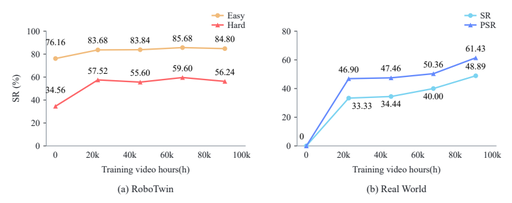
Figure 6 . Scaling pretraining improves control generalization.We vary training video hours on a fixed corpus of multisource experience, using the same downstream post-training protocol within each domain. (a) RoboTwin SR under the Easy (C2C) and Hard (C2R) settings. (b) Real-world SR and PSR under the Hard setting, averaged across three tasks. The 0-hour setting uses the video-model initialization without additional pretraining and achieves no success in real-world evaluation.
Original paper · CC BY 4.0 · Yu Zhou, Xinyuan Xia, Xuankun Yang, Yinghao Yang, Wendi Chen, Bowen Liu, Jianhan Ma, Weicheng Duan, Jun Lv, Cewu Lu, Yanwei Li · SWAM: Scaling World Action Models with Cross-Modal Alignment · Original paper figure · Extracted the figure area from page 15 of the original PDF.On real robots, the authors average Hard SR and PSR equally across the three tasks. Both metrics rise as training video hours grow from 22.5k to 90k, going from 33.33% and 46.90% to 48.89% and 61.43%. The real-world curve doesn't flatten within the range the authors evaluated, so they read it as continued gains.
Table 9 splits the longer pretraining into two stages, first egocentric videos and UMI demonstrations, then robot data. Under single-factor changes, background, lighting, clutter and table height scores also rise with pretraining investment.
How the recipe compares with baselines
On RoboTwin, the final recipe reaches a Hard SR of 61.56%, which is 12.86 percentage points above OpenWAM. The comparison covers five VLA and WAM baselines in the main table, with OpenWAM as the strongest of them. On Easy, the recipe scores 88.10%, slightly below OpenWAM's 89.30%. The authors read this as similar performance under clean conditions, and a clear gain under randomized conditions.
Averaged over both settings, the recipe reaches 74.83%, the highest average among the compared methods. The Hard gap matters more to the authors because it reflects how the model handles scene conditions it was not post-trained on.
Every compared method used the same task-specific post-training data, and each task ran for 50k steps. Under Hard, the recipe reaches 40.00% SR averaged over the three tasks, versus 23.33% for OpenWAM. Its PSR of 50.36% exceeds π0.5's 37.78% by 12.58 percentage points.
The authors attribute the baselines' failures to specific execution errors shown in the real-world visualizations.
Limits of the evidence
The simulation evidence rests on the 50 RoboTwin 2.0 tasks, each post-trained on Clean demonstrations only. Each task provides 50 Clean demonstrations, which makes 2,500 demonstrations in total. Ablation rows use 25 evaluation episodes per task and setting, while main results use 100 episodes. Real-world evaluation covers three bimanual tasks on a Flexiv Rizon 4 platform, with ten layouts fixed before evaluation.
Each layout gets three trials, which yields 30 trials per task and setting. Averaging SR and PSR across only three tasks leaves the real-world numbers sensitive to a few trials.
The scaling curves cover only 22.5k to 90k training video hours in the real-world study. Within that range, real-world Hard SR rose from 33.33% to 48.89% and PSR rose from 46.90% to 61.43%. The authors report continued gains only inside the evaluated range, and they don't test whether gains continue beyond 90k hours. The Stage 1 and Stage 2 table covers single-factor changes for background, lighting, clutter, and height only.
Transfer to other robot platforms beyond the Flexiv setup and RoboTwin was not tested. The simulation and real-world comparisons use a fixed set of baselines, so they don't cover every WAM or VLA method. Training uses AdamW with a learning rate of 4×10 −5 and a global batch size of 256 for pretraining. Post-training uses a global batch size of 128 and 20k steps in simulation, and 50k steps per task in the real world.
Paper info
- Authors
- Yu Zhou, Xinyuan Xia, Xuankun Yang, Yinghao Yang, Wendi Chen, Bowen Liu, Jianhan Ma, Weicheng Duan, Jun Lv, Cewu Lu, Yanwei Li
- Venue
- arXiv · Preprint
- First published
- 2026-11-9
- Added
- 2026-11-11
- Updated
- 2026-11-9
- Version
- v1
- arXiv
- 2611.12870
- Category
- cs.CV · cs.RO
- Original paper terms
- CC BY 4.0
- What we show
- Paper info, commentary and permitted figures from the original paper
AI commentary is a separate explanation from the original paper and may contain errors. The original paper and figures follow each source's terms of use and any rights noted separately.
Abstract
World action models jointly predict video and actions conditioned on language. Existing studies focus primarily on architectures and training mechanisms, typically treating language-video alignment acquired through video pretraining as an established foundation. However, introducing action learning may impair this alignment. Principled guidance on data and supervision design for maintaining language-video alignment during action learning remains limited. To investigate this, we curate a pool of approximately 47,000 hours of general videos, egocentric videos, UMI demonstrations, and robot demonstrations. Building on this, we systematically study how language-video supervision, language-video-action supervision, and the joint use of these two forms affect WAM performance. In particular, we examine how language annotation quality affects pretrained language-video capabilities, and how action supervision from UMI and robot demonstrations extends these capabilities to language-video-action modeling. To better scale the model, we further conduct detailed studies on joint training recipe and model architecture. Under a fixed training budget, mixing egocentric videos and UMI demonstrations improves control generalization. Model architecture affects how effectively these experiences are used, while scaling pretraining under the selected configuration brings further gains. The resulting recipe, post-trained on RoboTwin Clean demonstrations only, achieves success rates of 88.10% and 61.56% under Easy (Clean-to-Clean) and Hard (Clean-to-Random) conditions, respectively. Our model achieves 40.00% SR across three real-world tasks, compared with 23.33% for the strongest baseline, indicating better generalization under unseen conditions. We release the curated data, training code, and model weights.
Quote from the paper
Yu Zhou, Xinyuan Xia, Xuankun Yang, Yinghao Yang, Wendi Chen, Bowen Liu, Jianhan Ma, Weicheng Duan, Jun Lv, Cewu Lu, Yanwei Li (2026). SWAM: Scaling World Action Models with Cross-Modal Alignment. arXiv:2611.12870v1. https://arxiv.org/abs/2611.12870v1
BibTeX
@misc{zhou2026swam,
  title = {{SWAM: Scaling World Action Models with Cross-Modal Alignment}},
  author = {Yu Zhou and Xinyuan Xia and Xuankun Yang and Yinghao Yang and Wendi Chen and Bowen Liu and Jianhan Ma and Weicheng Duan and Jun Lv and Cewu Lu and Yanwei Li},
  year = {2026},
  eprint = {2611.12870},
  archivePrefix = {arXiv},
  url = {https://arxiv.org/abs/2611.12870v1}
}