Paper commentary
Scribble Once, Segment the Sequence: Bidirectional Temporal Consistency for Weakly Supervised Segmentation in Echocardiography Sequences
- Problem Scribble-supervised segmentation of echocardiographic sequences normally needs a scribble on every frame, so annotation effort grows with sequence length.
- Method Trains a mean-teacher model on LoRA-adapted frozen DINOv3 features from one scribble on an anchor frame, using connectivity-filtered pseudo-labels and anchor-relative temporal and CRF losses.
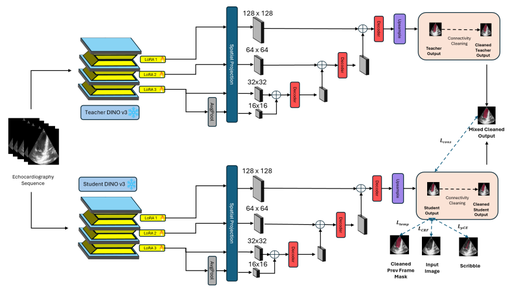
Figure 1 . Overview of the proposed weakly-supervised temporal segmentation framework. A mean-teacher architecture with LoRA- adapted frozen DINOv3 encoders generates mixed connectivity-filtered pseudo-labels for dense Dice supervision. Partial cross-entropy supervises scribbles on the anchor frame, gated-CRF refines boundaries and an anchor-relative temporal loss enforces bidirectional consis- tency while allowing cardiac deformation
Original paper · CC BY 4.0 · Weixin, Vincent Li, Jingkun, Chen, Grau, Vicente · Scribble Once, Segment the Sequence: Bidirectional Temporal Consistency for Weakly Supervised Segmentation in Echocardiography Sequences · Original paper figure · Extracted the figure area from page 4 of the original PDF.Why annotation cost grows with sequence length
Strong segmentation models usually depend on masks drawn for every frame, and collecting such masks across a clinical dataset is difficult. Echocardiography makes this harder because speckle blurs boundaries and neighbouring tissues look alike, so outlining structures depends on specialist judgement. Semi-supervised methods cut the number of frames that need masks, and weakly supervised methods cut the effort per frame, but both still need labels spread across the sequence, so effort rises with its length.
The scribble-based baselines in this study extend sparse strokes through augmentation, consistency regularization and architecture changes. These methods handle frames one at a time, so every frame in a sequence still needs its own scribble. The setting studied here removes that requirement: one scribble on one anchor frame, with every other frame left unlabeled.
A frozen 2D vision foundation model gives transferable spatial features with few trainable parameters, but it has no explicit way to carry information from one frame to the next. The method therefore adds temporal propagation on top of the spatial features, through the mean-teacher pseudo-labels and the temporal loss. The anchor is normally the middle frame, which reduces the maximum propagation distance to approximately T/2 frames, although end-systole or end-diastole frames can also serve as anchors.
Frozen DINOv3 features with a light decoder
Figure 1 lays out the pipeline: a mean-teacher pair built on LoRA-adapted frozen DINOv3 encoders produces pseudo-labels, partial cross-entropy acts on the anchor frame, and the CRF and temporal losses act across the sequence.
Each 16×16 patch becomes one token, so a 512×512 input gives a 32×32 token grid, and all three adapted blocks keep that resolution.
That coarse level gives the decoder a larger effective receptive field. The final output is converted to logits and bilinearly resized to the input resolution.
Because the backbone is frozen, its weights are shared by both branches, while the LoRA adapters, feature projections and decoder are kept separate in the student and the teacher. The student sees a weakly augmented view with brightness and contrast changes and additive noise, while supervision comes from the unaugmented sequence, which keeps the two pixel-aligned.
From one scribble to dense pseudo-labels
Only the anchor frame carries labels, so the first loss is partial cross-entropy computed on its foreground and background scribble pixels. The loss is written as follows. \[ L_{pCE} = -\frac{1}{|\Omega|}\sum_{i\in\Omega}\sum_{c=0}^{C-1} y_{ci}\log p_{ci} \] Here \(\Omega\) is the set of pixels whose scribble value is not 255, \(y_{ci}\) is the one-hot scribble label at pixel i, and \(p_{ci}\) is the predicted probability of class c at that pixel, so ignore pixels stay out of the sum.
Pseudo-labels start from connectivity filtering: on the anchor frame only the connected components that touch the foreground scribble are kept. Each later frame then keeps only the components that overlap the filtered mask of its adjacent frame, so the selection spreads outward from the anchor in both directions. The teacher and the student predictions are filtered separately and then fused by pixel-wise mixing, which takes each pixel from one branch through a random mask drawn from a Bernoulli distribution with β = 0.5.
The mixed label is written as follows. \[ \tilde y_t = M_t \odot \Phi^T_t + (1-M_t)\odot \Phi^S_t \] The student is then trained against this mixed label on every frame with a soft Dice loss, L_cons, averaged over both classes.
Anchor-relative temporal and boundary losses
For frame t, the reference frame lies at distance d on the side facing the anchor: frames before the anchor compare with later frames, and frames at or after the anchor compare with earlier frames. \[ r = \begin{cases} t+d, & t<m \\ t-d, & t\ge m \end{cases} \] Each reference is weighted by \(w_d = 1/d\), so nearer frames have more influence.
Three devices keep physiological change from being penalized as inconsistency. The first is a confidence gate: a pixel of frame t is kept only when the student's probability for its predicted class is above θ and the predicted class matches the reference pseudo-label. \[ \Omega_{t,r} = \{ i : \hat p_t(i) > \theta \ \text{and}\ \hat y_t(i) = \tilde y_r(i) \} \] A frame pair counts only when the gate covers at least a fraction η of the frame.
The second device averages predictions over non-overlapping cells before comparison, so small displacements between neighbouring frames are not penalized.
The third device is a margin γ applied to the difference between pooled foreground occupancy in frame t and in its reference r. \[ e_{t,r}(u) = \max\left(|\bar p_t(u)-\bar y_r(u)|-\gamma,\,0\right) \] Differences below γ cost nothing, and larger differences are penalized only by the part that exceeds γ. The gated CRF loss, L_CRF, works alongside these terms: spatially close pixels with similar intensity are pushed toward the same label, and disagreement across an intensity edge is not penalized.
The full objective sums four weighted terms. \[ L = \lambda_{pCE}L_{pCE}+\lambda_{cons}L_{cons}+\lambda_{temp}L_{temp}+\lambda_{CRF}L_{CRF} \] L_pCE acts only on the anchor frame, while the other three terms act across the whole sequence. The weights are 1.0, 0.5, 0.1 and 0.1 for pCE, Dice, temporal and CRF, and the three unsupervised terms ramp linearly from zero over the first five epochs.
Main comparison with scribble baselines
CAMUS uses the two-chamber half-sequence subset from 500 patients, with masks on every frame and the scribble on the middle frame. CardiacNet has ASD and PAH cohorts with 135 and 299 usable sequences, and masks cover about five frames in each sequence, so the scribble goes on the middle annotated frame. All datasets are split 70:10:20 into training, validation and test sets, and scores are measured on all frames that have ground truth.
ScribFormer and HELPNet are competitive on some CAMUS structures, but their averages on both CardiacNet cohorts stay low.
The pCE baseline shows recall 0.741 with precision 0.336 on CAMUS, and recall 0.781 with precision 0.037 on CardiacNet-ASD. The authors read this pattern as over-segmentation, in which high recall comes from large predicted regions, and they attribute the Dice and HD95 gains mainly to fewer false-positive predictions.
The authors base the over-segmentation reading on the qualitative comparisons in Figures 2 to 4, rather than on localized boundary errors.
Which components matter in ablations
The ablations use the LV endocardium on CAMUS, because masks exist for every frame, and the LV on CardiacNet-PAH, with Dice as the only metric.
The authors explain the drop by the coarsest level providing global shape context that finer scales cannot supply.
The authors take the CAMUS drop as evidence that adapting DINOv3 features matters for low-contrast boundaries and speckle patterns.
Training with only the student and no EMA teacher gives Dice 0.799 on CAMUS and 0.772 on CardiacNet-PAH. The authors attribute the drop to both branches adapting to similar training signals, which reduces the diversity and stability of the pseudo-label inputs.
The loss rows are cumulative: pCE alone gives Dice 0.613 on CAMUS and 0.410 on CardiacNet-PAH. The authors suggest that boundary-aware regularization helps only when image boundaries provide reliable cues.
Limits of the evidence
The CRF loss helps CAMUS but not CardiacNet-PAH in the ablation, so its benefit depends on the dataset in these experiments. Ablations cover only the CAMUS LV endocardium and the CardiacNet-PAH LV, with Dice as the sole metric. Reported results are single values, and the text gives no spread across seeds or runs. Keyframe selection is described as possible, but the experiments place the scribble on the middle frame for CAMUS and on the middle annotated frame for CardiacNet.
Comparisons are made only with scribble-supervised baselines, and semi-supervised methods are discussed without being run.
Paper info
- Authors
- Weixin, Vincent Li, Jingkun, Chen, Grau, Vicente
- Venue
- arXiv · Preprint
- First published
- 2026-11-16
- Added
- 2026-11-17
- Updated
- 2026-11-16
- Version
- v1
- arXiv
- 2611.21137
- Category
- eess.IV · cs.CV
- Original paper terms
- CC BY 4.0
- What we show
- Paper info, commentary and permitted figures from the original paper
AI commentary is a separate explanation from the original paper and may contain errors. The original paper and figures follow each source's terms of use and any rights noted separately.
Abstract
Temporal medical image segmentation relies on pixel-wise annotations, which are prohibitively expensive for long image sequences. Existing weakly-supervised methods reduce the annotation burden per frame but still require repeated annotations across the sequence. Furthermore, sparse supervision can result in temporally unstable representations. Addressing both challenges requires a model that can leverage strong spatial priors from large-scale pretraining while minimizing reliance on dense annotations. Frozen 2D vision foundation models provide a promising basis for this by offering transferable spatial representations with low trainable parameters. However, their lack of explicit temporal modeling limits their ability to propagate reliable information across anatomical sequences. To address this, we present a weakly-supervised framework for temporal segmentation from a single scribble-annotated frame, with all remaining frames left unlabeled. The framework combines parameter-efficient adaptation of DINOv3 encoders present in the mean-teacher architecture. Furthermore, a set of complementary losses, including a temporal loss helps generate reliable segmentation priors for the unlabeled frames. This formulation decouples annotation costs from sequence length while retaining the transferable spatial knowledge of the pretrained encoder. Extensive experiments on the publicly available CAMUS and CardiacNet datasets demonstrate that our approach outperforms other scribble-supervised methods. These results show that accurate and temporally consistent segmentation can be achieved from extremely sparse supervision, substantially reducing annotation requirements for temporal echocardiographic segmentation and providing a practical framework for scalable clinical deployment.
Quote from the paper
Weixin, Vincent Li, Jingkun, Chen, Grau, Vicente (2026). Scribble Once, Segment the Sequence: Bidirectional Temporal Consistency for Weakly Supervised Segmentation in Echocardiography Sequences. arXiv:2611.21137v1. https://arxiv.org/abs/2611.21137v1
BibTeX
@misc{li2026scribble,
  title = {{Scribble Once, Segment the Sequence: Bidirectional Temporal Consistency for Weakly Supervised Segmentation in Echocardiography Sequences}},
  author = {Weixin, Vincent Li and Jingkun, Chen and Grau, Vicente},
  year = {2026},
  eprint = {2611.21137},
  archivePrefix = {arXiv},
  url = {https://arxiv.org/abs/2611.21137v1}
}