Paper commentary
FERN: Cross-Benchmark Table Retrieval for Text-to-SQL with Frozen Retrievers and Learned Ranking
FERN ranks table candidates for text-to-SQL without calling an LLM
- Problem Text-to-SQL needs the right tables first, but LLM-based table selection costs money and sends schema text to outside services. Some organizations cannot send their schemas or questions out at all.
- Method FERN fuses three frozen retrievers into 100 candidate tables and describes each with up to 120 features. LightGBM rankers, fitted once on BIRD training questions, then reorder those candidates.
- Results On Spider, FERN reaches 96.7 recall at five tables, against 97.0 for RASL. The ranker also raises the share of questions with every gold table in the top five from 83.9% to 95.6%.
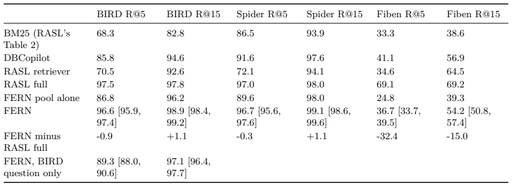
Table 5 . Table recall on the pooled catalogs. RASL full uses Claude 3.5 Haiku keywords and Claude 3.5 Sonnet v2 table selection and returns at most N tables; RASL retriever ranks by retrieval with the Haiku keywords, without LLM table selection. The BM25, DBCopilot, RASL retriever, and RASL full rows are from RASL’s Table 2. Differences are FERN minus RASL full, in points. FERN intervals: 95% bootstrap over questions.
Original paper · CC BY 4.0 · Arjun Rao, Nishant Gopinath · FERN: Cross-Benchmark Table Retrieval for Text-to-SQL with Frozen Retrievers and Learned Ranking · Original paper figure · Extracted the figure area from page 9 of the original PDF.Why table retrieval is the bottleneck
A text-to-SQL query is wrong if one of its tables is missing, and extra tables take up the generator's context. Across a pooled catalog with hundreds of tables, the first step has to narrow the search to a handful of tables. Many recent systems lean on large language models for this step, using them to extract keywords or to pick tables. That choice has a price: RASL's estimated input-token cost is 1.85 US dollars per 100 BIRD queries.
Some organizations can't send their schema and questions to an outside service at all. That makes a ranker that runs locally attractive, since lexical search, embedding models and schema statistics can all run on the organization's own hardware.
Frozen retrievers feeding a learned ranker
FERN computes, for each question, a feature vector for each of 100 candidate tables, and a LightGBM ranker then orders those candidates. The idea rests on a simple split: cheap frozen retrievers propose a short list, and a learned ranker decides the order. Each table gets a full card that lists its columns and a name card that holds the words of its name.
BM25 scores both cards, Qwen3-Embedding-0.6B scores both, and BGE-large-en-v1.5 scores the full card, with the question as query. Cards hold no types, keys, or values, and BGE-large reads at most 512 tokens, so very wide tables give it only the first part of the card.
The pool score adds up reciprocal ranks across the three retrievers, so a table ranked well by several of them rises to the top. The formula sums 1/(60 + rank) over the signals, with zero-based ranks taken over the whole catalog. The 100 highest-scoring tables become the candidates, and average recall at 100 is 99.4 on BIRD dev. Ties in the pool score are broken by array order, which keeps the candidate list deterministic.
For each candidate, the features cover retriever scores, lexical overlap, cell values, schema statistics and position in the join graph. Ranks, z-scores, percentiles and gaps are computed over the 100 candidates for each question, so every feature is relative to that question's pool. The full evidence variant uses all 120 features. LightGBM with the lambdarank objective treats each question's candidates as one group during training.
At run time the ranker scores each candidate on its own, and the candidates are then sorted by that score.
Three variants cover different inputs: FERN-ev for BIRD with evidence, FERN-q for question-only inputs, and FERN-schema without cell values or column types. BIRD with evidence uses FERN-ev, while BIRD without evidence and Spider use FERN-q. Fiben and BEA VER use FERN-schema, because the authors' copies lack cell values. The three rankers were fitted once on 9,394 BIRD training questions, and the hyperparameters were set once and never tuned.
Rules fixed in advance chose the pool and signals, and two documented exceptions shaped the final configuration.
Matching RASL on Spider and BIRD
Spider is the comparison least open to dispute, because no design step used it. On Spider, FERN's candidate pool alone reaches 98.0 recall at fifteen tables, the same as RASL's published 98.0. The ranker then lifts complete@5 from 83.9% to 95.6%, so its value sits mostly in complete table sets at small budgets. At five tables, FERN's recall is 96.7 against 97.0 for RASL full, a gap of 0.3 points.
FERN was evaluated with FERN-q on Spider, and it has values but no evidence.
On BIRD with evidence, FERN-ev reaches 96.6 recall at five tables, compared to 97.5 for RASL full. That is a 0.9-point gap, and the paper notes that RASL's use of evidence is not stated. Without evidence hints, FERN's question-only recall at five falls to 89.3, which is 8.2 points below the same 97.5 reference. The 7.3-point drop from evidence to no evidence mixes changes in the query text with changes in the evidence-specific features.
So that 7.3-point difference can't be assigned to one cause, and the authors didn't decompose it.
Fiben and BEA VER transfer
On Fiben, a ranker fitted on BIRD reaches much lower recall at fifteen tables than RASL does. FERN-schema scored 54.2 recall at fifteen, against 69.2 for RASL full. The two systems don't share a question set, since FERN scored 298 questions and RASL 279. Bounding the 19 unmatched questions leaves FERN's recall at fifteen between 51.1 and 57.9, far below RASL's 69.2.
At fifty tables, FERN reached 80.7, close to the 79.4 that RASL's question-only retrieval reached. So the shortfall appears under a small output budget, where FERN drops 26.5 points from fifty to fifteen tables. Fiben's gold SQL is parsed as PostgreSQL, and the schema has one database with run-together uppercase names.
On the 121 real BEA VER questions, FERN-schema was fitted on BIRD and never saw BEA VER questions. Its recall at fifteen reached 82.1, which sits between 80.8 for the NIFT-SQL row and 84.5 for the label-matched retriever. Its complete@15 of 49.6 was lower than both, compared to 54.5 and 62.0. Both BEA VER-trained baselines recovered more complete table sets, which the authors read as a limit on the BIRD-fitted ranker.
The comparison rows have no paired intervals, because the NIFT-SQL per-question outputs weren't available to the authors. The authors note that a retriever fine-tuned on BEA VER could enter FERN as another signal, but they didn't test that.
What the non-retrieval features add on BIRD dev
On BIRD dev with evidence, the two feature groups reach high recall at fifteen tables, so the difference between them shows up at five. Combining all 120 features reaches 98.9, and the gains of +0.6 and +0.4 both have intervals above zero. Against the other families alone, the same combination adds 2.0 points of complete@5. The database-grouped cross-validation within BIRD train, which the authors treat as a development diagnostic, shows the same ordering with 12.1 and 5.0 points.
So the non-retrieval features matter most when only a few tables reach the generator.
The authors removed one family at a time from the full ranker, and the exploratory comparisons are listed in Table 10. Removing the database family (14 features) or the graph family (7 features) each lowered BIRD dev complete@5 by 0.8 points. The intervals for those two removals run from 0.1 to 1.6, so they sit above zero. Removing the value family lowered it by 0.7 points, with an interval from 0.0 to 1.4 that touches zero.
For the other nine families, the complete@5 intervals include zero, and the authors ran twelve comparisons without correcting for multiplicity. They didn't establish whether this small effect reflects redundancy between families or little information in a family. The score family overlaps with the agreement and database families, since all three are built from the same scores.
In the fitted ranker, the gap between the top pool score and the best candidate carries 49.5% of the total gain. The pool rank contributes 13.3% and the best pool score in the table's database contributes 3.5%.
Running cost on one GPU
FERN's retrieval step took a median of 208.3 ms per question on BIRD dev. We timed it at batch size one on one NVIDIA A100 40GB, over 100 BIRD dev questions after 5 warm-up questions. The 90th percentile was 246.9 ms, and the indexes and card embeddings were precomputed before timing.
Feature computation is the largest stage, with a median of 122.7 ms on the CPU. Embedding the question with Qwen3 and BGE on the GPU took a median of 71.9 ms. BM25 over two views took 6.6 ms, and the ranker itself took 6.4 ms. Stage medians won't sum to the overall median, so the stages are listed separately. The two embedders together have under one billion parameters.
The features are plain Python and haven't been optimized, so the latency reflects this implementation.
Computing features for the 9,394 training questions took 11 minutes with evidence and 4 without. RASL estimates 1.85 US dollars per 100 BIRD queries, and that estimate includes SQL generation. RASL reports no latency, so FERN's timing can't be set against it directly.
Which comparisons and claims are still open
The main open point is that RASL was never rerun, so its per-question results are unavailable to the authors. Because of that, differences from RASL are only signed point differences and carry no interval. RASL's inputs also differ, since it uses BIRD's descriptions rather than cell values and returns at most N tables. The Fiben question sets differ, and RASL does not say which 279 of the questions it used.
The authors bound the Fiben effect by the two extremes for the 19 questions that differ.
The development exposure is the second open issue, because BIRD dev and BEA VER informed design decisions. Spider and Fiben informed no decision, so only their results are free of that exposure. The second exception was a fine-tuned decision model evaluated on BIRD dev, which was left out because it added little.
Gold-table extraction is another open margin, since a table-name regular expression changes 1.6% of BIRD dev gold sets. That share is the same order as the differences from RASL, and RASL does not describe its own extraction. BIRD's gold SQL also contains annotation errors that can affect both systems' reported recall. Gold tables outside the 100 candidates cannot be recovered, with average recall at 100 of 99.4 on BIRD dev and 82.8 on Fiben.
The authors evaluated table retrieval only, so they didn't test database routing or the SQL generated from retrieved tables. Larger enterprise suites with thousands of tables would need candidate-pool decisions of their own, which are left to future work.
Paper info
- Authors
- Arjun Rao, Nishant Gopinath
- Venue
- arXiv · Preprint
- First published
- 2026-11-10
- Added
- 2026-11-12
- Updated
- 2026-11-10
- Version
- v1
- arXiv
- 2611.14477
- Category
- cs.IR · cs.CL
- Original paper terms
- CC BY 4.0
- What we show
- Paper info, commentary and permitted figures from the original paper
AI commentary is a separate explanation from the original paper and may contain errors. The original paper and figures follow each source's terms of use and any rights noted separately.
Abstract
Text-to-SQL systems over large pooled catalogs must first retrieve the tables a question needs. We compare against the published table recall of RASL, which uses Claude 3.5 models to extract keywords and select tables, on pooled BIRD, Spider, and Fiben catalogs. FERN (Feature-Engineered Ranking with No generative LLM) instead fuses three frozen retrievers into 100 candidates, describes each with up to 120 features, and reorders them with LightGBM rankers fitted once on BIRD's training questions. On Spider, where it was not fitted, its candidate pool alone reaches RASL's published recall at fifteen tables (98.0), and the ranker raises the share of questions with every gold table in the top five (complete@5) from 83.9% to 95.6%. At five tables, FERN's recall is within one point of RASL's on Spider (96.7 vs 97.0) and on BIRD with its evidence hints (96.6 vs 97.5), and 8.2 points below on BIRD without them (89.3). On 121 real BEAVER questions, without BEAVER fitting, its recall at fifteen (82.1) falls between two BEAVER-trained retrievers (80.8, 84.5), but its complete@15 is below both (49.6 vs 54.5 and 62.0). On Fiben, it falls far short at fifteen tables (54.2 vs 69.2, different question sets), although its recall at fifty is numerically close to RASL's question-only retrieval result (80.7 vs 79.4). On BIRD dev with evidence, non-retrieval features raise complete@5 by 7.7 points over retrieval signals alone. On BIRD dev, median latency is 208 ms per question on one A100, without hosted model calls.
Figures from the paper
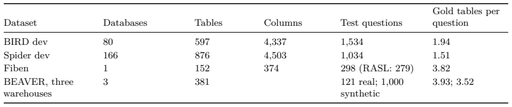
Table 1 . Catalogs and test questions.
Original paper · CC BY 4.0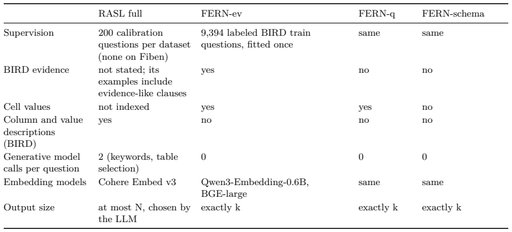
Table 2 . Inputs available to each system. FERN-ev, FERN-q and FERN-schema are defined in Section 4.
Original paper · CC BY 4.0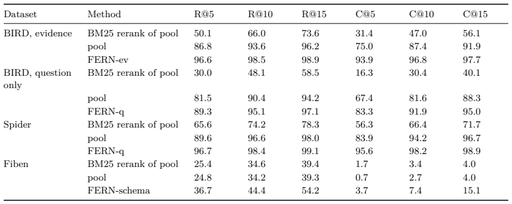
Table 6 . Recall and complete@k against the candidate pool on the same catalogs. “BM25 rerank of pool” ranks the 100 candidates by BM25 score. C@k is complete@k.
Original paper · CC BY 4.0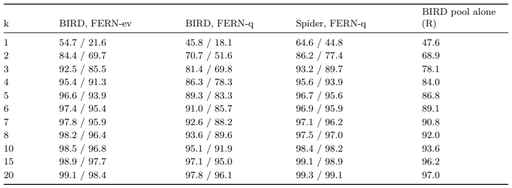
Table 7 . Recall@k and complete@k for k = 1 to 8, 10, 15 and 20 (R / C).
Original paper · CC BY 4.0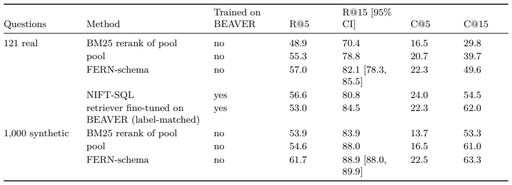
Table 8 . BEA VER, real questions (121) and a sample of synthetic questions (1,000). “BM25 rerank of pool” ranks the 100 candidates by BM25 score. Rows trained on BEA VER come from the NIFT- SQL confirmation run; their complete@15 values are published in Rao & Gopinath (2026, Table 9).
Original paper · CC BY 4.0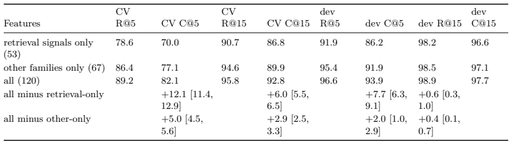
Table 9 . Feature groups in the frozen configuration, FERN-ev inputs. CV: database-grouped cross- validation within BIRD train with a shared unsupervised PCA (development diagnostic). The last two rows give all features minus the subset, paired over questions, with 95% bootstrap intervals; differences are computed from unrounded per-question values.
Original paper · CC BY 4.0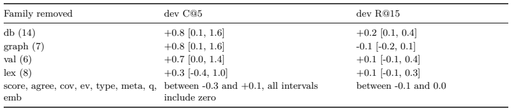
Table 10 . Removing one family (BIRD dev; all features minus the reduced set, 95% paired bootstrap, computed from unrounded values; twelve exploratory comparisons, not corrected for multiplicity).
Original paper · CC BY 4.0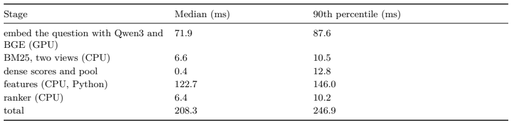
Table 11 . Measured retrieval latency per question, FERN-ev, batch size 1, one NVIDIA A100 40GB, 100 BIRD dev questions after 5 warm-up questions; indexes and card embeddings precomputed.
Original paper · CC BY 4.0Quote from the paper
Arjun Rao, Nishant Gopinath (2026). FERN: Cross-Benchmark Table Retrieval for Text-to-SQL with Frozen Retrievers and Learned Ranking. arXiv:2611.14477v1. https://arxiv.org/abs/2611.14477v1
BibTeX
@misc{rao2026fern,
  title = {{FERN: Cross-Benchmark Table Retrieval for Text-to-SQL with Frozen Retrievers and Learned Ranking}},
  author = {Arjun Rao and Nishant Gopinath},
  year = {2026},
  eprint = {2611.14477},
  archivePrefix = {arXiv},
  url = {https://arxiv.org/abs/2611.14477v1}
}