Paper commentary
Nearly Minimax-Optimal Sample Complexity of Natural Policy Gradient with a Matching Information-Theoretic Lower Bound
- Problem Finite-horizon MDPs with horizon-dependent transition kernels leave open how many transition queries sample-based NPG needs before its final policy reaches a small expected optimality gap.
- Method The method sweeps the horizons backward, replaces exact action values with batch averages of sampled successor values, and applies a softmax update at each horizon, storing O(SAH) memory without estimating transition probabilities.
- Results Three step size schedules reach an expected gap of at most ε with O(SAH^4/ε^2) transition queries, and any algorithm needs Ω(SAH^4/ε^2) queries on the constructed family.
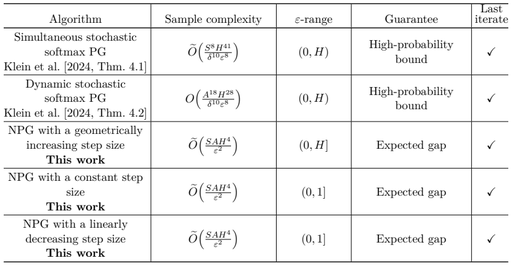
Table 2 : Sample-complexity bounds for model-free policy optimization in finite-horizon tabular MDPs with generative access, horizon-dependent transition kernels, and per-step rewards in[0,1]. For Klein et al. [2024], we compute the total number of transition queries by summing, over all updates, the number of rollouts at each update times their length. Their guarantees hold with probability at least1−δ. Our NPG methods return a last iterateπT that isε-optimal in expectation under the fixed initial state distributionρ.
Original paper · CC BY 4.0 · Asha Barua, Sajad Khodadadian · Nearly Minimax-Optimal Sample Complexity of Natural Policy Gradient with a Matching Information-Theoretic Lower Bound · Original paper figure · Extracted the figure area from page 4 of the original PDF.Why the horizon changes the sample count
Natural policy gradient (NPG) has produced strong results in control tasks, yet how many sampled transitions it needs for a good policy is a separate question. Most sample-complexity theory for policy optimization covers discounted infinite-horizon MDPs, where one transition kernel drives every step. A finite-horizon MDP suits a task with a fixed number of decisions, but each horizon can carry its own transition kernel, which breaks the single-kernel analysis.
The question here is how many transition queries sample-based NPG needs before its final policy has an expected optimality gap of at most ε under a fixed initial distribution ρ, with known rewards and unknown transitions.
Table 1 lists sample-complexity bounds for model-free policy optimization in discounted infinite-horizon MDPs under generative access. Those bounds are written in terms of \((1-\gamma)^{-1}\) and ε, and each rollout step counts as one transition query. With per-step rewards in [0,1], the nontrivial accuracy range is \(0<\varepsilon<(1-\gamma)^{-1}\).
Table 2 places the new NPG results beside finite-horizon bounds for model-free methods with horizon-dependent transition kernels. The three NPG rows, one per step size schedule, all carry O(SAH^4/ε^2) with an expected-gap guarantee for the last iterate, with accuracy ranges (0,H] for the geometrically increasing schedule and (0,1] for the constant and linearly decreasing ones.
The two Klein et al. [2024] rows are high-probability bounds, and their rollouts start from prescribed state distributions.
Summing over the H−1 nonterminal horizons gives O(SAH^4/ε^2), because the action values at the terminal horizon equal the known terminal rewards. Compared with the \((1-\gamma)^{-1}\) dependence of NPG in infinite-horizon MDPs, the finite-horizon bound carries an extra factor H.
How the sampled update uses the oracle
The policy is nonstationary: every horizon has its own decision rule, and the iteration starts from the uniform policy at every horizon, state and action. Exact NPG multiplies each action probability by an exponential of the step size times the true action value and then renormalizes, which keeps the support of the current policy.
Sample-based NPG keeps this update but replaces the exact action values with estimates built from the generative oracle. The oracle, queried at a triple (h,s,a), returns a fresh successor drawn from \(P_h(\cdot\mid s,a)\). The algorithm uses O(SAH) memory, including for the returned policy, and never estimates the transition probabilities.
Each iteration sweeps the horizons backward, from H down to 1. At horizon H the action value is the known reward \(R_H\), so no query is spent there. For an earlier horizon h, the algorithm draws m_t fresh successors for each state-action pair, averages the continuation estimate over them, and adds the known reward. \[\hat Q^{h}_t(s,a)=R_h(s,a)+\frac{1}{m_t}\sum_{\ell=1}^{m_t} f^{h+1}_t\big(Y^{h,s,a}_{t,\ell}\big)\]
The continuation estimate \(f^{h}_t(s)\) is the policy-weighted sum of the sampled action values, computed with the just-updated policy. \[f^{h}_t(s)=\sum_{a\in\mathcal A}\pi^{h}_{t+1}(a\mid s)\,\hat Q^{h}_t(s,a)\] The decision rule at horizon h is then updated by the softmax rule below, and \(f^{h}_t\) is computed for the next horizon down.
\[\pi^{h}_{t+1}(a\mid s)=\frac{\pi^{h}_{t}(a\mid s)\exp\big(\eta_t\hat Q^{h}_t(s,a)\big)}{\sum_{a'\in\mathcal A}\pi^{h}_{t}(a'\mid s)\exp\big(\eta_t\hat Q^{h}_t(s,a')\big)}\]
Conditioned on the information before the horizon-h batches, the sampled action value has mean \(R_h\) plus \(P_h\) applied to \(f^{h+1}_t\).
Each iteration uses m_t SA(H−1) transition queries. The sampled average equals the same sum over empirical successor frequencies, but the method accumulates the continuation values and never forms that matrix.
Three batch and step size schedules
The first schedule doubles the batch and the step size at each iteration, with \(m_t = 2^t\) and \(\eta_t = m_t/H\). After T iterations it has used \(N = SA(H-1)(2T-1)\) transition queries, because the batch sizes sum to \(2T-1\).
Theorem 2 bounds the expected gap of \(\pi_T\) by H and by a term that decays geometrically in T. Corollary 1 picks \(T = 1+\lceil \log_2(441H^3\log(2SA)/\varepsilon^2)\rceil\), which keeps the expected gap at most ε for \(0<\varepsilon<H\). With that T the query count is below \(1764\,SAH^4\log(2SA)/\varepsilon^2\). The log(2SA) factor means this schedule matches the lower bound only up to logarithmic factors.
The second schedule fixes the batch size \(m\ge 2\) and the step size η, with \(0<\eta\le 1/(4H^2)\). Theorem 3 bounds the gap by H and by a sum of a term of order \(H\log A/(\eta T)\) and a term of order \(\eta H^2\) that involves a harmonic sum over the iterations. Corollary 2 takes m=2 and any T with \(T/(1+\log T)\ge 60H^3\log A/\varepsilon^2\), together with the step size below.
\[\eta=\frac{\sqrt{\log A}}{15HT(1+\log T)}\] For \(A\ge 2\) and \(0<\varepsilon\le 1\) this returns an ε-optimal policy in expectation using \(N=2SA(H-1)T\) queries, and the smallest admissible T gives \(N=O\big(SAH^4\log A/\varepsilon^2\cdot\log(H^3\log A/\varepsilon^2)\big)\).
The third schedule uses two samples per triple and lowers the step size linearly, \(\eta_t=\eta_{\max}(T-t)/T\), from \(\eta_{\max}\) down to \(\eta_{\max}/T\). Theorem 4 bounds the gap by H and by \(2H\log A/(\eta_{\max}(T+1))\) plus \(30\eta_{\max}H^2\). This uses \(N=2SA(H-1)\lceil 240H^3\log A/\varepsilon^2\rceil=O(SAH^4\log A/\varepsilon^2)\) transition queries, and the proof shows the final gap is at most \(4\sqrt{15H^3\log A/(T+1)}\), which is at most ε.
Remark 3 explains the trade-off: a larger step size magnifies sampling error in the estimates, and the doubling schedule grows the batch along with the step size to keep that error in check. Remark 4 notes that when ε is fixed beforehand, one backward sweep suffices with \(\eta_0=2H\log A/\varepsilon\) and \(m_0=\lceil 144H^3\log(2SA)/\varepsilon^2\rceil\), using \(SA(H-1)m_0\) queries.
Two lower bounds: exact iterations and any-algorithm queries
The lower bounds use a constructed family with one absorbing reward state g and K=S−1 decision states, each with zero reward. Each horizon has parameters \(p_h\) and \(\alpha_h\) with \(0<\alpha_h<p_h\) and \(p_h+\alpha_h\le 1/(2H)\), and one favorable action per decision state and horizon enters g with a slightly higher probability.
Theorem 1 covers exact NPG with uniform initialization and constant step η. For some instance and every initial distribution on the decision states, the gap after T iterations is at least \(\frac{1}{128}\min\{H,\frac{H\log A}{\eta T}\}\). With η=1/H and \(0<\varepsilon<H/128\), reaching a last-iterate gap of at most ε needs \(T\ge H^2\log A/(128\varepsilon)\).
This matches the Ω(H^2/ε) iteration dependence stated among the paper's contributions.
Barua and Khodadadian [2026] give an upper bound of \(H^2(1+\log A)/T\) for the same initialization and step size η=1/H. The authors argue that the two match up to universal constants, since \(1+\log A\) is at most a constant times \(\log A\) for \(A\ge 2\).
Theorem 5 extends the argument to any agent: with at most N transition queries, adaptive selection and no memory limit, some instance has expected gap at least \(c\min\{H,H^2\sqrt{SA/N}\}\) for a universal constant \(c>0\). This result uses the uniform initial distribution over the decision states, which is imposed only for this bound.
The family is a subclass of the finite-horizon MDPs, so the same budget applies to any agent that guarantees that accuracy over the full class.
The authors say the NPG procedures reach the optimal worst-case polynomial dependence on S, A, H and 1/ε under the stated oracle and expected-gap criterion. The last iterate achieves this with O(SAH) memory and without estimating transition probabilities.
Where the matching claim stops
The matching is up to logarithmic factors. The doubling schedule's bound carries log(2SA), and the constant and linearly decreasing schedules carry log A factors in their query counts. The authors list the logarithmic dependence and the absolute constants of the last-iterate bounds as open questions.
The uniform initial distribution over decision states is used only for the information-theoretic bound, while the upper bounds keep a fixed initial distribution ρ. The iteration lower bound concerns exact NPG with known kernels, so it does not address sampling error.
The constant and linearly decreasing schedules require the step size η or \(\eta_{\max}\) to be at most \(1/(4H^2)\). The corollaries for those schedules assume \(A\ge 2\) and \(0<\varepsilon\le 1\), while the doubling schedule's accuracy range in Table 2 is (0,H].
The analysis covers finite-horizon tabular MDPs with generative access and horizon-dependent kernels. Extension to the infinite-horizon setting is left open, together with sharpening the logarithmic dependence and the absolute constants.
Paper info
- Authors
- Asha Barua, Sajad Khodadadian
- Venue
- arXiv · Preprint
- First published
- 2026-11-21
- Added
- 2026-11-24
- Updated
- 2026-11-21
- Version
- v1
- arXiv
- 2611.28628
- Category
- cs.LG · math.OC · stat.ML
- Original paper terms
- CC BY 4.0
- What we show
- Paper info, commentary and permitted figures from the original paper
AI commentary is a separate explanation from the original paper and may contain errors. The original paper and figures follow each source's terms of use and any rights noted separately.
Abstract
A fundamental question in reinforcement learning is how many sampled transitions are needed to learn a near-optimal policy, and whether direct policy optimization can attain this statistical limit. To answer this question, we consider natural policy gradient (NPG), a widely used policy optimization method. We study tabular finite-horizon Markov decision processes (MDPs) with known rewards and unknown horizon-dependent transition kernels, accessed through a generative model. Our sample-based NPG algorithms update the policy by backward sweeps and do not estimate transition probabilities. Under three different batch-size and step size schedules, we establish last-iterate guarantees with sample complexity $\widetilde O(SAH^4/\varepsilon^2)$, where $S$, $A$, and $H$ denote the number of states, the number of actions, and the horizon length, respectively. In this setting, horizon-dependent transition kernels contribute a factor of $H$ to our transition-query bound. Our information-theoretic lower bound of $Ω(SAH^4/\varepsilon^2)$ shows that the resulting $H^4$ dependence is unavoidable in the worst case, even for agents that select their queries adaptively. To the best of our knowledge, these are the first last-iterate guarantees for NPG whose sample complexity matches an information-theoretic lower bound up to logarithmic factors. Consequently, our results demonstrate that direct policy-space optimization through NPG can achieve the fundamental statistical limits of reinforcement learning while guaranteeing the performance of the final policy. Furthermore, for known kernels, we prove that exact NPG with a constant step size $η=1/H$ requires $Ω(H^2/\varepsilon)$ iterations in the worst case, matching the known upper bound for that step size.
Quote from the paper
Asha Barua, Sajad Khodadadian (2026). Nearly Minimax-Optimal Sample Complexity of Natural Policy Gradient with a Matching Information-Theoretic Lower Bound. arXiv:2611.28628v1. https://arxiv.org/abs/2611.28628v1
BibTeX
@misc{barua2026nearly,
  title = {{Nearly Minimax-Optimal Sample Complexity of Natural Policy Gradient with a Matching Information-Theoretic Lower Bound}},
  author = {Asha Barua and Sajad Khodadadian},
  year = {2026},
  eprint = {2611.28628},
  archivePrefix = {arXiv},
  url = {https://arxiv.org/abs/2611.28628v1}
}