論文解説
AbductionBench: Benchmarking Abductive Reasoning in Large Language Models
AbductionBench:大規模言語モデルにおけるアブダクション推論のベンチマーク
- 課題 複数のベンチマークは課題の形式や採点方法が異なるため、結果を比べにくい状況です。また、最終回答だけでは証拠の利用や仮説の修正はわかりません。
- 手法 課題を仮説の生成・選択、応用分野、証拠の提示方式で分け、27個のデータセットを一つのプロトコルで実行します。最終回答と推論過程は別々に測定します。
- 結果 CoTは一貫した効果を示さず、Jevは短い証拠の選択では競争力がありましたが、長い事例では後れを取りました。対話的課題の関連行動は後半に減り、受動的課題ではモデルが初期仮説をほとんど修正しませんでした。
既存の推論評価の限界
大規模言語モデルのアブダクション推論能力は、複数のベンチマークでそれぞれ別々に評価されてきました。課題の形式や採点方法が異なるため、結果を並べて比べるのは難しい状況です。この論文は、仮説の生成、仮説の選択、証拠を一度に与える方式と順番に与える方式が、それぞれ異なる能力を明らかにすると考えています。そこで、これらを一つの実行・報告プロトコルにまとめたAbductionBenchを提案しています。最終回答の正答率だけでは、モデルが証拠を実際に使ったのか、代替案を比較したのか、仮説を修正したのかはわかりにくい、という点が出発点です。
課題の軸と証拠の提示方式
AbductionBenchは、課題を仮説の生成か選択か、応用分野、証拠の提示方式という3つの軸で記述します。証拠の提示方式は、すべての証拠を最初に与える静的(static)方式、決まった順序で証拠が届きモデルが毎ターン仮説を修正する受動的(passive)方式、そしてモデルの質問や行動が次の観測を決める対話的(interactive)方式に分けられます。評価では、最終回答を課題ごとの採点で測定します。静的課題の推論過程はCoTの追跡で、受動的・対話的課題はターン単位の指標で別々に分析します。
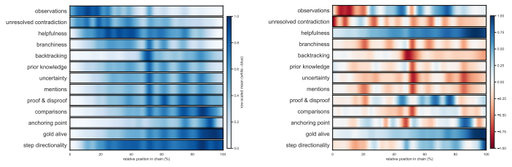
Figure 3 : Judged trace measures by relative position in the chain (0–100%), pooled over the eight LLMs. (a) Mean, each row min–max scaled. (b) Correct-minus-incorrect difference, computed within each dataset and averaged; each row scaled symmetrically around zero, so blue marks positions where correct chains score higher and red where incorrect chains score higher. Row intensities are not comparable across measures.
出典 · CC BY 4.0 · Moein Salimi, Amir Qeysarbeigi, Babak Hosseini Mohtasham, Faraz Doagoye Tehrani, Mahdi Naieni, Hanieh Sartipi, Ali Nouri, Amin Aghakasiri, Reyhane Khayatzade Mahani, Mahdi Jafari Siavoshani, Mohammad Hossein Rohban · AbductionBench: Benchmarking Abductive Reasoning in Large Language Models · 論文の図を引用 · 元のPDFの8ページ目から図の部分を抽出しています。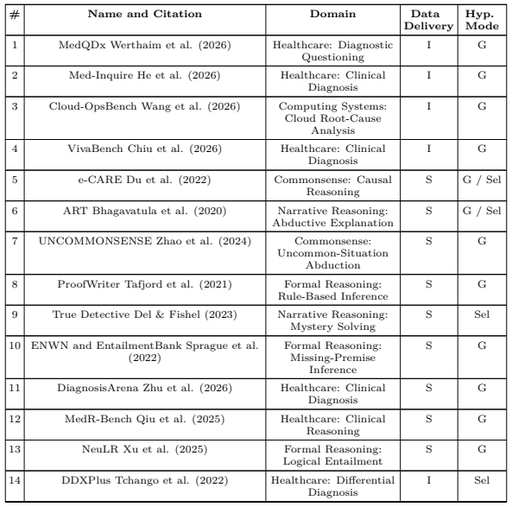
Table 2 : Summary of datasets used. Data Delivery Mode:I= Interactive,S= Static. Hypothesis Processing Mode:G= Generation,Sel= Selection;G / Seldenotes datasets with separate generation and selection tasks.
出典 · CC BY 4.0 · Moein Salimi, Amir Qeysarbeigi, Babak Hosseini Mohtasham, Faraz Doagoye Tehrani, Mahdi Naieni, Hanieh Sartipi, Ali Nouri, Amin Aghakasiri, Reyhane Khayatzade Mahani, Mahdi Jafari Siavoshani, Mohammad Hossein Rohban · AbductionBench: Benchmarking Abductive Reasoning in Large Language Models · 論文の図を引用 · 元のPDFの15ページ目から図の部分を抽出しています。主要な実験結果
CoTはどの条件でも精度を上げませんでした。課題によっては助けになり、逆に害になることもありました。Jevは比較的短く圧縮された証拠から選ぶ課題では、小型LLMと同程度か、それ以上の結果でした。しかし、長い事例では大きく後れを取りました。対話的課題では、関連する行動の割合が後半になるほど減りました。受動的課題では、新しい証拠が届いてもモデルは最初の仮説をほとんど変えませんでした。これらの結果は、特定のモデルとデータセットの条件で得られたものです。
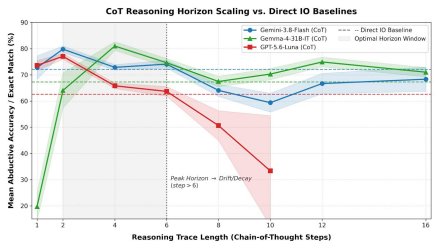
Figure 1 : Accuracy by CoT trace length (steps) against each model’s IO baseline (dashed); bands are±SEM, points withn<5omitted.
出典 · CC BY 4.0 · Moein Salimi, Amir Qeysarbeigi, Babak Hosseini Mohtasham, Faraz Doagoye Tehrani, Mahdi Naieni, Hanieh Sartipi, Ali Nouri, Amin Aghakasiri, Reyhane Khayatzade Mahani, Mahdi Jafari Siavoshani, Mohammad Hossein Rohban · AbductionBench: Benchmarking Abductive Reasoning in Large Language Models · 論文の図を引用 · 元のPDFの2ページ目から図の部分を抽出しています。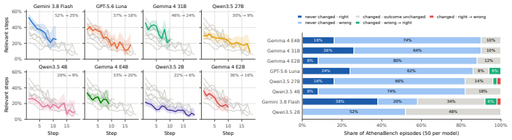
Figure 4 : Relevance and revision over the course of an episode. The left panel (a) tracks the share of actions judged relevant to the gold answer at each step of the interactive episodes, one colored panel per model (95% Wilson bands) against the other seven in gray; a step is plotted only once at least 30 of the model’s episodes reach it, so models that answer early trace shorter curves, and corner labels give relevance at the first and last plotted step. MedQDx counts its questions only. The right panel (b) shows, for AthenaBench’s passive setting, the share of each model’s 50 episodes whose predicted actor never changed, changed without changing the outcome, or flipped between wrong and right from the first turn to the last.
出典 · CC BY 4.0 · Moein Salimi, Amir Qeysarbeigi, Babak Hosseini Mohtasham, Faraz Doagoye Tehrani, Mahdi Naieni, Hanieh Sartipi, Ali Nouri, Amin Aghakasiri, Reyhane Khayatzade Mahani, Mahdi Jafari Siavoshani, Mohammad Hossein Rohban · AbductionBench: Benchmarking Abductive Reasoning in Large Language Models · 論文の図を引用 · 元のPDFの8ページ目から図の部分を抽出しています。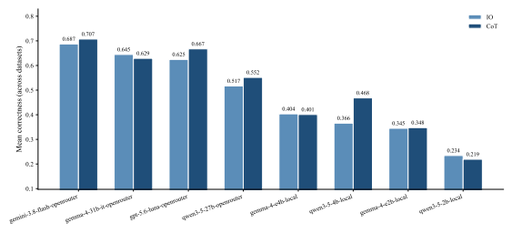
Figure 5 :Mean correctness per model, averaged across datasets, for theioandcotprompt- ing variants.Models are ordered bycotcorrectness, descending.cotimproves correctness for four of eight models, is roughly flat forgemma-4-e2b-local, and reduces it slightly forgemma-4-31b-itandgemma-4-e4b-local; the largest gain isqwen3-5-4b-local (+0.102) and the largest loss is negligible (−0.015,qwen3-5-2b-local).
出典 · CC BY 4.0 · Moein Salimi, Amir Qeysarbeigi, Babak Hosseini Mohtasham, Faraz Doagoye Tehrani, Mahdi Naieni, Hanieh Sartipi, Ali Nouri, Amin Aghakasiri, Reyhane Khayatzade Mahani, Mahdi Jafari Siavoshani, Mohammad Hossein Rohban · AbductionBench: Benchmarking Abductive Reasoning in Large Language Models · 論文の図を引用 · 元のPDFの21ページ目から図の部分を抽出しています。限界と解釈の範囲
著者らは、判定者(judge)の出力を無作為に確認し、プロンプトを修正したと説明しています。一方で、判定者の品質に関する体系的な評価や、全体の一致度の統計は報告していないとしています。また、モデルの構成が限られていること、対話的・受動的課題の数が少ないこと、そして時間的なコストのためエピソードを一度ずつしか実行していないことも挙げられています。推論過程の指標は、書かれた推論の観察可能な特徴であるため、モデル内部の計算を直接表すものとは見なせません。
論文情報
- 著者
- Moein Salimi, Amir Qeysarbeigi, Babak Hosseini Mohtasham, Faraz Doagoye Tehrani, Mahdi Naieni, Hanieh Sartipi, Ali Nouri, Amin Aghakasiri, Reyhane Khayatzade Mahani, Mahdi Jafari Siavoshani, Mohammad Hossein Rohban
- 学会・ジャーナル
- arXiv · プレプリント
- 公開日
- 2026年11月7日
- 登録日
- 2026年11月10日
- 更新日
- 2026年11月7日
- バージョン
- v1
- arXiv
- 2611.10705
- カテゴリ
- cs.LG
- ライセンス
- CC BY 4.0
- 掲載内容
- 論文情報・解説・論文の図
この解説は、Refivuの韓国語解説をAIで翻訳したものです。不正確な翻訳や誤りが含まれる可能性があります。論文と図の利用条件は各出典に従います。
アブストラクト
Abductive reasoning is the inference of plausible explanations for observed evidence. Evaluating this capability requires more than a single task: a system may need to generate an explanation, discriminate among competing hypotheses, revise its hypotheses as evidence arrives, or decide what evidence to seek next. Yet these capabilities are typically evaluated through isolated benchmarks with different task formulations and scoring procedures, so claims that a model is ``good at abduction'' may reflect only a narrow aspect of this capability. We introduce AbductionBench, a unified framework whose taxonomy characterizes abductive tasks. We instantiate this framework on 27 datasets spanning ten domains and evaluate eight LLMs from four model families evaluated on single-choice selection tasks. Beyond harmonizing heterogeneous tasks, AbductionBench separates final-answer evaluation from analysis of the observable reasoning traces and interaction histories produced alongside those answers. We analyze written traces as observable model outputs rather than faithful representations of internal computation, characterizing evidence use, hypothesis comparison, uncertainty, contradiction handling, and answer commitment. Jev matches or exceeds small LLMs when selecting among explanations over compact evidence but falls substantially behind on longer cases, suggesting that candidate discrimination and extended evidence integration place different demands on a system. In interactive tasks, the proportion of actions judged relevant declines at later steps, and a relevant first question is associated with a correct final answer; in the passive task, models rarely revise their initial hypothesis as new evidence arrives. Together, these findings highlight the value of evaluating abductive reasoning through both final answers and observable evidence use, hypothesis revision, and information gathering.
この論文を引用
Moein Salimi, Amir Qeysarbeigi, Babak Hosseini Mohtasham, Faraz Doagoye Tehrani, Mahdi Naieni, Hanieh Sartipi, Ali Nouri, Amin Aghakasiri, Reyhane Khayatzade Mahani, Mahdi Jafari Siavoshani, Mohammad Hossein Rohban (2026). AbductionBench: Benchmarking Abductive Reasoning in Large Language Models. arXiv:2611.10705v1. https://arxiv.org/abs/2611.10705v1
BibTeX
@misc{salimi2026abductionbench,
  title = {{AbductionBench: Benchmarking Abductive Reasoning in Large Language Models}},
  author = {Moein Salimi and Amir Qeysarbeigi and Babak Hosseini Mohtasham and Faraz Doagoye Tehrani and Mahdi Naieni and Hanieh Sartipi and Ali Nouri and Amin Aghakasiri and Reyhane Khayatzade Mahani and Mahdi Jafari Siavoshani and Mohammad Hossein Rohban},
  year = {2026},
  eprint = {2611.10705},
  archivePrefix = {arXiv},
  url = {https://arxiv.org/abs/2611.10705v1}
}