論文解説
The Neighbour's Label: Opposite Subgroup Effects of Same-Dialogue Exposure in Next-Act Evaluation
直前ラベルの露出を対象ごとに分けて測り評価の漏えいを確かめる
- 課題 従来の窓分割による次の行為の評価では、テスト対話の直前の正解ラベルが訓練や示例に入り込むことがあり、点数が実際より高く出てしまいます。
- 手法 本研究は、直前ラベルを訓練に入れるかどうかを対象ごとにランダムに分け、同じサイズの訓練どうしを比べます。継続と遷移で効果を分けて測り、集計では見えない逆向きの影響を確かめます。
- 結果 AMIでQwenの継続の効果は+2.58 natsでした。露出は継続では正解に近づけ、遷移では正解から遠ざけることが、2つのモデルと2つのコーパスで再現しました。
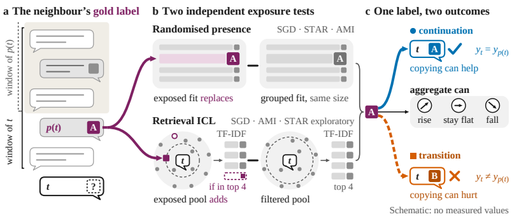
Figure 1 : Graphical overview (schematic, not measured values). (a) The labelled predecessor p(t) can expose its gold label; earlier unlabelled dialogue text is not itself gold-label leakage. (b) Independent tests: randomly controlled, equal-size training-set replacement (SGD, STAR, AMI), and TF-IDF top-four retrieval from exposed versus filtered demonstration pools (SGD, AMI; exploratory STAR). (c) Copying yp(t) can help continuations, hurt transitions, and mask subgroup effects in the aggregate. All exposure is induced on officially clean splits; the dense retriever was used for prevalence only.
出典 · CC BY 4.0 · Ali Amini, Masoumeh Chapariniya, Rytis Maskeliunas, Robertas Damaševičius · The Neighbour's Label: Opposite Subgroup Effects of Same-Dialogue Exposure in Next-Act Evaluation · 論文の図を引用 · 元のPDFの2ページ目から図の部分を抽出しています。行分割の評価で直前ラベルが入り込む理由
次の行為を予測する評価では、直前の5発話からなる窓を入力にし、次の対象の行為を正解ラベルとして組にします。連続する窓は同じ対話の文の多くを共有し、ある窓の対象のラベルが次の窓の直前の行為になります。未見の対話への汎化を測るSetting Aでは、テスト対話のゴールドラベルを訓練にも示例プールにも入れてはいけません。ところが行単位で分割すると、テスト対象の直前の窓が訓練側に入る確率は訓練の割合と同じになり、類似度検索でも同じ窓がよく返ってきます。
次活動予測では、テストの接頭辞の多くが訓練の接頭辞と重なるため、性能が過大に見積もられることが知られています。ただし本研究が扱う露出は、テスト例そのものの複製ではなく、その直前の例です。直前の例のラベルは、対象が継続なら正解になり、遷移なら誤りになります。同じ露出でも効きの符号が対象によって逆になるため、集計値は2つの効果を混ぜてしまいます。
対象tの直前の対象p(t)は同じ対話で直前にラベルのついた対象で、SGDでは2発話前にあたります。Ct=1のとき正解ラベルが一致する対象を継続とし、それ以外は遷移とします。対話の最初の対象はどちらにも入りません。集計の効果は、継続の効果と遷移の効果をπCと1−πCで重み付けした和になります。πCはSGDで0.135、STARで0.099、AMIで0.232と小さく、遷移が多数派になります。集計の符号は構成比で決まるため、集計が上がっても下がっても横ばいでも、モデルの振る舞いが変わっていないとは言えません。
ただし依存があっても、それだけでリークになるわけではありません。本研究は三種類の学習器で、共有行がスコアを変えるかどうかを確かめます。著者らは本研究を新しい機構の提案ではなく測定と位置づけ、対話単位で分割してから窓を作り、テスト対話を示例プールから外すことを提案します。
露出を対象ごとにランダム化する設計
直前ラベルの効果を他の要因と分けて取り出すには、直前の行を訓練に入れるかどうかを対象ごとにランダム化し、同じサイズの訓練集合どうしで比べます。露出ありの学習では、同じラベルの訓練行を評価対象の対話の別グループの窓で置き換えます。露出なしの学習は評価対象の対話を使わず、サイズと予測対象は揃えてあります。どの対象の直前行が訓練に入るかは対話内でランダムに決まるため、露出の効果を他の要因から切り離しやすくなります。
効果は、露出ありの対象ごとのスコアから露出なしのスコアを引いた差を被説明変数にし、対象固定効果つきの回帰で推定します。式(2)では、Ltrが直前行の露出の有無を表し、その係数βcがセルごとのlag-1効果になります。対照として、隣接しないプラセボ行、隣接2行をパージした条件、ラベルの置換、行単位の分割を用意しています。学習器はTF-IDFの1〜2-gramロジスティック回帰を主に使い、RoBERTa-baseと、後から加えたkNNを補助に使います。
データはSGDが3,000対話と30,501のシステム発話、AMIは139会議からの27,744セグメントです。区間はクラスタブートストラップで95%を求め、SGDは対話、AMIは会議系列を単位にしています。事前に決めた判定は、継続効果の正、継続と遷移の差の正、プラセボを上回ること、パージ対比の正の4点を求めました。
著者らの貢献は新しい機構の提案ではなく、露出の大きさと符号構造の測定です。つまり、露出は継続と遷移で逆向きに働くことが、この設計で確認されました。
隣接行だけが効くかの検証
TF-IDFロジスティック回帰では、著者らはlag-1行の係数を継続と遷移に分けて推定しました。その結果、lag-1係数はSGD、STAR、AMIの3コーパスすべてで継続に正、遷移に負になりました。事前に決めた判定は3コーパスすべてで満たされ、継続の効果は5回の反復すべてで正になりました。
対照条件を見ると、隣接しないプラセボ行は継続に検出できる効果を示しませんでした。別の分割では、隣接2行をパージすると継続の効果の84から93%が消えました。一方で、同じ数だけラベルが一致する別の行をパージした場合、変化は−2%から+1%にとどまりました。つまり、効果は隣接行に固有のものであり、同じ対話内の任意の行では説明できません。
効果はラベルにも依存することが、著者らの並べ替え実験で確かめられました。ラベルを対話内で並べ替えると、SGDとAMIでは正の効果がほぼ残らず、STARでは約4分の1が残りました。STARのテンプレート化されたwizard発話では、並べ替えたラベルが継続のラベルと一致しやすいため、この残存が生じると著者らは説明しています。学習器を変えると効果の大きさも変わり、TF-IDFの継続効果はファインチューニングしたRoBERTa-baseより、SGDで+0.0282 [+0.0113, +0.0443]LRAP、AMIで+0.2026 [+0.1432, +0.2977]nats大きくなりました。一方で、エンコーダ単独ではSGDで検出できる隣接効果が見られず、AMIでは効果が広く分散して現れました。
予測された後続行の効果は、遷移では観測されませんでした。後続行のラベルをコピーして遷移の正解になるのは、遷移全体の7から20%だけでした。さらに、AMIでは13,193の対象を履歴に重なり発話を含むものとして除いても、事前に決めた判定が成り立ちました。
検索示例で露出を作る手続きと、言語モデルのスコアへの影響
この節では、同じ露出を言語モデルの検索示例で再現する手続きを説明します。フィルタプールはクエリqのクラスタ、すなわち対話、近似重複グループまたはAMIの会議系列の外にある対象だけを含みます。露出プールは、これに加えてqと同じ対話の先行ラベル付き対象を含みます。著者らは、TF-IDFのコサイン類似度で上位4件を選び、類似度の低い順に並べて示例DEqまたはDFqとしました。
モデルは、ラベル候補の固定インベントリ(SGDは13種類の行為集合、AMIは15種類)の各文字列に、トークンの対数確率の和でスコアを付けます。この際、長さによる正規化は行いません。s(q;D)は、正解文字列の確率をインベントリ全体で正規化した値の対数であり、h(q;D)は正解文字列が1位のとき1になる指標です。露出の効果は、セルcのクエリ集合Qc上で、露出プールのsからフィルタプールのsを引いた平均として定義され、単位はnatsです。Δhcも同じ形でhを用い、top-1精度で表します。
自然構成比の集計では、層別のクエリをコーパスのπCに合わせて重み付けするので、式(1)をΔhCとΔhTに適用した値と一致します。さらに、同じ対話の示例を、同じラベルか別のラベルを持つ最も類似した別対話の窓に置き換える条件や、ランダムな示例、示例なしの条件も比較されました。対象モデルはQwen2.5-7B-InstructとMistral-7B-Instruct-v0.3で、SGDとAMIのそれぞれ750クエリを使いました。750クエリのうち300件が継続、450件が遷移でした。
検索示例でも継続と遷移が逆向きに動くか
検索示例を使った実験では、SGDでの継続の効果がQwenで+0.46 [+0.08, +0.85] nats、Mistralで+0.55 [+0.25, +0.86] natsとなりました。AMIでは、同じ条件で継続の効果がQwenで+2.58 [+2.17, +3.01] nats、Mistralで+2.40 [+1.99, +2.79] natsと、SGDより大きくなりました。つまり、露出した示例では、継続では正解に近づく一方で、遷移では正解から遠ざかるという逆向きの非対称性が再現しました。AMIの効果がSGDより大きい理由は、この論文では特定されていません。
著者らは、継続と遷移の交互作用を、事前に決めた判定基準で検定しました。交互作用は8つのアームすべてで0を除外しましたが、16の単一セル区間のうち4つは0を含みました。判定は、AMIのQwenとMistralで再現、SGDのMistralで再現、SGDのQwenで部分的な再現にとどまりました。
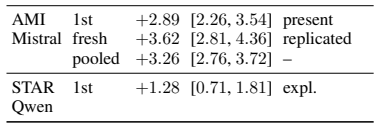
Table 2 : Interaction, continuation minus transition ef- fect, and the decision fixed before scoring:present (gain and interaction),replicated(every Qwen first- sample finding),partial(a component missed); expl.: exploratory arm. AMI samples share all 36 series; all cells in Table 6.
出典 · CC BY 4.0 · Ali Amini, Masoumeh Chapariniya, Rytis Maskeliunas, Robertas Damaševičius · The Neighbour's Label: Opposite Subgroup Effects of Same-Dialogue Exposure in Next-Act Evaluation · 論文の図を引用 · 元のPDFの7ページ目から図の部分を抽出しています。この感度分析は遷移の損失を検出できるようにしますが、主判定の再現という結論は変えません。Mistralは、SGDと両方のAMIの組で判定を満たしました。一方で、再現の対象ではないSGDの新しいサンプルの継続の効果は欠けました。AMIの2つのサンプルは36の会議シリーズを共有するため、AMIの再現は対象の抽出についての結果であり、新しい参加者についての結果ではありません。
AMIでは、Qwenが+0.036 [+0.017, +0.055]、Mistralが+0.020 [+0.004, +0.035]でした。AMIでは継続の精度が露出で改善しており、重み付けした寄与は部分的に相殺されました。つまり、集計の変化が小さくても露出がないことを意味せず、集計どうしの比較は漏えいの検定にはなりません。AMIの上位1件精度は、ランダム、フィルタ、露出のいずれの示例でも0.090から0.163と低く、previous-act参照の0.232を下回りました。
検索で前の窓が露出する頻度
この節が扱うのは、検索パイプラインによって前の窓がどれだけ示例に入り、露出が起きるかという点です。著者らは、TF-IDFで検索した示例の上位4件に、テスト対話の前の窓が入る割合を調べました。その結果、TF-IDFでは最初のサンプルにおいて、テスト対話の前の窓が上位4件に入る割合はSGDで97.6%、AMIで99.3%でした。一方、STARでは75.6%にとどまりました。STARのテンプレート化されたウィザードの発話により、他の対話も同じくらい似て見えるためです。つまり、露出の頻度は検索の方式によって決まるため、どのコーパスでも同じ露出が起きるとは言えません。
同じクエリとプールに対して、著者らは別のパイプラインとして、描画された窓のテキストを事前学習済みのdense encoderで埋め込む検索も評価しました。dense encoderは、前の窓をAMIで83.9%、SGDで43.2%、STARで27.2%のクエリについて検索しました。すべての対応する差は負で、SGDおよびAMIの評価サンプルではdense側だけで前の行の検索は観察されませんでした。ただし、この比較は2つの具体的なパイプラインの比較であり、denseと字句ベースの検索一般を比べたものではありません。また、dense検索の示例で言語モデルは実行していないため、その示例での効果はわかりません。
最後に、露出が遷移クエリでの前の行為の予測にどう影響したかを確認しました。AMIでは、露出によってQwenの割合が0.102から0.336、0.140から0.380に上がり、Mistralでは0.124から0.353、0.147から0.371に上がりました。SGDでは変化は最大0.05にとどまり、ゼロショットの割合を下回りました。前の行為を繰り返すベースラインは0.232で、両モデルのどの検索条件もこれを下回りました。設定Bではこのベースラインは正当ですが、設定Aではテスト対話の正解の前の行為は使えないため、露出プールが模倣させる内容を示すだけです。
限界:どこまでの結論にとどまり、何が未検証か
論文のLimitationsでは、著者らが結論の及ぶ範囲を示しています。露出はすべて誘導されたものであり、著者らは公開されたどのシステムも再評価していません。言語モデルの結果は、2つの7Bインストラクションモデル、1つのプロンプト形式、4件の示例、TF-IDF検索に限られます。dense検索で同じ対話の示例を与えた場合に、モデルが強く反応するかは試していません。
AMIでは、上位1件精度がランダム、フィルタ、露出のいずれの示例でも0.090から0.163と低く、previous-act参照の0.232を下回りました。弱いモデルでは、コピーされたラベルや繰り返されたテキストへの感度が増幅されているかもしれません。そのため、これらの効果の大きさを、より強いモデルにそのまま当てはめることはできません。AMIは36の会議系列を全サンプルで共有するため、新しい参加者への一般化は示されていません。
同じ会議の増分は、類似度を揃えた条件では特定されていません。未ラベル文の効果は、近重複や話者枠組みの変化と分けることができません。事前学習汚染は除外できず、コーパスは英語のタスク指向と会議対話に限られます。Tanaka et al., 2019は独立に評価できず、露出率は公開プロトコルから推定したものにとどまりました。
論文は、言語モデルの得点化で長さ正規化を使わなかったため、その選択に対比が依存する可能性を残しています。著者らは行動上の依存性のみを示し、モデル内部の仕組みは特定していないと述べています。
論文情報
- 著者
- Ali Amini, Masoumeh Chapariniya, Rytis Maskeliunas, Robertas Damaševičius
- 学会・ジャーナル
- arXiv · プレプリント
- 公開日
- 2026年11月11日
- 登録日
- 2026年11月13日
- 更新日
- 2026年11月11日
- バージョン
- v1
- arXiv
- 2611.15194
- カテゴリ
- cs.CV · cs.CL
- ライセンス
- CC BY 4.0
- 掲載内容
- 論文情報・解説・論文の図
この解説は、Refivuの韓国語解説をAIで翻訳したものです。不正確な翻訳や誤りが含まれる可能性があります。論文と図の利用条件は各出典に従います。
アブストラクト
Window-based next-act evaluation often aims to measure generalisation across dialogues, yet overlapping windows and similarity retrieval can expose labelled examples from the test dialogue. The nearest such example is the target's labelled predecessor, whose act is correct when the target continues it and wrong when the target changes act; a model that copies it can gain and lose in two subgroups that one aggregate averages. We induce this exposure under controlled designs on SGD, STAR and AMI, whose official splits are clean. Randomly including the predecessor's row in training raises a lexical classifier's continuation scores and lowers its transition scores in all three corpora, and purging the adjacent rows removes most of the gain. With TF-IDF-retrieved demonstrations, two 7B instruction-tuned models show the same opposite pattern in all eight model-corpus-sample arms (some single-cell intervals include zero; one replication is partial), while natural-weight accuracy changes by only -0.05 to +0.04. Exposure frequency depends on the retrieval pipeline. We evaluate two diagnostic comparisons without model retraining and find that excluding the test dialogue does not detectably reduce accuracy on SGD. All exposure is induced; no published system was re-evaluated.
論文の図
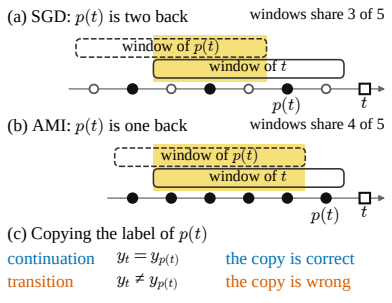
Figure 2 : (a, b) Labelled predecessor p(t) of target t (square) and the five-utterance windows of t and p(t); shaded: utterances in both; filled: labelled turns, open: unlabelled user turns. STAR: two back for most targets. (c) Copying the label ofp(t). Schematic; no corpus text.
出典 · CC BY 4.0 · Ali Amini, Masoumeh Chapariniya, Rytis Maskeliunas, Robertas Damaševičius · The Neighbour's Label: Opposite Subgroup Effects of Same-Dialogue Exposure in Next-Act Evaluation · 論文の図を引用 · 元のPDFの2ページ目から図の部分を抽出しています。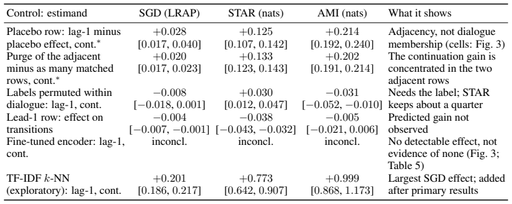
Table 1 : Controls of the randomised presence design (TF-IDF classifier unless stated), 95% cluster-bootstrap intervals; cont.: continuation targets; ∗prespecified decision criterion. All estimands: Tables 4–5.
出典 · CC BY 4.0 · Ali Amini, Masoumeh Chapariniya, Rytis Maskeliunas, Robertas Damaševičius · The Neighbour's Label: Opposite Subgroup Effects of Same-Dialogue Exposure in Next-Act Evaluation · 論文の図を引用 · 元のPDFの5ページ目から図の部分を抽出しています。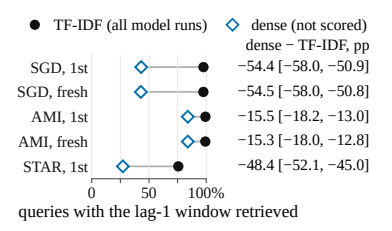
Figure 6 : Previous-act copying on transition queries, where predicting the previous act is always incorrect. The left panel shows copy rates under zero-shot, filtered, and exposed retrieval; the right panel shows the paired exposed-minus-filtered difference with its 95% cluster- bootstrap interval. Each sample contains 450 transition queries. Numerical results are reported in Table 13.
出典 · CC BY 4.0 · Ali Amini, Masoumeh Chapariniya, Rytis Maskeliunas, Robertas Damaševičius · The Neighbour's Label: Opposite Subgroup Effects of Same-Dialogue Exposure in Next-Act Evaluation · 論文の図を引用 · 元のPDFの7ページ目から図の部分を抽出しています。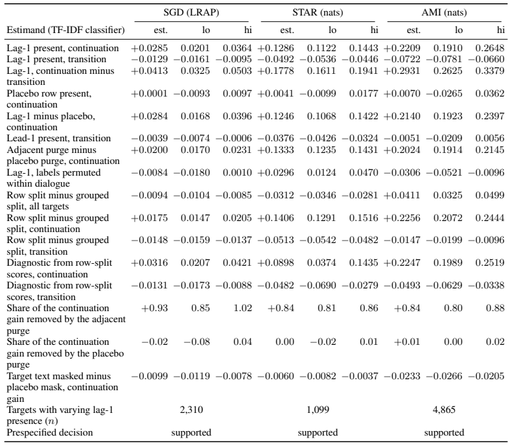
Table 4 : Complete estimands of the randomised presence design for the TF-IDF classifier. The row-split contrasts compare a naive 5-fold row-level split with the grouped split on the same targets; the diagnostic contrasts test targets whose lag-1 row fell into the training fold with those whose lag-1 row did not, using only row-split scores.
出典 · CC BY 4.0 · Ali Amini, Masoumeh Chapariniya, Rytis Maskeliunas, Robertas Damaševičius · The Neighbour's Label: Opposite Subgroup Effects of Same-Dialogue Exposure in Next-Act Evaluation · 論文の図を引用 · 元のPDFの14ページ目から図の部分を抽出しています。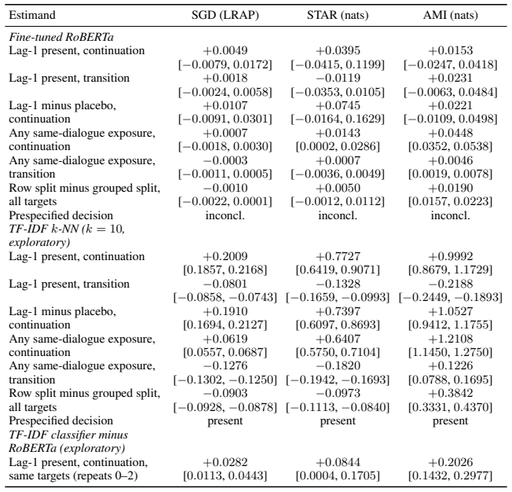
Table 5 : Learner dependence. The encoder shows no detectable adjacency effect (inconclusive, not falsified; the SGD encoder is near ceiling); the k-NN learner has the largest effect on the bounded LRAP of SGD, but its log scores are unbounded below, so magnitudes are not comparable across learners on STAR and AMI. Last row: paired difference between the TF-IDF classifier and the encoder on the same targets (exploratory).
出典 · CC BY 4.0 · Ali Amini, Masoumeh Chapariniya, Rytis Maskeliunas, Robertas Damaševičius · The Neighbour's Label: Opposite Subgroup Effects of Same-Dialogue Exposure in Next-Act Evaluation · 論文の図を引用 · 元のPDFの15ページ目から図の部分を抽出しています。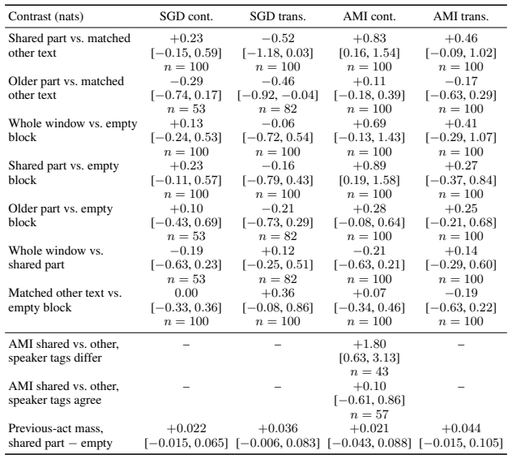
Table 11 : Follow-up decomposition of the unlabelled lag-1 window into the part already inside the query window and the older part (one model; new queries not used in the control above). Placebos are token-matched excerpts from other dialogues; all length checks passed. The speaker-tag strata are descriptive and not randomised.
出典 · CC BY 4.0 · Ali Amini, Masoumeh Chapariniya, Rytis Maskeliunas, Robertas Damaševičius · The Neighbour's Label: Opposite Subgroup Effects of Same-Dialogue Exposure in Next-Act Evaluation · 論文の図を引用 · 元のPDFの18ページ目から図の部分を抽出しています。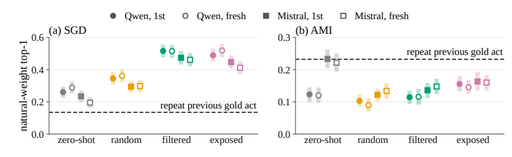
Figure 8 : Cost of the filter: natural-weight top-1 accuracy by demonstration condition (categories, not a sequence) for each model and sample, with 95% cluster-bootstrap intervals (bands); dashed: repeating the previous gold act, a baseline in Setting B, inadmissible in Setting A. Values: Table 12.
出典 · CC BY 4.0 · Ali Amini, Masoumeh Chapariniya, Rytis Maskeliunas, Robertas Damaševičius · The Neighbour's Label: Opposite Subgroup Effects of Same-Dialogue Exposure in Next-Act Evaluation · 論文の図を引用 · 元のPDFの19ページ目から図の部分を抽出しています。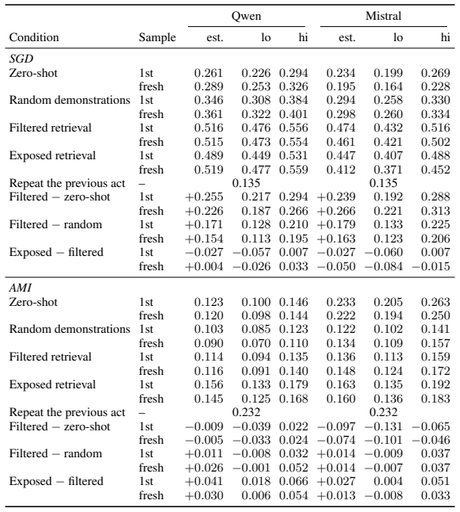
Table 12 : Utility of the provenance filter: top-1 accuracy at natural cell weights (levels, then paired differences) with 95% cluster-bootstrap bounds. Repeating the previous act scores 1 on continuations and 0 on transitions, so its natural-weight accuracy equals the continuation share. It is an admissible model only when the previous act is genuinely observed.
出典 · CC BY 4.0 · Ali Amini, Masoumeh Chapariniya, Rytis Maskeliunas, Robertas Damaševičius · The Neighbour's Label: Opposite Subgroup Effects of Same-Dialogue Exposure in Next-Act Evaluation · 論文の図を引用 · 元のPDFの19ページ目から図の部分を抽出しています。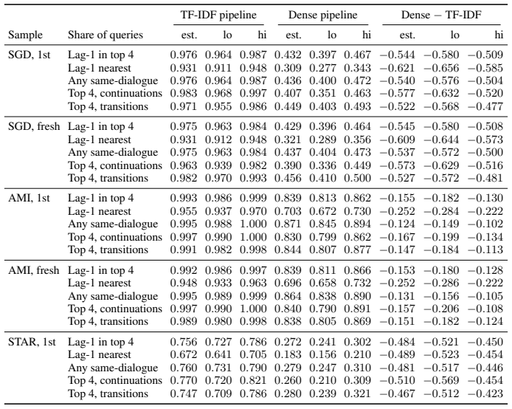
Table 14 : Retrieval structure under two pipelines (750 queries per sample; SGD and STAR clusters are dialogues or near-duplicate groups, AMI clusters are meeting series), with 95% cluster-bootstrap bounds. For SGD and AMI, the dense-only lag-1 retrieval count was zero in both the first and fresh samples (0 of 750 queries per corpus and sample). No language model was run on dense-retrieved demonstrations.
出典 · CC BY 4.0 · Ali Amini, Masoumeh Chapariniya, Rytis Maskeliunas, Robertas Damaševičius · The Neighbour's Label: Opposite Subgroup Effects of Same-Dialogue Exposure in Next-Act Evaluation · 論文の図を引用 · 元のPDFの20ページ目から図の部分を抽出しています。この論文を引用
Ali Amini, Masoumeh Chapariniya, Rytis Maskeliunas, Robertas Damaševičius (2026). The Neighbour's Label: Opposite Subgroup Effects of Same-Dialogue Exposure in Next-Act Evaluation. arXiv:2611.15194v1. https://arxiv.org/abs/2611.15194v1
BibTeX
@misc{amini2026neighbour,
  title = {{The Neighbour's Label: Opposite Subgroup Effects of Same-Dialogue Exposure in Next-Act Evaluation}},
  author = {Ali Amini and Masoumeh Chapariniya and Rytis Maskeliunas and Robertas Damaševičius},
  year = {2026},
  eprint = {2611.15194},
  archivePrefix = {arXiv},
  url = {https://arxiv.org/abs/2611.15194v1}
}