논문 해설
Controlling the Probability of Unknown Unknowns in Pre-Deployment Testing of AI Systems
AI 시스템의 배포 전 테스트에서 알려지지 않은 미지의 위험이 나타날 확률 통제하기
- 연구 문제 배포 전 테스트에서 아직 보지 못한 실패 모드가 남을 확률을 언제 충분히 작다고 판단할지가 어렵습니다.
- 연구 방법 Good-Turing missing mass 추정을 순차 설정으로 확장하고, 베팅 과정 혼합으로 임의 정지 시점에서도 유효한 상한을 만듭니다.
- 주요 결과 SWE-Chat에서 제안 상한은 다중 검정 보정 Good-Turing 상한보다 좁았고, 시간 동시 커버리지는 t=3000까지 0.973을 기록했습니다.
미관측 실패 확률을 언제 믿고 멈출 것인가
AI 에이전트의 배포 전 테스트에서는 이미 본 실패 모드는 수정하거나 대비할 수 있지만, 아직 나타나지 않은 미지의 실패(unknown unknowns)는 다루기 어렵습니다. 테스트를 계속하면 시간과 비용이 들고, 멈추면 발견되지 않은 실패가 남습니다. 그래서 개발자가 충분히 테스트했는지 판단할 기준이 필요합니다. 이 논문은 다음 출력이 이전에 보지 못한 실패 모드일 확률인 missing mass를 데이터에 따라 멈춰도 유효한 상한으로 추정하는 문제를 다룹니다.
고전적인 Good-Turing 추정은 고정된 표본 크기에서 missing mass를 추정합니다. 저자들은 이 문제를 관측과 추정이 번갈아 일어나는 순차적 설정으로 확장했습니다. 여기서 missing mass는 시간이 지날수록 줄어들며, 그 상한은 임의의 데이터 의존 정지 시점에서도 성립해야 합니다.
베팅 과정을 이용한 신뢰 수열
입력 X_t는 목표 배포 분포 P에서 독립적으로 뽑히고, 시스템 출력 A_t에 대해 fail 함수로 실패 여부를, unseen 함수로 이전 실패 이력 H_{t-1}에 비춰 새로운 실패 모드인지를 판정합니다. 두 지시자의 곱이 1인 경우가 미관측 실패 사건입니다. unseen은 이력이 늘어날수록 값이 작아지는 단조성과, 이미 이력에 있는 출력에 대해 0이 되는 조건을 만족해야 합니다.
Algorithm 1은 각 λ에 대해 관측값으로 베팅 이득 E^λ_{s:t}를 누적하고, 시작 시점이 다른 베팅 과정을 가중 혼합해 M_t(u)를 만듭니다. U_t(α)는 M_t(u)가 1/α보다 작은 가장 큰 u로 정의되며, 이 상한이 임계값 ε보다 작아지면 테스트를 멈춥니다. 저자들은 실패 확률이 줄어들면 이득이 커지는 구조를 사용해 정지를 설계했습니다. 혼합에서는 λ를 [0,1]에서 균등하게 두고 실제로는 유한 격자로 근사합니다.
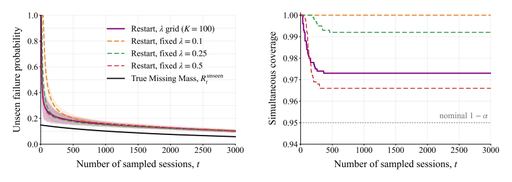
Figure 9 : Sensitivity to the choice of betting parameter λ. We compare the finite-grid mixture used in the main results with fixed choices λ ∈ { 0.1, 0.25, 0.5}. (a) Anytime-valid upper bounds on the unseen-failure probability together with the true missing mass. The grid mixture performs similarly to the fixed- λ alternatives across the evaluation horizon. (b) Empirical simultaneous coverage through time t. All choices remain above the nominal level 1 − α = 0.95 throughout the evaluation horizon.
원문 · CC BY 4.0 · Rachel Li, Chris Hays, Aaditya Ramdas, Manish Raghavan · Controlling the Probability of Unknown Unknowns in Pre-Deployment Testing of AI Systems · 원문 그림 인용 · 원본 PDF 50쪽에서 그림 영역을 추출했습니다.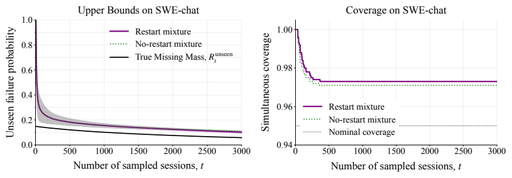
Figure 10 : Minimal benefit of restart-mixing on SWE-Chat. We compare the restart mixture (solid purple) with a non-restarted betting process (dotted green), using the same equally weighted grid of 100 lambda values and α = 0 .05. Left: mean upper confidence bounds across 1,000 paired trials, with shaded bands showing the empirical 2.5th97.5th percentiles; black denotes the true unseen-failure probability. Right: empirical simultaneous coverage, which is 0.973 with restarts and 0.971 without restarts through 3,000 draws, both above the nominal 0.95 level. Restarting yields modestly tighter bounds on this dataset.
원문 · CC BY 4.0 · Rachel Li, Chris Hays, Aaditya Ramdas, Manish Raghavan · Controlling the Probability of Unknown Unknowns in Pre-Deployment Testing of AI Systems · 원문 그림 인용 · 원본 PDF 50쪽에서 그림 영역을 추출했습니다.동시 커버리지와 정지 시간 보장
Theorem 3.2는 모든 t에 대해 R_t가 U_t(α) 이하일 확률이 적어도 1−α라고 주장합니다. 증명은 베팅 과정이 비음수 상위마팅게일임을 보이고 Ville 부등식을 적용하는 방식입니다. 이 증명은 R_t가 시간에 따라 줄어든다는 단조성에 의존합니다.
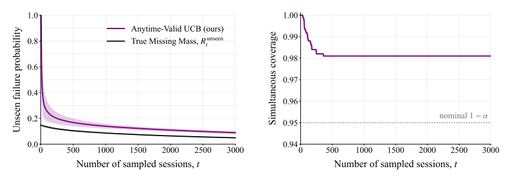
Figure 6 : Our method remains valid under an online embedding-based failure novelty rule , where a failure is considered unseen when its failure-mode description is insufficiently similar to all previously observed failures under the online embedding-based matching rule. (a) Anytime-valid upper bound on the unseen-failure probability, together with the true unseen-failure probability defined by the same online novelty rule. Solid line is the mean, shaded bands show 2.5th-97.5th percentiles across trials. (b) Empirical simul- taneous coverage through time t. Coverage remains above the nominal level 1 − α = 0 .95 throughout the evaluation horizon.
원문 · CC BY 4.0 · Rachel Li, Chris Hays, Aaditya Ramdas, Manish Raghavan · Controlling the Probability of Unknown Unknowns in Pre-Deployment Testing of AI Systems · 원문 그림 인용 · 원본 PDF 48쪽에서 그림 영역을 추출했습니다.Theorem 3.3은 Algorithm 1이 거의 확실하게 멈추며, 실패 확률이 γ 아래로 내려간 시점 T_γ 이후 지연이 로그 규모에 그친다고 말합니다. 하한은 특정 구성의 분포 조건에서 정지 지연이 줄어들 수 없음을 보이는 것이며, 이 조건 밖에서의 일반적 최적성으로 확대하지는 않습니다.
SWE-Chat 실험 결과
SWE-Chat의 5,001개 세션에서 실패 여부는 원래 점수 70 미만인 후보를 최신 판정 모델로 다시 확인해 정했고, 고정 분류 체계로 538개 범주를 만들었습니다. 1,000회 시행에서 표본은 복원 추출되었고 α=0.05로 설정했습니다.
제안 상한은 다중 검정 보정 Good-Turing 상한과 고정 시점 Good-Turing 상한보다 더 좁았습니다. 시간 동시 커버리지는 t=3000까지 0.973으로 명목 수준 0.95보다 높았습니다. 반면 Good-Turing 기준선은 이 실험에서 커버리지가 1이었습니다. 합성 최악 분포에서는 10,000회 시행의 커버리지가 0.9587로 명목 수준을 웃돌았습니다.
정의와 비용에 대한 한계
저자들은 유효성과 유용성이 fail과 unseen의 정의에 의존한다고 밝힙니다. 실패의 비용은 고려하지 않으며, 발생 확률이 매우 낮지만 피해가 큰 실패는 샘플링으로 충분히 다룰 수 없다고 적습니다. 또한 실험은 공개 데이터, 고정 분류 체계, LLM 판정기를 사용했으므로 민감한 비공개 데이터와 사람이 만든 정의에 그대로 옮겨 말할 수는 없습니다.
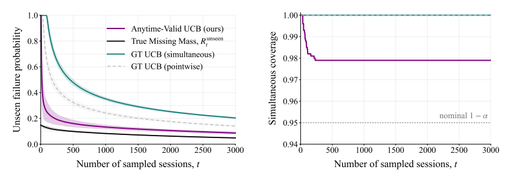
Figure 8 : Robustness to an alternative LLM-based fixed taxonomy. We repeat the main statistical evaluation using a second fixed taxonomy constructed by an LLM-based grouping procedure rather than the clustering-based taxonomy used in the main results. (a) Anytime-valid upper bound on the unseen-failure probability, together with the true missing mass and the simultaneous and pointwise Good-Turing UCBs. Solid lines show the mean, and shaded bands show the 2.5th-97.5th percentiles across trials. (b) Empirical simultaneous coverage through time t. Our method remains above the nominal level 1 − α = 0.95 throughout the evaluation horizon; both Good–Turing bounds achieve coverage of 1.
원문 · CC BY 4.0 · Rachel Li, Chris Hays, Aaditya Ramdas, Manish Raghavan · Controlling the Probability of Unknown Unknowns in Pre-Deployment Testing of AI Systems · 원문 그림 인용 · 원본 PDF 49쪽에서 그림 영역을 추출했습니다.논문 정보
- 저자
- Rachel Li, Chris Hays, Aaditya Ramdas, Manish Raghavan
- 학회·저널
- arXiv · 프리프린트
- 최초 공개일
- 2026년 11월 11일
- 등록일
- 2026년 11월 13일
- 수정일
- 2026년 11월 11일
- 버전
- v1
- arXiv
- 2611.15835
- 분류
- cs.AI · cs.CY · math.ST
- 원문 이용 조건
- CC BY 4.0
- 제공 범위
- 논문 정보, 해설, 허용된 원문 그림
AI 해설은 논문 원문과 별개의 설명이며 오류가 있을 수 있습니다. 원문과 그림은 각 출처의 이용 조건과 따로 표시된 권리를 따릅니다.
초록
In pre-deployment testing of AI systems such as AI agents, a developer can often deal with known failure modes (e.g., leaking API keys, deleting important databases, or installing a malicious package) by implementing fixes or making contingency plans for when the same issue might occur again. What is more challenging are the unknown unknowns: the unseen failure modes that haven't surfaced during testing. The decision to stop testing and deploy therefore faces an inherent tradeoff: continue testing to observe more behaviors, at the cost of time and resources, or stop testing and deploy, at the risk of failure modes remaining undiscovered. How then does the developer decide when they have tested enough? To answer this, we develop an algorithm that certifies when the probability of observing an unseen failure mode is sufficiently small. The algorithm constructs an anytime-valid upper confidence sequence on this quantity, so the developer can repeatedly test a system, inspect the bound, and decide to stop when it falls below a chosen threshold without invalidating the statistical guarantee. Our problem can be interpreted as a sequential variant of the missing-mass estimation problem which gave rise to the classic Good-Turing estimator (Good, 1953). On SWE-Chat, a dataset of real-world coding agent traces (Baumann et al., 2026), we implement our procedure and show that it achieves tighter upper bounds than a simple multiple-testing corrected Good-Turing baseline, and even dominates a fixed-horizon (non-multiple-testing-corrected) Good-Turing upper confidence bound, which is not anytime valid. Additionally, to better match realistic evaluation pipelines, we extend our method to handle sampling from a different task distribution and imperfect automated failure labeling.
원문 인용
Rachel Li, Chris Hays, Aaditya Ramdas, Manish Raghavan (2026). Controlling the Probability of Unknown Unknowns in Pre-Deployment Testing of AI Systems. arXiv:2611.15835v1. https://arxiv.org/abs/2611.15835v1
BibTeX
@misc{li2026controlling,
  title = {{Controlling the Probability of Unknown Unknowns in Pre-Deployment Testing of AI Systems}},
  author = {Rachel Li and Chris Hays and Aaditya Ramdas and Manish Raghavan},
  year = {2026},
  eprint = {2611.15835},
  archivePrefix = {arXiv},
  url = {https://arxiv.org/abs/2611.15835v1}
}