논문 해설
Consistent Video-to-Video Translation via Explicit Correspondences
명시적 대응 관계를 활용한 일관된 비디오-투-비디오 번역
- 연구 문제 슬라이딩 윈도우 밖으로 나간 대상을 자기회귀 비디오 번역이 잊어버려 장기 일관성이 깨집니다.
- 연구 방법 입력 영상의 패치 대응으로 과거 출력 패치를 검색하고 교차 주의로 디퓨전 트랜스포머에 주입합니다.
- 주요 결과 VACE-Bench 재방문 LPIPS를 Rolling Forcing 5 스텝 기준 0.427에서 0.240으로 낮췄습니다(DL3DV는 0.445에서 0.305).
슬라이딩 윈도우 밖의 기억 손실
실시간 비디오-비디오 번역은 스트리밍, 게임, AR/VR처럼 입력을 받으면서 즉시 출력해야 하는 응용에서 쓰입니다. 자기회귀 생성은 과거 프레임을 문맥으로 써야 시간적 연속성을 유지할 수 있습니다. 그런데 과거 출력을 모두 남기면 메모리는 길이에 비례해 늘고 연산은 길이에 따라 제곱에 가깝게 늘어납니다. 그래서 많은 방법은 최근 W개의 잠재 프레임만 보는 sliding window를 씁니다. 이 방식은 프레임당 메모리와 연산을 일정하게 묶어 주지만, 윈도우 밖으로 나간 대상은 모델이 다시 참조할 수 없습니다. 저자들은 이 한계가 입력 영상에서 같은 영역이 다시 나타날 때 출력 외형이 달라지는 형태로 드러난다고 봅니다.
초기 프레임을 전역 문맥으로 두는 attention sink는 나중에 새로 나타나는 내용을 포착하지 못한다고 비교합니다. 이 논문이 다루는 질문은 입력 영상 자체의 대응을 이용해 윈도우 밖의 과거 출력을 다시 찾을 수 있는지입니다.
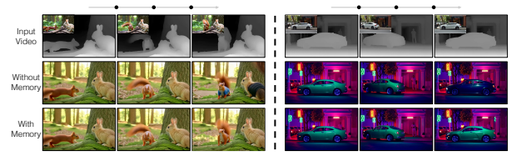
Fig.1 : Long-range consistency without long context windows.Standard auto- regressive video translation forgets content once it falls outside its context window (middle row). Our proposed methodvid2vid-long(bottom row) explicitly retrieves matching past outputs when the inputs recur, maintaining consistency over long videos. Please see the supplement for a large grid of qualitative result videos.
원문 · CC BY 4.0 · Gaurav Parmar, Zhengqi Li, Richard Zhang, Jun-Yan Zhu, Srinivasa Narasimhan, Eli Shechtman, Yotam Nitzan · Consistent Video-to-Video Translation via Explicit Correspondences · 원문 그림 인용 · 원본 PDF 2쪽에서 그림 영역을 추출했습니다.입력 대응으로 과거 출력 찾기
핵심 관찰은 입력 영상에서 서로 맞는 영역은 출력에서도 맞아야 한다는 것입니다. vid2vid-long은 입력 잠재 패치를 검색 키로, 생성된 출력 잠재 패치를 값으로 저장하는 키-값 메모리를 둡니다. 키는 VAE 잠재 패치 자체이며, 별도의 특징 추출기를 쓰지 않습니다. 메모리 크기는 영상 길이가 아니라 새로운 시각 정보가 나타나는 정도에 따라 커집니다. 즉 같은 장면이 반복되면 새 항목이 적게 쌓입니다. 이렇게 하면 윈도우 밖의 대상도 입력에서 같은 위치를 찾아 그 출력 값을 다시 쓸 수 있습니다.

Table 10 : Ablation of the feature extractorϕ.We compare three choices for computing patch descriptors: VAE latent features, DINOv2, and CLIP. VAE latent features achieve the best reconstruction on VACE-Bench and competitive performance on DL3DV, without requiring an external feature model. All variants usek=3retrieved neighbors.
원문 · CC BY 4.0 · Gaurav Parmar, Zhengqi Li, Richard Zhang, Jun-Yan Zhu, Srinivasa Narasimhan, Eli Shechtman, Yotam Nitzan · Consistent Video-to-Video Translation via Explicit Correspondences · 원문 그림 인용 · 원본 PDF 22쪽에서 그림 영역을 추출했습니다.메모리 읽기와 쓰기 규칙
쓰기 규칙은 새로 생성된 각 잠재 패치의 키가 기존 메모리와 가지는 최대 코사인 유사도를 계산합니다. 이 값이 τh보다 작을 때만 키-값 쌍을 저장하므로, 이미 충분히 표현된 패치는 건너뜁니다. 빈 메모리에서는 첫 블록의 모든 패치가 저장됩니다. 읽기 규칙은 블록을 생성하기 전에 현재 입력 잠재 패치마다 메모리에서 코사인 유사도 상위 k개를 찾고, 유사도가 τm 이상인 항목만 사용합니다. 실험 설정은 k=3, τh=0.75, τm=0.75입니다. 조건을 만족하는 항목이 없으면 유효 마스크가 0이 되어 그 토큰의 교차 주의 출력도 0이 됩니다. 검색은 블록당 한 번 수행되고, 그 결과는 모든 디노이징 스텝에서 재사용됩니다.
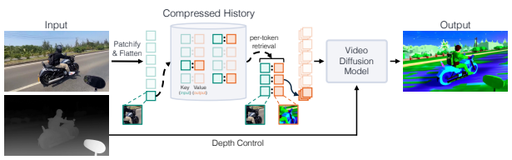
Fig.2 : Correspondence-based video translation.The memory is populated with input-output correspondence pairs from previous generations. To support the consis- tent translation of the next block of frames, we first retrieve from memory the output patcheswhosecorrespondinginputismostsimilartothecurrent.Theseoutputpatches, together with the normal input signal, is the input to our video diffusion model. Based on the new induced input-output pairs, we write to memory only those that are suffi- ciently different from existing.
원문 · CC BY 4.0 · Gaurav Parmar, Zhengqi Li, Richard Zhang, Jun-Yan Zhu, Srinivasa Narasimhan, Eli Shechtman, Yotam Nitzan · Consistent Video-to-Video Translation via Explicit Correspondences · 원문 그림 인용 · 원본 PDF 3쪽에서 그림 영역을 추출했습니다.
Table 7 : Hyperparameter analysis.We show the effects of varying the thresholds τh andτ m on our method. As the thresholdτh is increased, our method stores more patches in the history bankHand improves the reconstruction performance.
원문 · CC BY 4.0 · Gaurav Parmar, Zhengqi Li, Richard Zhang, Jun-Yan Zhu, Srinivasa Narasimhan, Eli Shechtman, Yotam Nitzan · Consistent Video-to-Video Translation via Explicit Correspondences · 원문 그림 인용 · 원본 PDF 20쪽에서 그림 영역을 추출했습니다.correspondence cross-attention으로 조건 주입
검색된 출력 패치는 입력 잠재와 같은 패치 임베딩을 거쳐 이력 토큰이 됩니다. 이 토큰들은 각 트랜스포머 블록에서 자기 주의와 텍스트 교차 주의 사이에 추가된 correspondence cross-attention 레이어로 들어갑니다. 각 토큰은 자기 k개의 이웃에만 주의를 기울이고, 출력에 유효 마스크를 곱한 뒤 잔차로 더합니다. 출력 투영 Wo는 0으로 초기화되어, 학습 시작 시점에는 pre-training VACE의 동작을 바꾸지 않습니다. 구현은 쿼리와 메모리 텐서의 시퀀스 길이를 배치 차원으로 옮겨, 토큰마다 독립적인 1×k 연산으로 처리합니다.
distillation 학습 설정
기본 설정은 Rolling Forcing distillation을 5 스텝으로 쓰는 것입니다. 저자들은 이 목표를 수정하지 않았고 추가 손실 항도 넣지 않았습니다. 학습 중에도 학생 모델은 자신이 앞서 생성한 블록에서 대응을 검색하고, 새 패치를 임계값 규칙에 따라 기록합니다. 이 값은 VACE 1.3B 학생과 Rolling Forcing 기준 설정이며, 다른 자기회귀 백본에 같은 값을 적용했다고 명시된 부분은 확인되지 않았습니다.
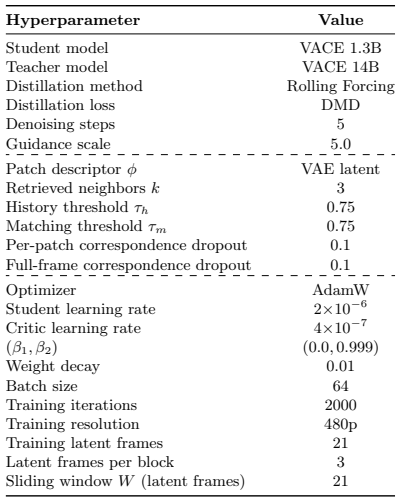
Table 9 :Training and model hyperparameters.
원문 · CC BY 4.0 · Gaurav Parmar, Zhengqi Li, Richard Zhang, Jun-Yan Zhu, Srinivasa Narasimhan, Eli Shechtman, Yotam Nitzan · Consistent Video-to-Video Translation via Explicit Correspondences · 원문 그림 인용 · 원본 PDF 21쪽에서 그림 영역을 추출했습니다.재방문 일관성과 V-Bench 비교
VACE-Benchmark의 ABAB 구성에서 Rolling Forcing 5 스텝은 LPIPS 0.427, DreamSim 0.172, CLIP-Sim 0.905를 기록했습니다. 같은 백본에 correspondence 메커니즘을 더한 Ours 5 스텝은 LPIPS 0.240, DreamSim 0.066, CLIP-Sim 0.955를 기록했습니다. DL3DV에서는 Rolling Forcing 5 스텝의 LPIPS가 0.445였고, Ours 5 스텝은 0.305였습니다. 세 자기회귀 백본에 메커니즘을 더한 Table 3에서 VACE-Bench LPIPS는 Self-Forcing 0.548에서 0.343으로, LongLive 0.511에서 0.272로, Rolling Forcing 0.427에서 0.240으로 낮아졌습니다.
같은 표에서 Rolling Forcing의 V-Bench 품질 평균은 VACE-Bench 0.799에서 0.828로, DL3DV 0.806에서 0.821로 올랐습니다. 이 수치들은 VACE 1.3B를 기본 백본으로 하고 깊이 조건으로 얻은 값입니다. 양방향 VACE 기준선과의 비교에서는 Self-Forcing과 LongLive가 VACE-Bench 장기 재구성에서 VACE보다 낮았고, Rolling Forcing은 약간만 앞섰습니다.
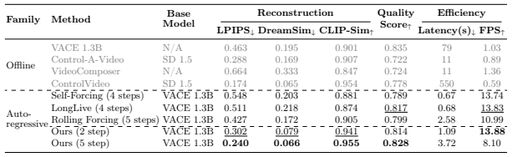
Table 1 : Quantitative evaluation on depth-to-video translation.We report long-context reconstruction metrics (LPIPS, DreamSim, CLIP-Sim), quality scores (V- Bench), and inference efficiency. Offline methods are shown in gray on the top and distillation based autoregressive methods are shown at the bottom. The best method in each column is marked in bold and the second best method is marked in underline.
원문 · CC BY 4.0 · Gaurav Parmar, Zhengqi Li, Richard Zhang, Jun-Yan Zhu, Srinivasa Narasimhan, Eli Shechtman, Yotam Nitzan · Consistent Video-to-Video Translation via Explicit Correspondences · 원문 그림 인용 · 원본 PDF 8쪽에서 그림 영역을 추출했습니다.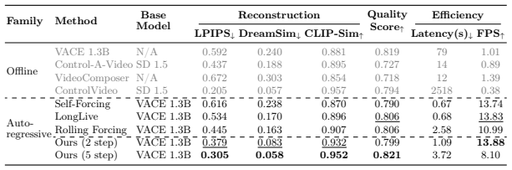
Table 2 : Quantitative evaluation on depth-to-video translation (DL3DV). We report long-context reconstruction metrics (LPIPS, DreamSim, CLIP-Sim), quality scores (V-Bench), and inference efficiency. Offline methods (gray) are shown on the top and distillation based autoregressive methods are in the bottom.The best method in each column is marked in bold and the second best method is marked in underline.
원문 · CC BY 4.0 · Gaurav Parmar, Zhengqi Li, Richard Zhang, Jun-Yan Zhu, Srinivasa Narasimhan, Eli Shechtman, Yotam Nitzan · Consistent Video-to-Video Translation via Explicit Correspondences · 원문 그림 인용 · 원본 PDF 9쪽에서 그림 영역을 추출했습니다.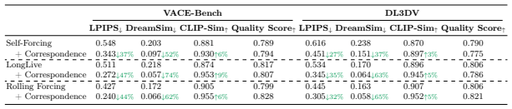
Table 3 : Sensitivity to the distillation method.Our correspondence mechanism consistently improves long-context reconstruction across all three autoregressive distil- lation methods, with minimal impact on quality. The base model used is VACE 1.3B.
원문 · CC BY 4.0 · Gaurav Parmar, Zhengqi Li, Richard Zhang, Jun-Yan Zhu, Srinivasa Narasimhan, Eli Shechtman, Yotam Nitzan · Consistent Video-to-Video Translation via Explicit Correspondences · 원문 그림 인용 · 원본 PDF 9쪽에서 그림 영역을 추출했습니다.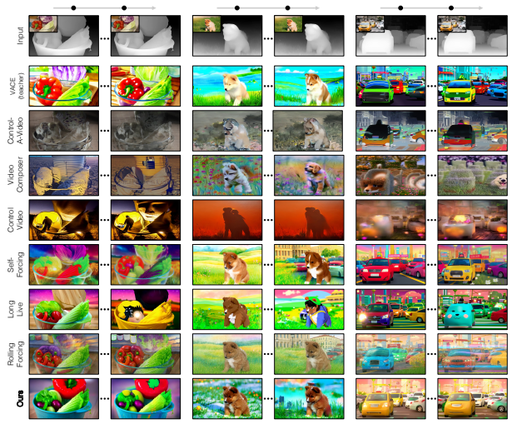
Fig.3 : Qualitative comparisons.We show two frames sampled far apart in time for three example videos (left and right). Bidirectional methods (VACE 1.3B) and Autoregressive distillation methods produce high-quality individual frames but fail to maintain object identity over long durations. Adding our correspondence mechanism preserves consistent appearance throughout the video.
원문 · CC BY 4.0 · Gaurav Parmar, Zhengqi Li, Richard Zhang, Jun-Yan Zhu, Srinivasa Narasimhan, Eli Shechtman, Yotam Nitzan · Consistent Video-to-Video Translation via Explicit Correspondences · 원문 그림 인용 · 원본 PDF 10쪽에서 그림 영역을 추출했습니다.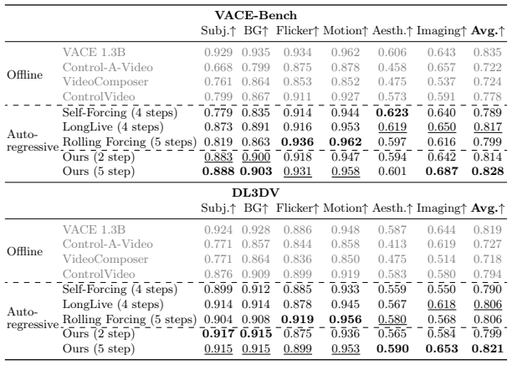
Table 12 : Per-metric V-Bench quality scores.We report individual normalized V-Bench [13] metrics for all methods on both benchmarks. The rightmost column shows the average across all six metrics (reported as the aggregate quality score in the main paper). Best among autoregressive methods isbold, second best is underlined.
원문 · CC BY 4.0 · Gaurav Parmar, Zhengqi Li, Richard Zhang, Jun-Yan Zhu, Srinivasa Narasimhan, Eli Shechtman, Yotam Nitzan · Consistent Video-to-Video Translation via Explicit Correspondences · 원문 그림 인용 · 원본 PDF 25쪽에서 그림 영역을 추출했습니다.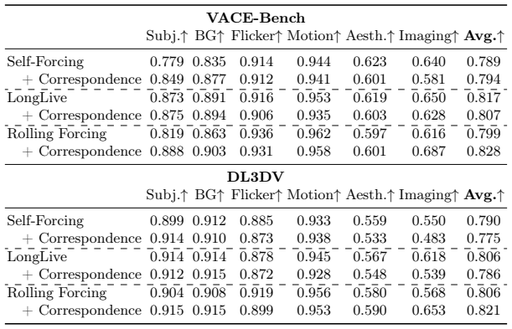
Table13 :Per-metricV-Benchqualityscoresforeachdistillationmethod.We report individual normalized V-Bench [13] metrics for each autoregressive distillation backbone with and without our correspondence mechanism. Adding correspondences maintains comparable overall visual quality across different autoregressive backbones, with some variations in individual metrics.
원문 · CC BY 4.0 · Gaurav Parmar, Zhengqi Li, Richard Zhang, Jun-Yan Zhu, Srinivasa Narasimhan, Eli Shechtman, Yotam Nitzan · Consistent Video-to-Video Translation via Explicit Correspondences · 원문 그림 인용 · 원본 PDF 26쪽에서 그림 영역을 추출했습니다.대응 패치 제거와 대안 메커니즘
대응 교차 주의를 끈 변형은 VACE-Bench에서 LPIPS 0.379, DL3DV에서 LPIPS 0.437을 기록했습니다. 전체 방법은 같은 설정에서 각각 0.240과 0.305였습니다. 품질 점수는 두 설정이 비슷해서 VACE-Bench에서 0.829 대 0.828, DL3DV에서 0.822 대 0.821로 나타났습니다. 따라서 이 비교에서 대응 토큰은 주로 재구성 일관성을 바꾸고 품질 점수는 크게 바꾸지 않았습니다. 무작위 검색은 VACE-Bench LPIPS 0.396, DL3DV LPIPS 0.451이었습니다. FramePack은 VACE-Bench LPIPS 0.304였으며, 저자들은 과거 블록의 공간 압축이 세부 정보를 줄여 재구성을 약하게 만든다고 해석합니다.
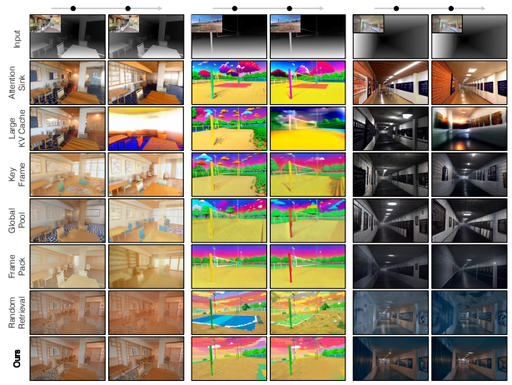
Fig.4 : Comparing to alternate consistency mechanisms.We compare different strategies for extending the temporal context beyond sliding window, including enlarg- ing the KV cache, keyframe retention, global pooling, FramePack [53] compression, and random retrieval. While these approaches provide partial improvements, they suffer for loss of details or quality degradation under long-range revisits. In contrast, our cor- respondence based method (bottom row) enables accurate reuse of historical content and preserving consistency over long time horizons.
원문 · CC BY 4.0 · Gaurav Parmar, Zhengqi Li, Richard Zhang, Jun-Yan Zhu, Srinivasa Narasimhan, Eli Shechtman, Yotam Nitzan · Consistent Video-to-Video Translation via Explicit Correspondences · 원문 그림 인용 · 원본 PDF 11쪽에서 그림 영역을 추출했습니다.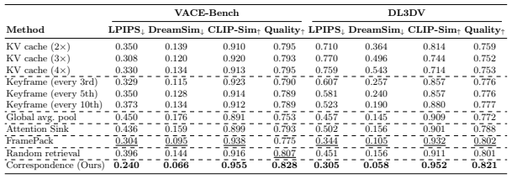
Table 4 : Comparison of alternate consistency mechanisms.We compare several strategies for extending temporal context beyond the default sliding window (W=21): increasing the KV cache window size, retaining everyN-th keyframe, maintaining a global average-pooled KV cache, Attention Sinks, and FramePack. While larger win- dows and keyframe retention provide modest reconstruction gains, our correspondence- based retrieval achieves substantially better long-range consistency.
원문 · CC BY 4.0 · Gaurav Parmar, Zhengqi Li, Richard Zhang, Jun-Yan Zhu, Srinivasa Narasimhan, Eli Shechtman, Yotam Nitzan · Consistent Video-to-Video Translation via Explicit Correspondences · 원문 그림 인용 · 원본 PDF 12쪽에서 그림 영역을 추출했습니다.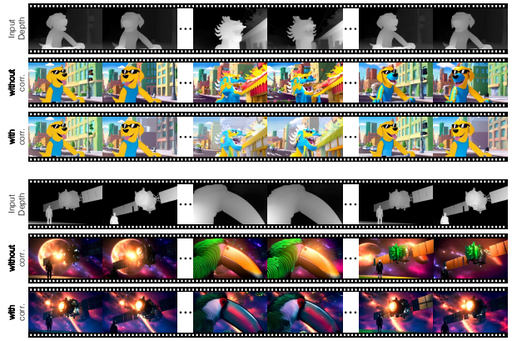
Fig.5 : Effect of correspondence pointers on long-range consistency.Without correspondence pointers, the model generates plausible but inconsistent frames. Object appearancedriftsovertime.Considerthetopexample,thedogstartsoffhavingayellow snout, but it changes to blue when it re-appears. With correspondence pointers, the model retrieves and reuses visual context from earlier frames, maintaining consistent identity throughout the video. For example in the top video, the dog snout is yellow at the beginning of the video. However it turns into a blue snout when reappearing if correspondence is not used. However it stays consistently yellow with our method.
원문 · CC BY 4.0 · Gaurav Parmar, Zhengqi Li, Richard Zhang, Jun-Yan Zhu, Srinivasa Narasimhan, Eli Shechtman, Yotam Nitzan · Consistent Video-to-Video Translation via Explicit Correspondences · 원문 그림 인용 · 원본 PDF 14쪽에서 그림 영역을 추출했습니다.한계와 적용 조건
저자들이 밝힌 한계는 두 가지입니다. 첫째, 움직임이 빠른 영상에서는 신뢰할 수 있는 교차 프레임 대응을 세우기 어려워 모델이 어려움을 겪습니다. 둘째, 텍스트 프롬프트가 입력 깊이 영상과 맞지 않으면 의미 조건과 구조 조건이 충돌하므로 실패할 수 있습니다. 제공된 실험 표에는 빠른 움직임만 따로 나눈 결과가 없습니다. 실험은 VACE-Benchmark와 DL3DV에서 깊이 조건 중심으로 이루어졌고, 스케치와 광학 흐름 조건은 부록에서 별도로 확인했습니다. 메모리 크기는 새 내용이 많을수록 커지므로 길이와 무관하게 상수는 아닙니다.
논문 정보
- 저자
- Gaurav Parmar, Zhengqi Li, Richard Zhang, Jun-Yan Zhu, Srinivasa Narasimhan, Eli Shechtman, Yotam Nitzan
- 학회·저널
- arXiv · 프리프린트
- 최초 공개일
- 2026년 11월 12일
- 등록일
- 2026년 11월 14일
- 수정일
- 2026년 11월 12일
- 버전
- v1
- arXiv
- 2611.17298
- 분류
- cs.CV · cs.AI · cs.GR · cs.LG
- 원문 이용 조건
- CC BY 4.0
- 제공 범위
- 논문 정보, 해설, 허용된 원문 그림
AI 해설은 논문 원문과 별개의 설명이며 오류가 있을 수 있습니다. 원문과 그림은 각 출처의 이용 조건과 따로 표시된 권리를 따릅니다.
초록
Interactive video-to-video applications require real-time generation while maintaining long-range temporal consistency. However, recent methods achieve speed by restricting attention to a fixed-length causal window. This limits long-range consistency whenever relevant history falls outside the context window. To address this limitation, we introduce vid2vid-long, a correspondence-based approach grounded in a simple observation. Video-to-video translation provides an explicit cross-frame reference: the regions that match in the input video should match in the output video too. Concretely, we compute patch-level correspondences in the input, guiding retrieval of previously generated outputs in the corresponding regions, and condition the model on these patches through correspondence cross-attention. Our experiments demonstrate that vid2vid-long consistently improves long-range temporal consistency across recent video models while preserving generation quality and real-time performance.
원문 인용
Gaurav Parmar, Zhengqi Li, Richard Zhang, Jun-Yan Zhu, Srinivasa Narasimhan, Eli Shechtman, Yotam Nitzan (2026). Consistent Video-to-Video Translation via Explicit Correspondences. arXiv:2611.17298v1. https://arxiv.org/abs/2611.17298v1
BibTeX
@misc{parmar2026consistent,
  title = {{Consistent Video-to-Video Translation via Explicit Correspondences}},
  author = {Gaurav Parmar and Zhengqi Li and Richard Zhang and Jun-Yan Zhu and Srinivasa Narasimhan and Eli Shechtman and Yotam Nitzan},
  year = {2026},
  eprint = {2611.17298},
  archivePrefix = {arXiv},
  url = {https://arxiv.org/abs/2611.17298v1}
}