Paper commentary
Consumer-Time Validity in Stateful AI Runtimes: Verifying Recovered State and Deferred Authority
Stateful AI runtimes can act on state that has since changed
- Problem Runtimes reuse state and permissions across components. Recording a cancellation or approval does not make a later use valid, since the object may have changed.
- Method Consumer-bound recovery contracts make each consumer re-check, at the point of use, the identity its operation depends on, instead of trusting an upstream record.
- Results On a pinned scheduler-case matrix, the allocation-aware repair satisfied 7/7 triggered fault predicates, where upstream PR 61769 satisfied 2/7.
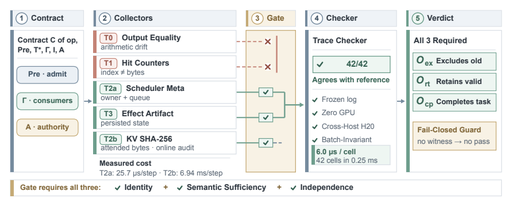
Figure 3 : The verifier evaluates consumer-bound recovery predicates using admissible recorded evidence; enforcement remains in the target runtimes.Contracts determine which predicates must be decided. An admissibility gate rejects Tier 0 (output equality) and Tier 1 (hit counters) for state predicates and admits Tier-2a scheduler metadata and persisted Tier-3 artifacts. These two feed the offline trace verifier, which reads frozen traces, uses no GPU tensors, and takes 6.0µ s per cell. Tier-2b attended-KV digests are admissible evidence but are collected by a separate online audit (Section 5.2), not by the offline verifier. Repairs are separate code in each target system. The three obligations in the verdict panel, Oex, Ort, and Ocp, apply to state-recovery contracts. Authority-freshness predicates are Equations 5 and 6.
Original paper · CC BY 4.0 · Guijia Zhang, Huihao Jing, Bing Li, Shing-Chi Cheung, Harry Yang, Ziqi Zhang · Consumer-Time Validity in Stateful AI Runtimes: Verifying Recovered State and Deferred Authority · Original paper figure · Extracted the figure area from page 13 of the original PDF.Where a valid record goes stale
Stateful LLM serving and agent runtimes reuse execution state across components, so a cancellation, rollback, or approval often gets recorded in one place and used in another. Recording the decision correctly doesn't make the later use valid, because the consumer may act on an object that has changed since the record was made. The authors name the missing step consumer-time validity and split it into two forms, state validity and authority freshness.
The first case runs vLLM with the LMCache connector, where two tenants, ALPHA and BETA, share a cached system-prompt and tool-schema prefix. ALPHA's load was interrupted and the connector reported the failure, but the prefix index still listed the whole shared prefix. When BETA's request arrived, the index reported a full hit, so BETA was admitted onto positions that the aborted load never filled.
In 10/10 native-fault runs, BETA then produced a schema-valid tool call naming ALPHA as its target, even though BETA's session was authenticated. The call was recorded and never executed, so this shows wrong-target generation, not an unauthorized write.
The second case is a multi-session coding agent built on the DSH approval runtime. Session 1 queued a file write at revision κ, Session 2 committed κ+1, and the dispatcher later released Session 1's grant. The principal, path, operation and permission version all still passed, because the dispatcher never read the file's live revision. In one admitted live execution, the stale write overwrote Session 2's newer state.
Checking the consumer's own identity
The key idea is that each consumer re-checks the identity its own operation depends on, instead of trusting an upstream record. The authors package that check into a consumer-bound recovery contract, which states what must hold at the consuming request. For state, the identities are task eligibility and block allocation generation, and for authority they are the principal, permission version and the target's live revision.
Cancellation, reallocation and workspace writes each advance one of these identity spaces.
For a cached prefix, C is the template and tokenizer applied to the retained history and the query, and C_{:r} is its first r tokens. An admission and its continuation satisfy the three evaluated conditions when Q_{:r} equals C_{:r}, SeamOK(e,r) holds, and the range [0,r) lies inside the verified completed range V(x). Token identity is all that a prefix hash certifies, while production completion asks whether the producer wrote every admitted position.
SeamOK is a condition on positions: the host-side and device-side counters must agree where the continuation begins. Meeting the three conditions doesn't make execution correct, because they don't cover every runtime lifecycle failure.
Scheduler metadata and persisted tool artifacts qualify, but output equality and hit counters don't. In a fault-free control, batching alone made the output diverge at token 30, while the attended-KV digests still matched. The authors conclude that output equality can't serve as the test for state validity.
For tool dispatch, a grant names the principal, session, permission version and revision, and Equation 6 requires that revision to be checked against the live revision. The comparison has to sit inside an atomic check-and-write, because a check made earlier leaves a window in which a commit can land.
How the verifier and the repairs run
The offline verifier reads frozen scheduler traces and persisted artifacts with the harness labels removed. It only reports verdicts and enforces nothing, so its results depend on the instrumentation that recorded the evidence. Attended-KV digests come from a separate online audit, because the verifier doesn't take them as inputs.
On the frozen GPU matrix, the verifier agreed with the reference verdicts in 42/42 scenarios. At obligation level, it matched the reference on 159/162 comparable obligations, and all three disagreements were conservative.
Repairs are separate code in each target system, and each one makes the consumer validate an identity of its own. On vLLM, the repair evicts unwritten hashes by allocation, settles preempted owners and rewinds the device position. On DSH, a grant is dispatched only when its revision equals the live revision.
Why eviction and rewind both have to change
On a pinned scheduler-case matrix, the allocation-aware repair satisfied 7/7 triggered fault predicates. Upstream PR 61769 satisfied 2/7, and the authors attribute the gap to its coverage of only the direct-abort path. The uncovered cases were preempted owners and reports aimed at a recycled block.
Only the conjunction met both conditions, which the authors read as necessity on the tested path rather than a general law.
Without the repair, the second tenant's session produced a wrong-target call in 10/10 native-fault runs. The repair restricted admission to the 128 verified tokens, and correct-target calls rose to 10/10. The no-fault baseline also gave 10/10 correct-target calls, so the wrong target appears only with the fault.
The 256-token hit had three spans: 128 written prefix tokens, 128 unwritten tokens whose hashes stayed indexed, and BETA's own body. At the seam the host counted 128 computed tokens while the staged GPU buffer read 288, so positional encodings applied 160 places ahead over the unwritten span. The emitted tenant label was Alpha, and the authors ran no spacer control, so they don't attribute the label to one span.
Deferred grants at the dispatcher
The authors ran eight live episodes across four grant dispositions and two model families, and five reached dispatch. Only the allowed-once disposition released an unrevoked grant whose target had moved, which tests the revision check directly. In that one admitted execution, the dispatcher rechecked principal, path, operation and permission version without reading the revision, and overwrote Session 2's newer state.
The revision-unbound dispatcher overwrote newer state in all 160 conflicting cases, while the revision-bound dispatcher blocked all 160 and applied the 140 valid grants. The comparison is made at dispatch, so it excludes a concurrent write only inside the atomic check-and-write section.
In a seeded dispatcher model over 4,000 episodes, the unbound dispatcher reverted newer writes 1,502 times. These are model episodes rather than agent attacks, and the authors state they don't establish field prevalence.
Clearing state isn't recovery
On ChatGLM2, deleting a branch pruned the visible transcript but left the past_key_values cache intact. Forward-pass tensor digests matched the deleted branch in 9/9 runs. Clearing the cache removed the stale tensors too, but it also stripped every retained turn, because the wrapper rebuilt the prompt from the current round only.
Across six matched conditions, native deletion violated exclusion in 6/6 conditions. Naive clearing satisfied exclusion in 6/6 but dropped retention and completion to 0/6. Prefix reconstruction satisfied all three obligations in 6/6 runs and matched full recomputation. So exclusion alone is not recovery, because a repair that only removes state can pass the check while losing what remains valid.
The unmodified exporter satisfied the post-rewind contract in 3/9 histories and exported rewound turns in the other six. Filtering by rewind epoch, applying an upstream commit, or exporting from reconstructed active events each gave 9/9 compliance across 36 conditions.
Limits
The wrong-target result shows stale admission and call generation, not an unauthorized write, because no backend executed the call. The call would become an unauthorized write only if a backend trusted the model-supplied tenant identifier.
The 42/42 agreement covers recorded traces only, and the Tier-2b digests weren't collected on the 100-run corpus. The serving models are small dense decoders, and mixture-of-experts, FP8 and INT8 setups were untested. Faults were injected at fixed positions, and the live approval evidence is one admitted episode.
The propositions are existence results on pinned stacks and aren't proofs over arbitrary runtimes. The anonymized artifact is planned and isn't public yet.
Paper info
- Authors
- Guijia Zhang, Huihao Jing, Bing Li, Shing-Chi Cheung, Harry Yang, Ziqi Zhang
- Venue
- arXiv · Preprint
- First published
- 2026-11-21
- Added
- 2026-11-24
- Updated
- 2026-11-21
- Version
- v1
- arXiv
- 2611.29004
- Category
- cs.CR · cs.AI · cs.SE
- Original paper terms
- CC BY 4.0
- What we show
- Paper info, commentary and permitted figures from the original paper
AI commentary is a separate explanation from the original paper and may contain errors. The original paper and figures follow each source's terms of use and any rights noted separately.
Abstract
Stateful LLM serving engines and agent runtimes reuse execution state and deferred permissions across components and sessions. A cancellation, rollback, or approval is recorded by one component and relied on by another, and recording it does not make the later use valid: a downstream consumer may read state or dispatch an action whose identity, production status, allocation, or target revision has since changed. We call the missing check consumer-time validity and separate two forms. State validity governs what a consumer reads. On vLLM with LMCache, an interrupted KV load leaves unwritten blocks indexed, and a host-only counter rewind desynchronizes the GPU position, so a second tenant generates a schema-valid tool call naming the wrong tenant in 10/10 native-fault runs; the call is recorded and not executed. Authority freshness governs what a consumer executes: on a multi-session approval runtime, an unrevoked deferred grant overwrote a newer revision in one admitted live execution. Output equality cannot test state validity: a fault-free run diverges at token 30 through BF16 batching alone while attended-KV digests match. We therefore specify consumer-bound recovery contracts that, for state recovery, jointly require exclusion, retention, and task completion, and an admissible-witness standard realized as a GPU-free offline trace verifier over scheduler metadata and persisted tool artifacts. On recorded traces the verifier agrees with the reference verdicts in 42/42 frozen GPU-matrix scenarios. An allocation-aware repair satisfies 7/7 triggered vLLM fault predicates on a pinned scheduler-case matrix, where upstream PR 61769 satisfies 2/7, and revision-bound dispatch blocks all 160 deterministic conflicting overwrites in a separate dispatcher cohort. Recovery must be checked where state and authority are consumed, with evidence bound to the consuming request.
Quote from the paper
Guijia Zhang, Huihao Jing, Bing Li, Shing-Chi Cheung, Harry Yang, Ziqi Zhang (2026). Consumer-Time Validity in Stateful AI Runtimes: Verifying Recovered State and Deferred Authority. arXiv:2611.29004v1. https://arxiv.org/abs/2611.29004v1
BibTeX
@misc{zhang2026consumer,
  title = {{Consumer-Time Validity in Stateful AI Runtimes: Verifying Recovered State and Deferred Authority}},
  author = {Guijia Zhang and Huihao Jing and Bing Li and Shing-Chi Cheung and Harry Yang and Ziqi Zhang},
  year = {2026},
  eprint = {2611.29004},
  archivePrefix = {arXiv},
  url = {https://arxiv.org/abs/2611.29004v1}
}