Paper commentary
Should the Action Expert Train the VLM? Action-Token Supervision and Gradient Routing in Mixture-of-Transformer VLAs
Gradient insulation in VLA models is not a safe default
- Problem Robot VLA models often block the action expert's gradients from reaching the VLM to protect its pretrained skills. That benefit was never separated from action-token supervision.
- Method The authors vary two switches independently: action-token supervision, and whether expert gradients reach the VLM. Insulation blocks those gradients with a stop-gradient, unlike coupling.
- Results In open-loop driving without action tokens, coupling reduces trajectory error (ADE) by approximately 26% on Public Golden compared with insulation.
Where insulation gets stuck
Many recent VLA models use a Mixture-of-Transformers layout, where a VLM feeds per-layer K/V states to a smaller action expert. The open question is whether the expert's loss should also update the VLM. Letting it do so, which the authors call coupling, lets the backbone learn which information it must keep for precise control.
The common alternative, insulation, blocks those gradients with a stop-gradient or a frozen backbone. Yet full-parameter fine-tuning on a narrow robot distribution can degrade pretrained capabilities regardless of gradient routing. Vision-language co-training is often added to mitigate forgetting, so the extra protection from insulation is unclear.
Insulated recipes also supervise the VLM on discrete action tokens, which target the same behavior the expert models.
Knowledge Insulation reports benefits with FAST action tokens but doesn't test insulation without them. Wall-OSS-0.5 reports stronger action performance from coupled training even when discrete-action objectives are retained. Those systems also differ in recipe, initialization, data and optimization, so their results can't isolate action-token supervision.
The authors therefore vary action-token supervision and expert-to-VLM gradient flow independently, holding semantic co-training fixed.
In open-loop driving, coupling reduces trajectory-prediction error by roughly 25% when action tokens are absent. With action tokens supervised, the two routing choices are nearly indistinguishable. Under joint training, coupling raises closed-loop route progress by approximately 17% with tokens and 40% without them.
Two signals that might stand in for each other
The core idea is that the VLM can learn action-relevant features from two sources: the expert's gradient, or a discrete prediction of the same target actions. The discrete action tokens and the continuous expert encode the same future trajectory, so the token loss can teach the VLM about the same behavior the expert produces. Figure 1 lays out the two independent switches that the study varies.
Coupling sends the flow loss through the layerwise K/V interface, while insulation stops those gradients before they reach the VLM. In both conditions the expert uses the same conditioning mechanism and flow-matching target, so only the backward path differs.
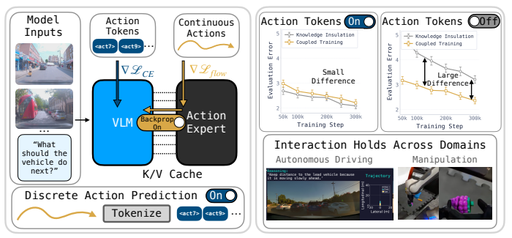
Figure 1 :Action-token supervision shapes the effect of expert-to-VLM gradient flow. Left:the VLM is supervised to predict discrete action tokens while a flow-matching expert decodes continuous actions from the VLM’s K/V cache. We independently vary whether action tokens are supervised and whether the expert’s gradient (∇Lflow) updates the VLM.Right:open-loop driving evaluation error during training. With action-token supervision, insulated and coupled training differ little; without it, coupling is substantially better. We test this interaction in closed-loop autonomous driving and robot manipulation.
Original paper · CC BY 4.0 · Hancock, Asher James, Li, Boyi, Chen, Yuxiao, Tan, Shuhan, Ding, Wenhao, Tian, Thomas, Wang, Yan, Ivanovic, Boris, Pavone, Marco · Should the Action Expert Train the VLM? Action-Token Supervision and Gradient Routing in Mixture-of-Transformer VLAs · Original paper figure · Extracted the figure area from page 2 of the original PDF.If the two signals substitute for each other, coupling should matter little when tokens are supervised and matter a lot when they are not. The study tests that pattern while holding data, architecture, optimization and semantic co-training fixed within each schedule and token setting. It repeats the check across three training schedules: concurrent, VLM-first and expert-first.
The result is meant to show that insulation is a conditional choice rather than a default recipe.
How the expert reads the VLM and what the loss asks for
The driving model pairs a Qwen3-VL-2B-Instruct backbone with a same-width, non-causal flow-matching action expert. At each transformer layer, the expert attends to the key-value representations of the matching VLM layer. The VLM doesn't attend to the expert's continuous action inputs, so information flows in only one direction. A discretized unicycle model integrates these controls, starting from the current ego state, into position and heading waypoints.
Training combines a cross-entropy loss on the VLM with a rectified flow-matching loss on the expert. The joint objective is written as L = L_CE + L_flow, and both loss terms carry unit weight. The flow term asks the velocity output to match a minus epsilon at the noisy point a_t = t a + (1 - t) epsilon. The expert sees the VLM's key-value representations through the term H-tilde_theta, so its velocity depends on the VLM.
The timestep t is sampled from a Beta(1.5, 1.0) distribution and scaled by 0.999.
The two routing conditions differ only in this key-value interface. Coupling sets H-tilde_theta equal to H_theta, so flow gradients reach the VLM. Insulation applies a stop-gradient to H_theta, which passes the same values forward but blocks the flow gradient. Because the forward computation is unchanged, the routing choice changes only what the VLM learns from the flow loss.
With action-token supervision on, the cross-entropy loss also covers the future-action value tokens. The expert's K/V context excludes these future-action token states, so the expert never reads them. With supervision off, those value tokens are masked, but trajectory delimiters stay supervised. The normalizer N keeps the pre-mask count of supervised token positions, which preserves the weight of the other CE terms.
At evaluation the action tokens are never decoded, so they serve only as an auxiliary training signal for the VLM.
Three schedules under one step budget
The study crosses four conditions, with action tokens on or off and coupled or insulated routing, under three training schedules. Concurrent training starts the pretrained VLM and a randomly initialized action expert together from the outset. Expert-first training trains the expert alone for 100k steps against a frozen VLM, so neither action tokens nor routing affect that stage.
Token supervision varies during that VLM-only stage, while gradient routing applies only after the expert arrives.
Every schedule runs for 300k total optimizer steps, and the authors compare checkpoints at that point. Trajectory-bearing batches make up approximately 48.5% of the data, and the VLM updates on every joint step. The expert, however, receives updates only on trajectory-bearing steps, so matching total steps doesn't equalize component-level update budgets.
Open-loop driving under concurrent training
Open-loop driving under concurrent training asks whether the routing choice changes trajectory error with and without action tokens. The evaluation runs on the Public Golden split of 1,434 scenes and the OOD split of 273 scenes. Each example gets six sampled candidate trajectories, and the headline number uses the ADE of the first sampled candidate.
Clip-cluster bootstrap resamples, 10,000 of them, produce the 95% intervals drawn as error bars.
With action tokens on, insulation gives 2.09 m on Public Golden, and coupling gives 2.21 m. Insulation slightly lowers ADE on that split, while the OOD routing difference stays comparatively small. The two routings therefore stay close when the VLM predicts action tokens.
Without action tokens, the insulated model reaches 3.21 m on Public Golden, while coupling gives 2.36 m. On OOD, the insulated model reaches 3.22 m, compared to 2.44 m for coupling. Relative to insulation, coupling reduces ADE by approximately 26% on Public Golden and 24% on OOD.
The paper attributes this roughly one-quarter reduction to action-token supervision and expert gradients acting as partly substitutable signals for the VLM. Action-token cross-entropy keeps a direct trajectory signal on the VLM even when expert gradients are blocked. Without tokens, the expert's flow loss becomes the sole direct future-action signal reaching the VLM.
Rationale quality does not follow trajectory error
Rationale quality is scored by a frozen Lingo-Judge classifier that compares each generated reasoning trace with a reference rationale. A rationale passes when its judge score exceeds 0.5, and the first-sample pass rate counts only the first generated rationale. The authors compute 95% intervals from 10,000 paired clip-cluster bootstrap resamples, so every condition sees the same sampled clips.
With action tokens on, insulated and coupled models pass at 64.7% and 64.9% on Public Golden, which is nearly identical. Without tokens, the coupled model passes at 63.5% versus 56.6% for the insulated model on Public Golden.
On the OOD split, the routing difference without tokens is small and points the opposite way. Top-k counts an example as passing when any of six sampled rationales passes, which gives a looser test. Under concurrent training with tokens off, the coupled model reaches Top-k 0.811 on Public Golden, against 0.767 for insulated. The trajectory picture differs, since coupling reduces ADE by approximately 26% on Public Golden without tokens.
The staged schedules don't mirror that trajectory pattern for rationales. For example, the Expert-First insulated model without tokens passes at 0.620, against 0.612 for the coupled model. In the VLM-First history without tokens, the insulated model passes at 0.630 and the coupled model at 0.613 on Public Golden. Lower trajectory error and better rationales therefore don't necessarily coincide, and neither routing wins on both.
The rationale result doesn't establish broader VLM capability retention, because the study tests one co-training recipe. The authors ran one training run per condition, so training-seed variation remains unmeasured.
Closed-loop driving still favors coupling with tokens
Closed-loop driving tests whether the open-loop picture survives when the policy drives inside AlpaSim, a simulator with realistic sensors, vehicle dynamics, and traffic. Route progress is the mean of these scene-level averages.
Under concurrent training, coupling raises route progress from 0.600 to 0.703 when action tokens are supervised. Without action tokens, coupling raises route progress from 0.425 to 0.601, a 17.6 percentage-point increase on the same evaluation scenes. That latter gain is about 41% relative, so the relative effect is larger than the 17% figure in the abstract suggests.
Coupling without tokens also reaches about the route progress of insulated training with tokens.
Open-loop error was nearly tied with tokens, so coupling's closed-loop gain there shows a difference the ADE numbers did not reveal. Coupling still improves closed-loop progress with supervision, while the open-loop difference is small. The authors read the common factor as the VLM receiving a direct action learning signal, from either tokens or expert gradients.
The authors state that allowing the expert's loss to update the VLM gives a substantial gain in interactive driving. The largest observed gain appears when action-token supervision is absent. Under the staged histories, the paper keeps this routing pattern in Table 3 for both Expert-First and VLM-First training. Concurrent coupled training with tokens reaches the highest observed route progress overall, at 0.703.
Does training order change the answer?
Under staged training, the routing pattern from concurrent training still appears in open-loop driving error. Insulation raises mean ADE without action tokens in every history, on both evaluation datasets. With action tokens, the routing effect is smaller, and its size depends on which module trains first. Training order changes how large the routing effect is, but it doesn't remove the dependence on action-token supervision.
Reasoning-trace quality doesn't track the ADE pattern, because insulated models pass more often on Public Golden without tokens despite higher ADE.
The closed-loop comparison uses the same AlpaSim scenes as the concurrent experiments, with the staged histories in Table 3. Without action tokens, coupling raises route progress after both Expert-First and VLM-First training. With tokens, coupling raises progress after Expert-First training but barely changes it after VLM-First training.
Concurrent training still gives the highest absolute action-prediction performance across all training histories. Concurrent coupled training with tokens reaches 0.703 route progress, the highest value in Table 3. This result stands against the VLM-first recipes that prior works use.
Robot manipulation with and without FAST
The authors repeat concurrent training in robot manipulation, using a π0.5 re-implementation and MolmoAct2 as the two model families. The π0.5 re-implementation pairs a PaliGemma-3B VLM with a flow-matching action expert, and it trains for 400k steps. Its robot data comprises 90% DROID and 10% PolaRiS training data, with batches split equally between VQA and robot data.
Each condition runs 50 rollouts in each of three PolaRiS environments, from matched initial states. BlockStackKitchen, FoodBussing, and PanClean are the three environments, and the primary score is normalized task progress averaged equally across them. Normalized task progress counts the fraction of rubric criteria achieved, and credit stays once a criterion is satisfied.
For the π0.5 re-implementation, coupling raises progress from 10.3% to 32.9% without FAST, compared to 19.5% to 30.7% with FAST. Coupled training without FAST reaches about 1.7 times the progress of insulated training with FAST, the highest of the four conditions.
MolmoAct2 shows the same qualitative pattern, rising from 14.5% to 36.5% without FAST and from 22.0% to 24.3% with FAST. Coupled training without action-token prediction gives the highest mean progress among the four MolmoAct2 strategies. The released MolmoAct2 checkpoint reaches 32.9% under the authors' adaptation and evaluation protocol.
That released checkpoint follows a VLM-first procedure that trains FAST prediction before the continuous expert is introduced, so the comparison mixes training history with routing.
The authors attribute part of the gap to the released checkpoint to differences in training history and VLM training mixture. Across both model families, coupling improves progress with and without FAST, with larger gains when FAST is absent. The answer to whether coupling still helps in manipulation is therefore yes under both settings.
Limitations of the study
The evidence covers one driving model family and two manipulation model families, which limits architectural diversity. The closed-loop tests run only on simulated driving scenes and simulated manipulation tasks. The manipulation policies never ran on physical robots, so real-world transfer of the gains is untested.
Each condition received only one training run, so training-seed variation is left unmeasured. Seed-to-seed noise therefore can't be separated from the routing effects reported here.
That collision result holds even though its route progress is higher or similar. The study characterizes the interaction between action-token supervision and gradient routing without establishing its mechanisms.
The authors point to how action-token supervision and expert gradients shape VLM representations and learning dynamics as the next step.
Paper info
- Authors
- Hancock, Asher James, Li, Boyi, Chen, Yuxiao, Tan, Shuhan, Ding, Wenhao, Tian, Thomas, Wang, Yan, Ivanovic, Boris, Pavone, Marco
- Venue
- arXiv · Preprint
- First published
- 2026-11-3
- Added
- 2026-11-6
- Updated
- 2026-11-3
- Version
- v1
- arXiv
- 2611.05249
- Category
- cs.RO
- Original paper terms
- CC BY 4.0
- What we show
- Paper info, commentary and permitted figures from the original paper
AI commentary is a separate explanation from the original paper and may contain errors. The original paper and figures follow each source's terms of use and any rights noted separately.
Abstract
Vision-language-action (VLA) models increasingly pair a pre-trained vision-language model (VLM) with a flow-matching expert that conditions its action predictions on the VLM's key-value representations. Those representations must carry information useful for control, yet the VLM was never trained for the action expert's flow-matching objective. Two signals can address this: gradients backpropagated from the expert's loss (coupling), or VLM supervision to predict discrete tokens encoding the same target actions. Prominent training recipes forgo the first, blocking expert-to-VLM gradients (insulation) to protect the VLM's existing capabilities, while also supervising it on vision-language data and action tokens. Because vision-language co-training also aims to preserve those capabilities, the additional protection provided by insulation is unclear. At the same time, insulation removes a direct signal about which features continuous action prediction requires. On the other hand, action-token supervision offers an alternative way to learn action-relevant representations, which may explain why insulation succeeds in practice. We disentangle these factors in autonomous driving and manipulation by independently varying action-token supervision and whether the expert's loss updates the VLM. In open-loop driving, insulation is competitive with coupling when action tokens are supervised; without them, coupling reduces trajectory-prediction error by roughly 25%. When both components are trained jointly from the outset, coupling increases closed-loop driving route progress by approximately 17% with action-token supervision and 40% without it, and similarly improves robot manipulation performance under both settings. These findings show that the value of gradient insulation depends on the VLM's action supervision and the evaluation setting, challenging insulation as a default VLA training recipe.
Quote from the paper
Hancock, Asher James, Li, Boyi, Chen, Yuxiao, Tan, Shuhan, Ding, Wenhao, Tian, Thomas, Wang, Yan, Ivanovic, Boris, Pavone, Marco (2026). Should the Action Expert Train the VLM? Action-Token Supervision and Gradient Routing in Mixture-of-Transformer VLAs. arXiv:2611.05249v1. https://arxiv.org/abs/2611.05249v1
BibTeX
@misc{james2026should,
  title = {{Should the Action Expert Train the VLM? Action-Token Supervision and Gradient Routing in Mixture-of-Transformer VLAs}},
  author = {Hancock, Asher James and Li, Boyi and Chen, Yuxiao and Tan, Shuhan and Ding, Wenhao and Tian, Thomas and Wang, Yan and Ivanovic, Boris and Pavone, Marco},
  year = {2026},
  eprint = {2611.05249},
  archivePrefix = {arXiv},
  url = {https://arxiv.org/abs/2611.05249v1}
}