Paper commentary
Before AI Agents Negotiate for Us: A Competitive Tournament of Rule-Based, Search, Optimization, Learned, and Language-Model Negotiators Under Scarcity
Nine negotiation agents compete in a tournament to show hidden failure modes under scarcity
- Problem Earlier negotiation comparisons pit one strategy against a few fixed rivals, so they miss how agents fare when several rivals compete for matches. A good price alone is not enough, because a matching step can drop an agreed deal.
- Method The authors run nine negotiation architectures at once on both sides of a Gale-Shapley matching market. Each condition rotates scarcity across all 36 exclusion pairs, so each agent faces several live rivals.
- Results RL2 kept its match rate above 91 percent in every condition, but it lost on realized payoff to all eight shipper-side rivals in two of three conditions. RL's match rate fell from 62% to 16% when shippers were scarce.
Why isolated duels miss the matching stage
In two-sided markets such as freight brokering, prices are settled at bilateral tables first, and then every outcome goes through a matching step. That second step means a good price isn't enough, because a stable-matching mechanism can drop a deal that was already agreed. It does so when a better partner turns up elsewhere, so the agent must also win the competition for a match.
Most earlier comparisons pit one strategy against a few fixed opponents, or put one population in a single market condition. Neither setup shows what happens when an architecture faces several rivals from its own side while supply tightens. The paper's tournament runs all nine architectures at once, on both sides of a Gale-Shapley matching market.
An architecture with good prices in isolation can still go unmatched if a scarce resource rarely prefers it. The authors' RL2 result, discussed later, shows this kind of gap in measured form.
The hand-designed engines rest on negotiation-psychology findings, such as an ambitious opening anchor and a geometrically decreasing concession schedule. Those findings were tested in isolated, single-negotiation settings, so their value under rival pressure is unknown. The authors therefore let these design choices compete directly, instead of evaluating each one alone.
They also add language models to the same tournament, because a concurrent study found LLM move selection losing to a model-and-search agent.
How one negotiation runs, step by step
One negotiation runs a bilateral freight-price table for every shipper-carrier pair at once, on a shared turn clock. Shippers act on odd turns and carriers on even turns, so each side gets six decisions out of T_max = 12 turns. Each engine sees the full turn history of its own table, the counterpart's current offer, and a snapshot of its other live tables.
That portfolio snapshot is the only view an engine has of its own concurrent load, and it never sees a rival architecture's tables. A shipper's band runs from its hard reservation price down to an ambitious target, and its offers can only rise. An offer that breaks the band or the monotonicity rule counts as an automatic forfeit of that table, just like an explicit reject.
The market model draws six routes once per round, and the balanced condition's 400 negotiations form one round. Each route's mean is drawn from Unif(800, 3000), and its standard deviation is 0.15 times that mean. The shipper never sees the true mean; it sees a noisy estimate with noise scale 0.3 sigma. That noisy estimate is the one deliberate information asymmetry, because the carrier's band is exact.
Sale price and goods cost each follow a log-space Ornstein-Uhlenbeck process with kappa = 0.2 and sigma_OU = 0.12. Both prices are clamped to fixed ranges, so they mean-revert around their base values instead of drifting.
Shippers do the proposing, and impasse tables are removed from both preference lists. So an engine that never closes a table can't be matched on that table at all. A matched carrier scores its rate minus the route's true reference-price mean, while an unmatched carrier scores zero. A matched shipper scores its sale price minus the rate and goods cost, and it scores zero if that profit would be negative.
Every negotiation therefore gives one margin per carrier and one profit per shipper, however many tables each agent ran.
All nine engines share one decision interface, next_move(state), and they are evaluated frozen with no online updates. Each engine is built as a mirrored carrier and shipper pair, with the anchors swapped by role.
Nine engines on one normalized scale
Every engine is built as a mirrored carrier and shipper pair from one underlying logic, with the anchors swapped per role. All nine share one decision interface, next_move(state), returning an Offer, Accept or Reject, and they run frozen with no online parameter updates. The shared yardstick is the negotiation distance, which scores a price between a worst anchor w and a best anchor b, clipped to the range 0 to 1.
Because each table uses its own band, routes whose reference prices differ by almost a factor of four land on one scale, and so do both roles. Eight of the nine engines build on this distance, and only R doesn't.
R accepts once the counterpart's offer clears a threshold that falls over time, and it can accept unconditionally on its last turn if the offer clears the hard floor. If no acceptable offer arrives, R opens at its target and steps its offers down by a geometrically decaying concession step. R V keeps R's band, threshold and concession schedule, but it compares closing with continuing through a shared value function.
IS adapts the particle-based determinization of information-set Monte Carlo tree search to a single bilateral decision point. It samples M particles from a uniform band starting at the counterpart's last offer, because that offer is a hard lower bound for a rule-based counterpart. It scores K candidate counter-offers by expected utility across all particles and offers the best one, or accepts the counterpart's offer if that is worth more.
OPT treats the next offer as a real variable and climbs an expected-utility surface built on a sigmoid acceptance model. OPT2 fits a line to the counterpart's whole offer sequence and randomizes its final offer within a window that costs at most a fixed tolerance in expected utility.
ML predicts the negotiation distance for its next offer with a gradient-boosted regressor trained on OPT2's self-play offers. ML leaves the accept decision to the shared value function, comparing against its own last offer rather than a predicted one. ML2 adds a separate accept classifier and accepts a legal counterpart offer when its predicted probability is at least 0.5.
RL is trained with proximal policy optimization in an isolated environment with no rival carriers, and it outputs one aspiration. RL2 uses the same mechanism but was rewarded for winning the Gale-Shapley matching stage against rival carriers. RL2's inference code pins its portfolio-occupancy feature to the neutral training value before every decision, a mismatch the authors left unrepaired.
Who leads in each market
By point estimate, ML2 leads with a mean margin of 98.5 USD and a match rate of 0.79 in the balanced condition. RL follows at 90.4 USD with a match rate of 0.62, and OPT2 and OPT come next at 83.5 and 79.8 USD. None of these four differs significantly from the others after Holm-Bonferroni correction, so the authors call them a tied group.
IS sits in the upper-middle, while R and R V take the bottom two places, with R's margin confidence interval excluding zero on the losing side.
The shipper side of the balanced market is much more compressed among the top eight architectures. Those top eight, from RL through ML2, sit within roughly 85 profit units of each other. RL2 is the exception, trailing the shipper ranking by roughly 250 to 340 profit units in the balanced and shipper scarce conditions. OPT2 and ML2 rank seventh and eighth of nine on the balanced shipper side, so their carrier-side advantage does not carry over.
The authors read this as evidence that opponent-awareness does not generalize across roles.
Figure 4 plots each architecture's bootstrap mean outcome under all three market conditions. Its error bars are 95% percentile bootstrap intervals, which the authors chose over normal-approximation intervals. The ranking from this section is therefore read together with those intervals, not as point estimates alone. Sophistication alone does not settle the ranking, as the match-rate and feature-mismatch findings show.
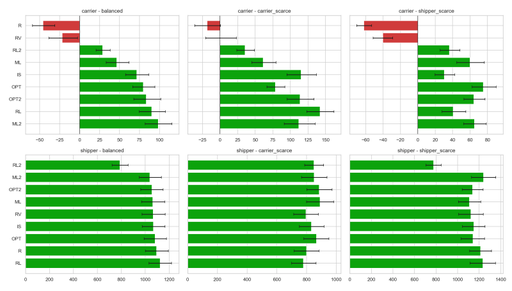
Figure 4 : Bootstrap mean outcome (margin for carriers, profit for shippers) by architecture, for all nine architectures under all three market conditions. Error bars are 95% percentile bootstrap confidence intervals.
Original paper · CC BY 4.0 · Eduardo de Avila-Armenta, Raúl Alejandro Aquino-Ibarra, Jorge Octavio Nicolás-Díaz, Umberto Leon-Dominguez · Before AI Agents Negotiate for Us: A Competitive Tournament of Rule-Based, Search, Optimization, Learned, and Language-Model Negotiators Under Scarcity · Original paper figure · Extracted the figure area from page 14 of the original PDF.Match rates under shipper scarcity
Under shipper scarcity, carriers must out-compete one another for a smaller pool of shipper demand.
RL2 was trained with the same algorithm, but its reward depended on winning the Gale-Shapley matching stage against rival carriers. Its match rate stays at 0.92, 0.93 and 0.92 across the three conditions. R and R V are also stable at similar levels, even though neither was trained with any competitive pressure. So stability alone doesn't show that competitive training is the cause, and what the data show is that RL2 avoids the specific failure that collapses RL and IS.
RL2's weakness appears on the shipper side, where it wins none of its eight significant comparisons in the balanced market. The authors traced this gap to a regression-tested bug in RL2's inference path, which pins the portfolio-occupancy feature to a neutral value before every decision. During training that feature was always neutral, while a deployed RL2 negotiates several tables at once, so the pinned value restores the training distribution.
The authors evaluate RL2 with this pin still in place, so they keep the mismatch as a measured result rather than repairing it first. A reward-design explanation was checked against the training code and doesn't account for the low realized payoff.
Language models under the same protocol
The nine language models ranged from 1 to 72 billion parameters and faced the same protocol as the hand-designed engines. Against the two strongest engines, OPT2 and ML2, they lost significantly in 32 of 36 comparisons. They won none of their comparisons, so no model beat either engine in a significant result. The three same-side rivals were R, OPT2 and ML2, chosen to span the weak, strong and learned range.
A model's record against the other six architectures isn't measured, so that comparison stays open.
llama3.3:70b had the largest raw shipper profit among the twelve participants. That profit result didn't reach significance against OPT2 or ML2. deepseek-r1:70b collapsed to a 2.5% match rate. Its responses ran into the 90-second limit on the single-GPU workstation. Figure 10 logs three successive days in which the first decision on one carrier table forfeited each time.
The authors read this as a latency artifact of their hardware and timeout, not as a general reasoning failure of the model family. The 24 GB GPU can't hold any 70B-class model whole, so a longer timeout could change these latency results.
At turn 3 it twice emitted accept with a non-null amount, although the schema requires amount to be null for accept. At turn 9 it repeated accept with amount 3022.19 three times, and the table forfeited.
The trajectory examples show one side's concession path only, because the call log never stored the counterpart's offers.
Limitations that bound how far the rankings can be read
The authors calibrated it for internal consistency rather than fitting it to real freight-market data.
It doesn't study an open-ended co-adaptation process between the architectures. Each hyperparameter, such as concession rates, particle counts and optimizer step counts, was set once for all market conditions.
The log-space Ornstein-Uhlenbeck price process generates serially correlated draws across consecutive negotiation indices. The paired Wilcoxon signed-rank test's standard assumptions don't account for that correlation. The authors don't report which zero-difference handling method, Wilcoxon's, Pratt's or zero-split, they used on tied pairs.
They report only Holm-Bonferroni-corrected significance for the 36 comparisons per condition and role, with no standardized effect size.
Those results describe that prompting choice, not each model's best performance under prompt engineering. The three same-side rivals R, OPT2 and ML2 were chosen to span the weak, strong and learned range, so a model's record against the other six architectures isn't measured.
Paper info
- Authors
- Eduardo de Avila-Armenta, Raúl Alejandro Aquino-Ibarra, Jorge Octavio Nicolás-Díaz, Umberto Leon-Dominguez
- Venue
- arXiv · Preprint
- First published
- 2026-11-11
- Added
- 2026-11-13
- Updated
- 2026-11-11
- Version
- v1
- arXiv
- 2611.15838
- Category
- cs.AI · cs.GT · cs.LG · cs.MA
- Original paper terms
- CC BY 4.0
- What we show
- Paper info, commentary and permitted figures from the original paper
AI commentary is a separate explanation from the original paper and may contain errors. The original paper and figures follow each source's terms of use and any rights noted separately.
Abstract
Automated bilateral negotiation underlies two-sided matching markets such as freight brokering, where many shippers and carriers negotiate price before a matching mechanism decides who is paired with whom. Prior strategy comparisons typically use isolated one-on-one duels or a single fixed market, so they cannot show how a strategy behaves against several live rivals under a changing balance of supply and demand. We built nine negotiation architectures spanning rule-based, search-based, optimization-based, imitation-learning, and reinforcement-learning families, and ran all nine simultaneously on both sides of a Gale-Shapley matching market under a balanced condition and two scarcity conditions rotated across all 36 exclusion pairs. In the balanced carrier market, an imitation-learned engine (ML2), a reinforcement-learning policy trained only on isolated negotiations (RL), and an expected-utility optimization engine (OPT) formed a statistically tied top group, and no architecture led in every condition and role. RL beat all eight carrier rivals when carriers were scarce, but its match rate collapsed from 62% to 16% when shippers were scarce and it had to compete with the other carrier agents for demand. A second reinforcement-learning policy trained against rival agents (RL2) kept its match rate above 91% in every condition, yet lost on realized payoff to all eight shipper-side rivals in two of the three conditions, traced to a confirmed train/deployment feature mismatch. We also tested nine large language models (LLMs), from 1 to 72 billion parameters, under the same protocol: they lost significantly to the two strongest engines (OPT2 and ML2) in 32 of 36 comparisons and won none. These results show that isolated or single-condition evaluation can hide failure modes that a many-sided, scarcity-varying, statistically corrected tournament exposes directly.
Quote from the paper
Eduardo de Avila-Armenta, Raúl Alejandro Aquino-Ibarra, Jorge Octavio Nicolás-Díaz, Umberto Leon-Dominguez (2026). Before AI Agents Negotiate for Us: A Competitive Tournament of Rule-Based, Search, Optimization, Learned, and Language-Model Negotiators Under Scarcity. arXiv:2611.15838v1. https://arxiv.org/abs/2611.15838v1
BibTeX
@misc{avilaarmenta2026before,
  title = {{Before AI Agents Negotiate for Us: A Competitive Tournament of Rule-Based, Search, Optimization, Learned, and Language-Model Negotiators Under Scarcity}},
  author = {Eduardo de Avila-Armenta and Raúl Alejandro Aquino-Ibarra and Jorge Octavio Nicolás-Díaz and Umberto Leon-Dominguez},
  year = {2026},
  eprint = {2611.15838},
  archivePrefix = {arXiv},
  url = {https://arxiv.org/abs/2611.15838v1}
}