Paper commentary
The Dark Matter of Clinical Data: An Identification Limit on Disentangling Physiology from Care Process in electronic health records
Lab values cannot be cleanly separated from clinicians' ordering decisions in EHR representations
- Problem Lab values mix physiology with ordering, and one dataset cannot separate them.
- Method The authors formalize the data-generating process with latent physiology, ordering intent, and clinical environments. They then build pairs of models that generate the same observed data but disagree about biological invariance.
- Results The authors prove that a sentinel-coded lab value carries all the ordering indicator's entropy.
Why a lab value and its ordering can't be split
A representation learned from EHR data reflects who gets a test as much as how the patient is doing. An order is placed because a clinician judged the test worth doing, so the presence of a value already carries care-process information. The paper asks whether a method applied within one dataset can divide the information in a lab value from the information in the decision to order it.
Its answer is that this split fails for a structural reason rather than a statistical one.
When ordering depends on the analyte, the analyte's distribution among untested patients can't be recovered from the data. Without that distribution, no division of the outcome information carried by value and ordering is identified. Theorem 1(i) makes this precise, and the paper notes that any such division must add up to the mutual informations involved, whatever decomposition method is chosen.
Removing the problem needs assumptions that make the untested distribution recoverable, or measuring every patient.
Analysts often avoid the gap by filling unmeasured patients with a sentinel, such as -1 for lactate. So the encoded value determines the ordering indicator, and the mutual information between them equals H(S), which is above zero, whatever the joint law. Theorem 1(ii) states this result in equation (4), including when ordering is independent of physiology.
Partial information decomposition (PID) is the method usually proposed for this separation, and the paper shows it inherits the same problem on this encoding. If lactate is ordered mainly when clinicians suspect sepsis, PID reports the mortality signal of that suspicion as shared with lactate, even when measured values add nothing. This is an interpretive failure, not a poor-predictor claim, since missingness indicators are often among the most informative features.
Corollary 1 extends the point: any encoding-neutral split must drop the ordering channel, fill in values by a rule, or posit values that contradict Assumption 3.
The model class and the assumptions behind the cross-site test
The model class starts from a structural causal model with the environment E, latent physiology Z⋆, latent ordering intent S⋆, a learned representation Z, and an outcome Y. The indicator S equals S⋆(1−C), so a test counts as performed only when the ordering intent is present and censoring has not happened first. Censoring C refers to the measurement window, whereas Y is assessed over a later horizon.
The recorded value V exists only on {S = 1}, which the authors call structural undefinedness rather than missingness.
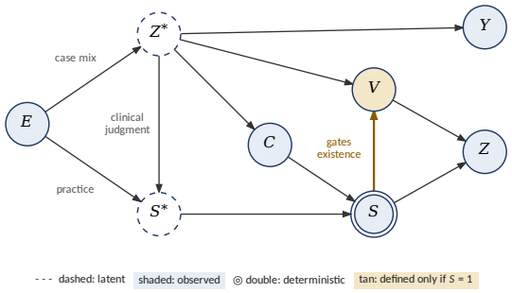
Figure 1 :Clinical data-generating process.Dashed circles are latent; shaded circles are observed; the double circle marks a deterministic node (S =S⋆(1−C )); the tan nodeV exists only when S = 1. The environment enters the record twice, through case mix (E→Z ⋆) and through practice (E→S ⋆), so any representationZ computed from the record inherits both physiology and care process. The absent edgeE→Y encodes Assumption 4, and the absent edgesS→Y and Z→Y encode Assumption 6a (both stated in Section 3.3).
Original paper · CC BY 4.0 · Extracted the figure area from page 6 of the original PDF.The analyte level V◦ exists for every patient, and V equals V◦ only on the measured subset. Analysts usually fill V with a sentinel: for lactate, −1 serves as the symbol ∅ outside the range of V. The graph omits an edge from E to Y by design, because that absence is the hypothesis under investigation. The authors note that the sentinel encoding in Eq.
(1) is the proxy variable of the m-graphs of Mohan and Pearl.
Assumption 6 has two parts, because exclusion (6a) and representation sufficiency (6b) play distinct roles. Exclusion has a practical consequence for mortality: a death before the specimen is drawn would force both S = 0 and Y = 1. The graph doesn't imply Assumption 6b, and the authors don't assume Y⊥E|Z directly because that is the implication to be tested.
Assumption 4, biological invariance, is the hypothesis whose identifiability is at issue. The model class M holds the channel fixed across sites and builds in exclusion, because the outcome mechanism f_Y doesn't take Z as an argument. Every model in M induces an observational distribution by summing over the latent state, using the outcome, channel, and case-mix kernels.
Two models are observationally equivalent when they induce the same joint distribution of outcome, representation, and environment.
What a stable cross-site outcome law can establish
The outcome law given the representation doesn't vary across environments on the shared support, once Assumptions 4 and 6 hold. The proof conditions on latent physiology, uses biological invariance to drop the environment, and then applies representation sufficiency to remove it from the posterior. Each of the three assumptions strips site dependence from a single factor.
A reliable cross-site violation therefore falsifies at least one of Assumptions 4, 6a and 6b, though it doesn't say which. The implication runs one way, so a passed test rules out none of the three.
Proposition 1 shows why passing the test isn't enough. The authors enlarge the latent state with an independent binary coordinate U and add site-specific perturbations of size ±δe to the outcome mechanism. The perturbations average to zero over U within each representation cell, so the model still generates the same observed distribution.
That model satisfies Assumptions 6a, 6b and 7 but violates Assumption 4. Assumption 4 alone has no testable implication, since any distribution on finite alphabets can come from a site-invariant mechanism.
A passed test therefore constrains only a margin of the joint distribution, not the mechanism beneath it. Falsifiability doesn't imply identifiability: a hypothesis can be refuted by data yet never confirmed by them. The conjunction of Assumptions 4 and 6 sits in this position, while Assumption 4 alone is neither identifiable nor falsifiable.
The authors' construction shows that passing the test doesn't establish biological invariance.
So a cross-site test can support or contradict a stated joint hypothesis, but it can't identify biological invariance itself. The worked example shows a 9.6-percentage-point gap under an unchanged biological mechanism.
Why invariance can't be identified from the data
The collapsing construction sets the latent state equal to the representation, so the identity channel makes Z the physiology in the new model. All remaining site dependence moves into the outcome mechanism, which gives the new model the same joint law of outcome, representation and environment. Theorem 3 says that if the original model satisfies Assumption 4 but its outcome law varies across sites, the collapsed twin violates Assumption 4.
The two models are observationally equivalent, so biological invariance is not identifiable over the model class. A failed invariance test therefore can't be blamed on Assumption 4 rather than Assumption 6.
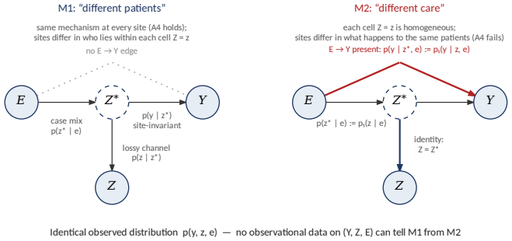
Figure 3 :Observational equivalence.Left, M1: biological invariance holds (noE→Y edge), case mix differs by site, and the representation is lossy, so the posterior over physiology within a cell Z =z depends on the site. Right,M2 (Lemma 1): the latent state is the representation itself and the outcome mechanism is site-specific (E→Ypresent). Both induce the samep(y,z,e).
Original paper · CC BY 4.0The question reduces to whether some model satisfies Assumption 4 yet has site-varying outcome laws given the representation. Under Assumption 4 and Bayes' rule, the site dependence enters only through the posterior over physiology, and only through the case-mix prior. Conditioning on Z doesn't block the path from E to Z* to Y, because Z is a lossy descendant of Z*.
For binary physiology, Proposition 2 writes P(Y=1|z,e) as μ0 + (μ1−μ0) times π_e(z), where π_e(z) = a_z q_e / (a_z q_e + b_z(1−q_e)). The cross-site gap is non-zero only when physiology affects the outcome, case mix differs, and the representation is lossy at that cell.
For finite state spaces, Proposition 3 shows that the parameters giving exact invariance on the shared support have Lebesgue measure zero. The sensitivity analysis of Section 4.4 is the tool the authors name for that case.
Figure 3 places M1 and M2 side by side, with different patients in M1 and different care for the same patients in M2. Applying Lemma 1 to the full observed record W gives a model equivalent on (y,z,s,v,e). Ordering indicators and values sharpen the posterior over physiology only when they pin down its outcome-relevant component. The joint distribution of (Y,Z,E) can't tell the two worlds apart.
A worked example with a 9.6-point gap
The authors use stylized binary numbers: two sites with case mix 0.3 and 0.7, a symmetric channel with 10% error, and an outcome mechanism of 0.2 and 0.8 that is site-invariant in M1. The second model M2 uses the representation as its latent state with site-specific mechanisms equal to these observed rates, so the same gap appears although the biology in M1 is unchanged.
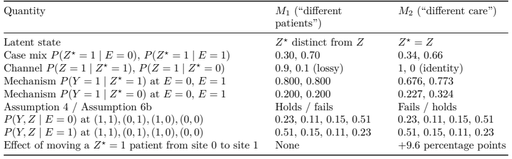
Table 2 :M 1 versusM 2: different structures, identical observations.
Original paper · CC BY 4.0The authors also give a sensitivity calculation: for a symmetric error rate \(\varepsilon\), the case mix is recovered as \(q_e=[P(Z=1\mid e)-\varepsilon]/(1-2\varepsilon)\). Because the absolute mechanism difference is at most 1, invariance can explain at most 0.029 at \(\varepsilon=0.02\), 0.075 at \(\varepsilon=0.05\) and 0.160 at \(\varepsilon=0.10\).
So the 9.6-point gap is compatible with Assumption 4 only if the error rate is at least about 0.063, which makes this one-cell bound a necessary condition. Detecting the 9.6-point gap with 80% power at α=0.05 needs about 340 patients per site in the Z=1 stratum.
Using both cells, a latent-class model with a symmetric channel reproduces the four cell rates exactly only at error rate 0.10, which recovers M1. This does not contradict Theorem 3, because M2 has a symmetric channel with error 0 and a site-specific mechanism, and it fits the same data exactly. An external error-rate estimate, such as one from adjudicated sepsis status, is what would turn this calculation into evidence about Assumption 4.
Routine measurements as identification routes
Routine measurements remove the ordering gate, because a panel drawn for every inpatient has no selection and its distribution is observed directly. For such a test S is identically 1, so the recorded value exists for everyone and no part of its distribution is missing.
The authors use routine measurements to state conditions under which the cross-site comparison identifies biological invariance. The first route is an exact summary: the test takes the value V = g(Z⋆), the same function at every site. The proof is short: for each v and e, p(y|v,e) reduces to h_e(y|v), because every physiological state occurs at every site.
In Corollary 3, a routine test with V = Z⋆ at every site identifies the case mix, the error rates of the representation, and the site-specific mechanism.
That route uses two binary tests with conditionally independent errors, and it exploits the case-mix difference between sites as the source of identification. The proof treats each site as a latent-class model, and the six parameters are identified up to swapping the labels of Z⋆. For each v1, the mechanism at each site solves a linear system whose determinant is non-zero, so the solution is unique.
Neither proposition contradicts Theorem 3, because each one adds an assumption the observational distribution cannot check. Proposition 4 assumes the measured value captures all outcome-relevant physiology, which excludes the lossy models that Theorem 3 relies on. Routine measurement removes only the site-specific ordering pathway, so the case-mix pathway of Proposition 2 remains.
Digital twins and retrieval-augmented language models over site protocols could add related information, but neither removes the boundary.
Limitations: where the results stop
The results are exact within the stated model class, with one exception: Proposition 3 holds generically rather than universally. The model class fixes the representation channel across sites and builds in exclusion (Assumption 6a). Relaxing the fixed channel only strengthens non-identifiability, so that restriction doesn't help the identification claim.
Exclusion is the substantive restriction, because a test result that triggers treatment changing prognosis independently of physiology forces the ordering indicator S into the outcome mechanism. The same problem arises when Y is mortality and early deaths aren't separated by a landmark design.
The conclusion is limited the same way: biological invariance is not identifiable from observational data within the model class studied. Whether representation-conditional outcomes differ across sites or agree, the observed distribution is generated by both a site-invariant model and one in which the mechanism is not.
Paper info
- Authors
- Shahin, Mohammad, Chaisutyakorn, Krittaphas, Proios, Dimitrios, Restrepo, David, Mishra, Vishala, Zhang, Boya, Sivaraman, Aadarsh, Roy, Sparsh, Abril, Benet Fité, Chen, Tina Yen-Ting, Kwak, Hyunjung Gloria, Waschka, Andre Kurepa, Mathur, Vinayak, Celi, Leo Anthony
- Venue
- arXiv · Preprint
- First published
- 2026-11-9
- Added
- 2026-11-10
- Updated
- 2026-11-9
- Version
- v1
- arXiv
- 2611.11726
- Category
- cs.LG · stat.ME
- Original paper terms
- CC BY 4.0
- What we show
- Paper info, commentary and permitted figures from the original paper
AI commentary is a separate explanation from the original paper and may contain errors. The original paper and figures follow each source's terms of use and any rights noted separately.
Abstract
Representations learned from electronic health record (EHR) data encode patient physiology together with the clinical process that decides what is measured, when, and for whom. We formalize the data-generating process with latent physiology, ordering intent, laboratory values that exist only when measured, a learned representation, and clinical environments, and analyze two strategies for undoing this entanglement. First, no division of the information carried by laboratory "value" and "ordering" channels is identified from a single dataset: when ordering depends on the analyte, its distribution among untested patients is not recoverable, and a sentinel code for the undefined recorded value makes it carry all the entropy of the ordering indicator, fixing partial information decomposition (PID) for every redundancy measure satisfying the Williams-Beer axioms and invariant under injective re-encoding. Second, cross-site invariance of representation-conditional outcomes is a falsifiable implication of biological invariance taken jointly with exclusion and representation-sufficiency conditions, but not an identification strategy: we construct observationally equivalent models that disagree about biological invariance, whether the invariance test fails or passes. For binary physiology this happens exactly when case mix differs, the representation is lossy, and physiology affects the outcome. A worked example yields a 9.6-percentage-point cross-site gap under an unchanged biological mechanism. Tests performed for every patient remove the ordering gate, and measured tests can restore identification: biological invariance is identified when a test exactly summarizes outcome-relevant physiology, or, for binary physiology, when two tests with independent errors are available at sites with different case mix. Cross-site analyses should be reported as tests of a stated joint hypothesis.
Quote from the paper
Shahin, Mohammad, Chaisutyakorn, Krittaphas, Proios, Dimitrios, Restrepo, David, Mishra, Vishala, Zhang, Boya, Sivaraman, Aadarsh, Roy, Sparsh, Abril, Benet Fité, Chen, Tina Yen-Ting, Kwak, Hyunjung Gloria, Waschka, Andre Kurepa, Mathur, Vinayak, Celi, Leo Anthony (2026). The Dark Matter of Clinical Data: An Identification Limit on Disentangling Physiology from Care Process in electronic health records. arXiv:2611.11726v1. https://arxiv.org/abs/2611.11726v1
BibTeX
@misc{mohammad2026dark,
  title = {{The Dark Matter of Clinical Data: An Identification Limit on Disentangling Physiology from Care Process in electronic health records}},
  author = {Shahin, Mohammad and Chaisutyakorn, Krittaphas and Proios, Dimitrios and Restrepo, David and Mishra, Vishala and Zhang, Boya and Sivaraman, Aadarsh and Roy, Sparsh and Abril, Benet Fité and Chen, Tina Yen-Ting and Kwak, Hyunjung Gloria and Waschka, Andre Kurepa and Mathur, Vinayak and Celi, Leo Anthony},
  year = {2026},
  eprint = {2611.11726},
  archivePrefix = {arXiv},
  url = {https://arxiv.org/abs/2611.11726v1}
}