Paper commentary
Beyond Validation Loss: Coverage and Reliability Dynamics in Robot Policy Pretraining
Checkpoint coverage, not validation loss, predicts how well robot policies finetune
- Problem Validation loss and mean task success miss which pretrained robot policies still succeed on hard starts. Two checkpoints with similar pass@1 can finetune very differently, so the usual pick is unreliable.
- Method The authors select checkpoints offline with a criterion that balances coverage and reliability. It reads the quantile profile of held-out action error instead of running closed-loop rollouts.
- Results On a real-robot Push-T variant, the selected checkpoint beats the final checkpoint by 10% on pass@1 and 20% on pass@5.
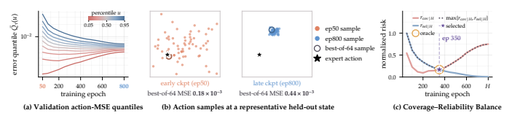
Figure 4 :Held-out action-MSE quantiles expose the coverage–reliability balance.(a) Held-out action-MSE quantiles across training, colored by percentileufrom0.05(red) to0.95(blue). (b) For a held-out observation, 64 matched-noise samples from ep50 and ep800, plus the expert action, are projected with PCA; rings mark the minimum-MSE sample. ep50 is more dispersed yet has lower best-of-64 MSE, whereas ep800 contracts but its best sample lies farther from the expert. Consistent with (a), lower quantiles favor earlier checkpoints, while higher quantiles improve later. (c) We summarize the lower and upper halves asr cov|H(τ)andr rel|H (τ)and select the checkpoint minimizingmax{r cov|H(τ), rrel|H (τ)}; the selected ep350 matches the closed-loop oracle.
Original paper · CC BY 4.0 · Zhanyi Sun, Max Simchowitz, Shuran Song · Beyond Validation Loss: Coverage and Reliability Dynamics in Robot Policy Pretraining · Original paper figure · Extracted the figure area from page 7 of the original PDF.Why the handoff checkpoint matters
Robot policies are often trained in two stages, with supervised learning from demonstrations first and RL, SFT, or another adaptation step afterward. The checkpoint passed to posttraining is usually picked by validation loss, average task success, or simply the final checkpoint. Both criteria judge the supervised pretraining stage in isolation, so they say little about how a policy will fare once it is finetuned.
Prolonged pretraining or stronger SFT performance doesn't always carry over to later posttraining, and coverage of high-quality outputs matters for it. Robot control looks different, because actions are continuous, have far less distributional diversity, and need precise closed-loop execution. That difference could seem to favor ever more reliable policies over broader behavioral coverage.
The authors argue that supervised training of generative robot policies follows the same kind of tradeoff between coverage and reliability.
The authors frame coverage and reliability through closed-loop pass@k from a fixed initial condition. At k equal to 1, the measure recovers mean task success, which the paper calls reliability. As k grows, pass@k measures the fraction of initial conditions where at least one success occurs, which the paper calls coverage. The authors find that checkpoints with similar pass@1 but different large-k pass@k can yield substantially different performance after SFT or RL finetuning.
Fixed-start pass@k as the diagnostic
The core idea is to read one metric at two ends: k equal to 1 gives reliability, while larger k asks whether success is still reachable. The authors call single-rollout success reliability, and the fraction of start conditions with at least one success within k attempts is called coverage. Pass@1 recovers the standard mean task-success rate, so the same curve carries both the average and the tail.
To measure it, the simulator is reset to a held-out initial condition c, and k independent rollouts from the same checkpoint are executed. If q_τ(c) is the one-rollout success probability of checkpoint τ at condition c, then pass@k is the expectation over c of 1 − (1 − q_τ(c))^k. The average runs over initial conditions drawn from the evaluation distribution, written as P_k(τ) with c drawn from p_eval.
Because each start is scored separately before averaging, a policy that rarely succeeds on a hard start still registers at large k. Averaging over starts this way keeps low-probability successes visible instead of hiding them inside a single mean. The authors stress that pass@k is a diagnostic in resettable simulation, not a deployment protocol that requires resets and repeated attempts.
They use it to study pretraining dynamics and their relation to finetunability, and they don't ask deployment to reset and retry.
Pass@k peaks early and posttraining follows
The section asks whether checkpoints with similar pass@1 really finetune alike, and the answer in these experiments is no. Figure 1 compares early and late checkpoints in two settings: single-task BC followed by residual RL on MimicGen, and multitask pretraining followed by SFT on RoboCasa. The authors chose the early checkpoint with their offline coverage–reliability criterion, and the final checkpoint is the blue one.
The multitask setting pretrains a π0.5 policy with OpenPI on 65 atomic RoboCasa365 tasks, using 100 demonstrations per task.
In both settings, pass@k for large k peaks earlier than pass@1, and then declines while pass@1 keeps improving. So later checkpoints can have higher mean success even after large-k pass@k has started to fall. Pass@1 depends only on the mean one-rollout success, so two checkpoints can match on it while differing in how success is spread across start conditions.
The authors read this as success being redistributed across conditions during supervised pretraining, not simply lost. Starting finetuning from the earlier checkpoint gave stronger results than starting from the final one in both settings, even though pass@1 was similar. This suggests that pass@1 alone can miss what posttraining needs from a checkpoint.
The paper doesn't claim this ordering holds for every RL method or every online budget.
Choosing a checkpoint without rollouts
The offline criterion reads the quantile profile of held-out action error instead of running the policy in closed loop. That profile captures favorable-tail coverage and typical-case reliability, so the criterion weighs both sides of the tradeoff. Because it avoids these three choices, the authors argue it is easy to add to existing robot policy training pipelines.
The authors test the criterion on hardware with a harder Push-T variant that uses only a wrist-mounted camera. The variant allows full 6-DoF end-effector control, and the end-effector moves the T-block only through non-prehensile contact. On the validation set, the best-of-k action MSE and error quantiles show the same coverage–reliability tradeoff seen in simulation.
The criterion selects the checkpoint at epoch 46, which the authors compare with the final epoch 200 checkpoint.
Each checkpoint is evaluated with five rollouts from each of 20 fixed initial states. The selected checkpoint beats the final checkpoint by 10% on pass@1 and by 20% on pass@5. The gap grows as k increases, so the selected checkpoint keeps more coverage than the final checkpoint. The authors also train two action-conditioned world models, one with rollouts from each checkpoint, to probe downstream learning.
They include all rollouts regardless of task success, and they validate on 100 rollout trajectories from intermediate checkpoints.
Downstream world models and the action-only variant
The world-model test asks whether rollouts from a coverage-preserving checkpoint help a model trained on them. The authors train two action-conditioned world models on the same demonstrations. One adds 200 rollouts from the selected early checkpoint, and the other adds 200 from the final checkpoint. They keep every rollout regardless of task success, so failed attempts still feed world-model training.
The world model uses a frozen Stable Diffusion VAE and a spatio-temporal DiT trained from scratch, with action conditioning added at each frame. At evaluation, it predicts the first chunk from ground-truth frames, then predicts the following chunk autoregressively from its own outputs. The world model trained with selected-checkpoint rollouts achieves higher PSNR and lower LPIPS than the one trained with final-checkpoint rollouts.
The authors read this as evidence that preserving policy coverage can benefit downstream world-model learning.
For RoboCasa, joint generation is expensive, so the authors use a lighter action-only variant. The variant resembles PostBC but takes its covariance from the policy's own action samples instead of a bootstrapped ensemble. This choice avoids tuning a perturbation scale. The procedure selects a checkpoint c⋆ with the coverage-reliability criterion, then estimates the action covariance from multiple policy samples at each training observation.
Pretraining resumes from c⋆ with perturbed targets, where the noise is drawn from a Gaussian with that covariance. The perturbation leaves the expected target unchanged, so the expected perturbed action equals the original action. Across these runs, the variant preserves large-k pass@k while pass@1 improves. Its SFT performance is comparable to the selected early checkpoint.
The authors summarize this as generative augmentation preserving coverage while reliability improves.
Where the results stop
The main evidence comes from simulation, with five MimicGen tasks and RoboCasa atomic tasks. The real-robot check is smaller: a Push-T variant with 740 human demonstrations, evaluated on only 20 fixed initial states. Each of those 20 states gets five rollouts, so the real-robot comparison rests on a small number of trials. The selected checkpoint beats the final one by 10% on pass@1 and 20% on pass@5, which is a narrow sample to generalize from.
Pass@k needs resettable simulation to measure, so it stays a diagnostic rather than a deployment rule.
The world-model result is also a single comparison, with one set of 200 rollouts per checkpoint. Validation uses 100 rollouts from intermediate checkpoints, so the gain in PSNR and LPIPS is measured on that held-out split only. The mechanism behind the coverage loss stays open, and the authors leave a deeper theory of how policy distributions evolve during pretraining for future work.
They also leave open how joint data collection and training objectives should be designed to keep reliability without losing coverage.
Paper info
- Authors
- Zhanyi Sun, Max Simchowitz, Shuran Song
- Venue
- arXiv · Preprint
- First published
- 2026-11-1
- Added
- 2026-11-4
- Updated
- 2026-11-1
- Version
- v1
- arXiv
- 2611.01565
- Category
- cs.LG · cs.RO
- Original paper terms
- CC BY 4.0
- What we show
- Paper info, commentary and permitted figures from the original paper
AI commentary is a separate explanation from the original paper and may contain errors. The original paper and figures follow each source's terms of use and any rights noted separately.
Abstract
In modern robot learning, generative robot policies are first pretrained through supervised learning from demonstrations, then refined through reinforcement learning, supervised finetuning, or other forms of posttraining. Yet conventional pretraining metrics, such as validation loss and average task success, provide an incomplete account of which policies support both effective direct deployment and subsequent posttraining. In this work, we study closed-loop pass@k, which evaluates the probability that k rollouts from the same initial condition attain at least one success. Thus, pass@1 measures mean task success; large-k pass@k measures whether success remains reachable under repeated sampling. Across a wide range of posttraining recipes, we show that large-k pass@k reveals posttraining differences not captured by pass@1. In particular, checkpoints with similar pass@1 but different large-k pass@k have different posttraining performance. Moreover, we show pass@k peaks at different checkpoints during supervised pretraining, revealing a coverage-reliability tradeoff over the course of training. Based on these observations, we propose two practical interventions: (1) a purely offline checkpoint-selection criterion that balances coverage and reliability without closed-loop evaluation, and (2) a generative data augmentation procedure that expands supervision beyond the finite demonstration set, preserving large-k pass@k while maintaining or improving pass@1 and raising the observed coverage-reliability Pareto frontier. Together, our results motivate evaluation, checkpoint selection, and training procedures that explicitly account for posttraining. Blog post, visualizations, and code are available at https://zhanyisun.github.io/robot-policy-learning-dynamics/.
Figures from the paper
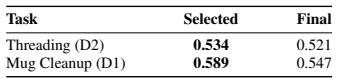
Table 1 :Filtered BC.Pass@1/pass@32after retraining on successful rollouts generated by the selected or final checkpoint.
Original paper · CC BY 4.0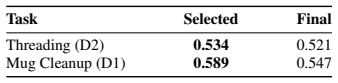
Table 2 :
Original paper · CC BY 4.0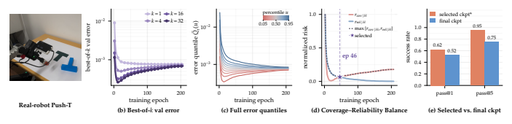
Figure 7 :Real-robot Push-T.(a) Task setup. (b) Best-of-kvalidation action MSE across training epochs. (c) Quantiles of validation action error across training epochs. (d) Normalized coverage and reliability scores with the selected checkpoint at epoch 46. (e) Pass@1and pass@5success rates of the selected (epoch 46) and final (epoch 200) checkpoints over 20 fixed initial states.
Original paper · CC BY 4.0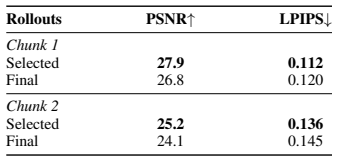
Table 3 :World-model prediction quality. Models are trained on demonstrations and roll- outs from the selected or final checkpoint. Chunk 1 is predicted from two ground-truth context frames; Chunk 2 is predicted autore- gressively from the model’s Chunk-1 output.
Original paper · CC BY 4.0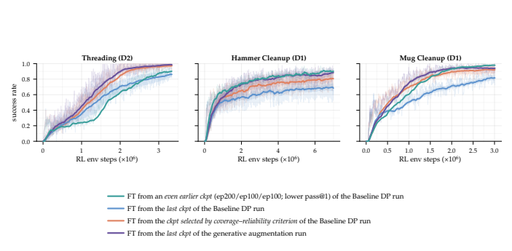
Figure 9 :Residual RL finetuning across the coverage–reliability tradeoff.We additionally finetune an earlier baseline checkpoint (ep.200/100/100 forThreading/Hammer Cleanup/Mug Cleanup) with lower pass@1and higher coverage than the checkpoint selected by our criterion. Its performance relative to later checkpoints depends on the available online budget.
Original paper · CC BY 4.0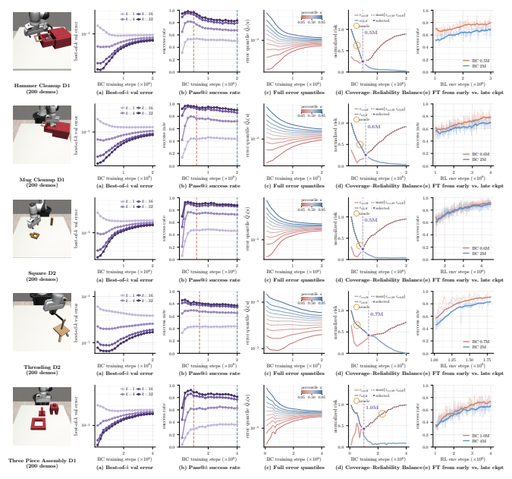
Figure 10 :Flow-matching policy pretraining and OGPO finetuning.Each row shows a Mim- icGen task with 200 demonstrations. (a) Best-of-kvalidation action MSE. (b) pass@kduring BC pretraining. (c) Validation error quantiles. (d) Coverage–reliability scores and selected checkpoint. (e) OGPO finetuning from the selected versus final BC checkpoint. The selected initialization gen- erally achieves better downstream RL performance.
Original paper · CC BY 4.0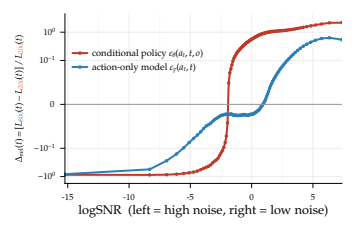
Figure 12 :Observation conditioning exacerbates the deterioration in held-out denoising dur- ing late training.Relative change in held-outϵ-prediction MSE from epoch 200 to 800 for the image-conditioned and action-only models, evaluated on the same noisy action chunks. Negative values indicate lower held-out loss at epoch 800; positive values indicate higher loss. The condi- tional model exhibits held-out loss deterioration at higher diffusion noise levels.
Original paper · CC BY 4.0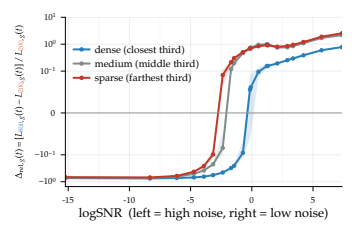
Figure 13 :Late-training held-out denoising loss increases more at lower diffusion noise levels and with sparser local conditioning support.Relative change in mean held-outϵ-prediction MSE from epoch200to epoch800,∆ rel,g(t)(Eq. D.6), for queries divided into equal thirds by local con- ditioning support. Negative values indicate lower mean loss at epoch 800; positive values indicate higher mean loss. At a fixed noise level, the relative loss change is generally larger for queries with sparser local conditioning support.
Original paper · CC BY 4.0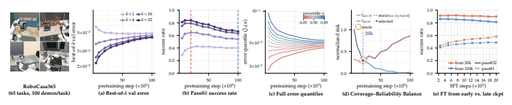
Figure 15 :Full RoboCasa multitask pretraining results.Best-of-kvalidation loss, pass@k, error quantiles, coverage–reliability checkpoint selection, and downstream SFT.
Original paper · CC BY 4.0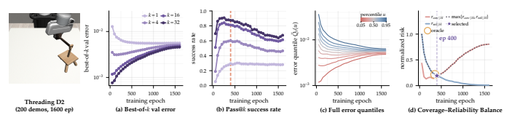
Figure 16 :Extended training on Threading D2.The coverage–reliability dynamics persist to 1600 epochs, and the offline criterion continues to select an intermediate checkpoint.
Original paper · CC BY 4.0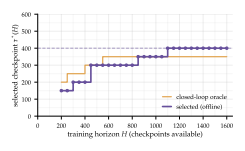
Figure 17 :Robustness to train- ing horizon.Offline selection tracks the closed-loop oracle asH increases.
Original paper · CC BY 4.0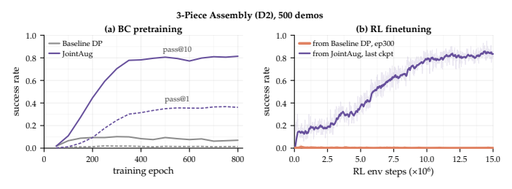
Figure 18 :JointAugenables residual RL finetuning on 3-Piece Assembly (D2).Left: JointAugsubstantially improves pass@1and pass@10during BC pretraining.Right:residual RL from the finalJointAugcheckpoint reaches over0.8success, while finetuning from the base- line checkpoint remains near zero.
Original paper · CC BY 4.0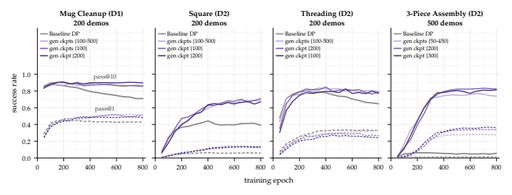
Figure 19 :JointAugis relatively robust to generator checkpoint selection.We compare the five-checkpoint mixture used in our main experiments against individual generator checkpoints from the same run . Across four tasks, single-checkpoint variants have similar pass@10gains over the baseline, while the mixture performs similarly overall and slightly improves pass@1onMug CleanupandThreading.
Original paper · CC BY 4.0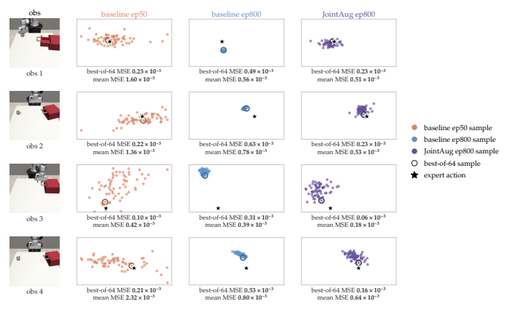
Figure 20 :JointAugretains favorable-tail coverage while improving typical action accuracy. For four held-outMug Cleanupstates, we jointly project 64 action samples from baseline ep50, baseline ep800, andJointAugep800 with PCA. Stars mark expert actions and rings mark the minimum-MSE sample. The baseline ep50 is dispersed with low best-of-64 but high mean MSE; baseline baseline ep800 contracts and lowers mean MSE but worsens best-of-64 MSE;JointAug ep800 achieves best of both worlds.
Original paper · CC BY 4.0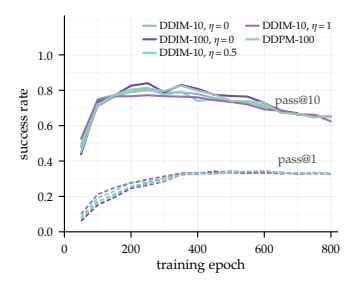
Figure 22 :Pass@ktraining dynamics are stable across sampling configurations.Pass@1and pass@10are evaluated using DDIM with different numbers of denoising steps andη, and using DDPM. All settings show the same late-training decline in pass@10.
Original paper · CC BY 4.0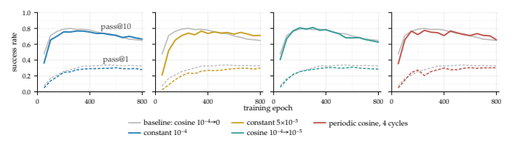
Figure 23 :Learning-rate schedule ablation onThreading D2Each panel overlays one ablated schedule (colored) with the default single-cosine schedule (gray). Solid and dashed curves denote pass@10and pass@1, respectively. Across schedules, large-kpass@kpeaks earlier and declines as pass@1improves later in training; changing the learning-rate schedule primarily shifts the timing of these changes.
Original paper · CC BY 4.0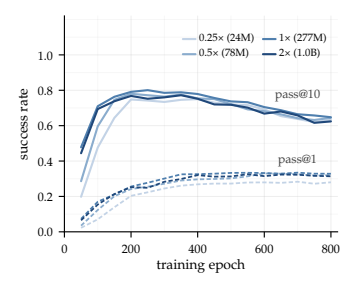
Figure 24 :The late-training coverage loss persists across denoiser widths.We vary the U-Net from 24M to 1.0B parameters while keeping the encoder, data, optimizer, learning-rate schedule, and sampler fixed. All four models show a similar peak and subsequent decline in pass@10.
Original paper · CC BY 4.0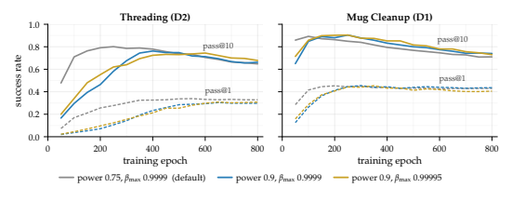
Figure 25 :Longer EMA memory delays and smooths the pass@10decline but does not funda- mentally remove it.Holdingβ max = 0.9999fixed, increasingpfrom0.75to0.9gives the EMA a longer memory earlier in training, causing pass@10to peak and decline later. Holdingp= 0.9 fixed, increasingβ max from0.9999to0.99995allows the EMA memory to continue growing later in training and further smooths the decline. Pass@10still decreases under all schedules.
Original paper · CC BY 4.0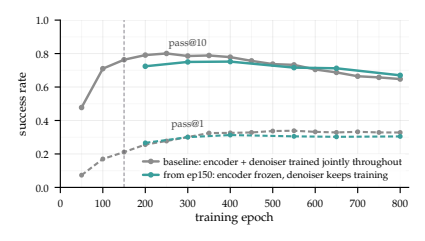
Figure 26 :Freezing the encoder does not prevent the late-training largekpass@kdecline. From epoch 150 onward, the encoder is fixed and only the denoiser is trained. Pass@10still de- creases at later epochs. The overall training dynamics is largely the same as baseline run.
Original paper · CC BY 4.0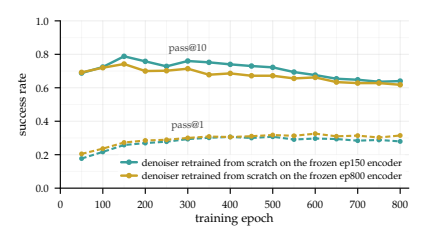
Figure 27 :Fresh denoisers reproduce the pass@10decline with fixed encoder representations. New denoisers are trained from scratch with either the epoch-150 or epoch-800 encoder frozen throughout training. Both show a later decline in largekpass@k.
Original paper · CC BY 4.0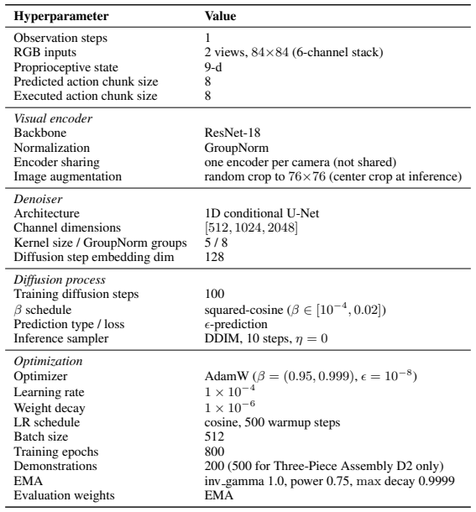
Table 5 : Baseline diffusion-policy configuration. All settings are shared across the six MimicGen tasks unless noted.
Original paper · CC BY 4.0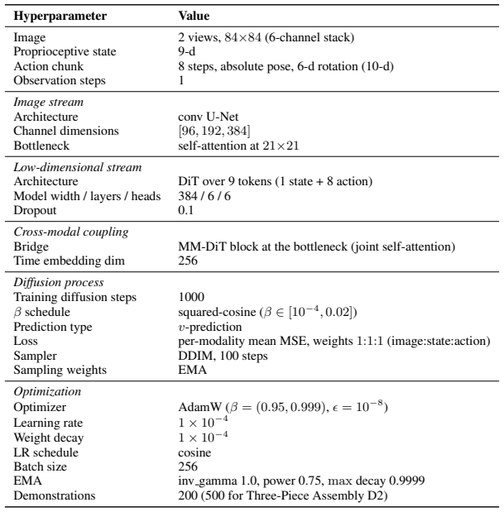
Table 6 : Joint(o, a)generator configuration. All settings are shared across the six MimicGen tasks unless noted.
Original paper · CC BY 4.0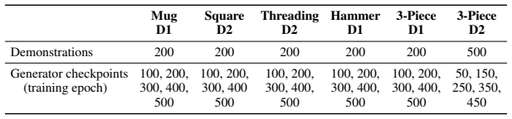
Table 7 : Per-taskJointAugsettings. Generator checkpoints are indexed by their training epoch; rows of each minibatch are drawn equally from the listed checkpoints
Original paper · CC BY 4.0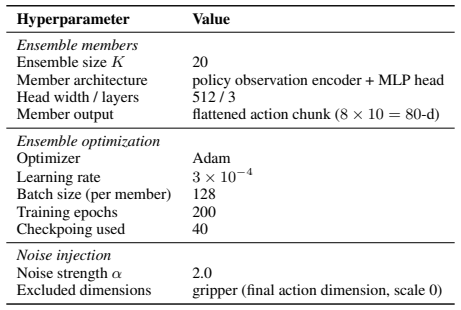
Table 8 :PostBCposterior-ensemble config and noise injection. All settings are shared across the five MimicGen tasks for which we reportPostBC.
Original paper · CC BY 4.0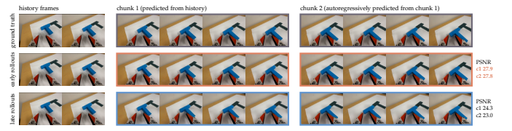
Figure 30 :Qualitative world-model predictions on real-robot Push-T.The top row shows ground truth; the middle and bottom rows show predictions from world models trained on rollouts from the selected early and final policy checkpoints, respectively. Each model predicts four frames from two history frames (Chunk 1), then autoregressively predicts four more frames (Chunk 2). The early- rollout model achieves higher PSNR in both chunks.
Original paper · CC BY 4.0Quote from the paper
Zhanyi Sun, Max Simchowitz, Shuran Song (2026). Beyond Validation Loss: Coverage and Reliability Dynamics in Robot Policy Pretraining. arXiv:2611.01565v1. https://arxiv.org/abs/2611.01565v1
BibTeX
@misc{sun2026beyond,
  title = {{Beyond Validation Loss: Coverage and Reliability Dynamics in Robot Policy Pretraining}},
  author = {Zhanyi Sun and Max Simchowitz and Shuran Song},
  year = {2026},
  eprint = {2611.01565},
  archivePrefix = {arXiv},
  url = {https://arxiv.org/abs/2611.01565v1}
}