Paper commentary
SciToT: Multimodal Tip-of-the-Tongue Retrieval for Scientific Papers
SciToT generates tip-of-the-tongue queries to benchmark scientific paper re-finding
- Problem Existing tip-of-the-tongue benchmarks cover casual domains like movies and games. Scientific communities lack enough community question-answering posts to build one, so no benchmark existed for scientific queries.
- Method SciToT generates queries instead of collecting them, pulling text clues and figure clues separately from each paper and then writing one query from both.
- Results On page-level inputs, Qwen3-VL reached 0.793 MRR@10, compared with 0.710 for Qwen3-Emb on text.
Why scientific re-finding needs its own benchmark
Tip-of-the-tongue retrieval is known-item search for an item that users remember but can't name by title or author. Compared with keyword queries, ToT queries are longer and more complex. They also often hold uncertainties, relative comparisons, or false memories. Traditional retrieval systems find this task difficult, and users who fail to re-find items often grow frustrated, which can cut their productivity.
For scientific papers, the remembered content is often visual in nature. The authors' own analysis of real ToT queries found visual elements frequent and highly distinctive. Earlier ToT benchmarks focus on casual domains such as movies, music, and games. Those queries come from community question-answering platforms, which scientific communities lack at sufficient coverage because of confidentiality, privacy, or data scarcity.
So no benchmark existed for scientific ToT queries, despite how common such query failures are in literature search.
The authors therefore generate queries synthetically instead of collecting them. They extend the LLM-based query elicitation framework of He et al. to scientific documents and add visual as well as textual information. Before building the generator, they annotated a sample of 51 publicly available re-finding requests from community question-answering platforms.
Some of their codes are reused from Arguello et al., so the generated queries can be checked against real requests. The resulting SciToT benchmark contains 108,512 documents and 11,499 queries.
Key idea: separate memory cues for text and figures
SciToT splits memory cues into two streams, one from the paper's text and one from its figures, then writes a single query from both. The authors keep the modalities apart so that each clue relates to a single modality and a single element. Qwen3-4B reads the paper text, truncated to the token limit, and follows the instructions that He et al.
used. The text prompt asks for JSON output with unstylized clues that avoid named entities and directly identifying information. For figures, Qwen3-VL-4B-Instruct receives one image at a time and derives clues about structural appearance and high-level semantic elements.
Phi-4 14B then turns the clue set into a query, using a different provider from the one that extracted the cues. This choice reduces single-provider bias and stylistic monotony in the generated queries. Visual clues come from at most 15 figures per paper, which keeps the prompt within token limits. The prompt follows He et al. with role-play instructions, a clue set, strict musts, and optional coulds.
The authors adjusted the prompt so the model applies the clues exactly and follows the clue style described in Section 3.1. They left out temporal and physical contextual clues, because including them would demand a user simulation beyond the paper content.
For figures, the prompt steers the model toward those that stand out, since such figures are most likely to be remembered. This design rests on evidence that people recognize images well and remember visually distinctive items. When people describe a remembered figure, they tend to recall its semantic details along with its structural elements.
The authors' own analysis of real-world ToT queries found visual elements frequent and often highly distinctive.
The pipeline yields a benchmark of 108,512 documents and 11,499 queries. Human annotators checked 100 test queries, with 20 queries per scientific domain.
How the pipeline runs, step by step
The pipeline starts by turning each PDF into text and images, and the authors use MinerU for this step. Each document's text goes into markdown, while figures and tables go into separate images.
Clue extraction runs on text and images separately, so each clue relates to a single modality and element. For text, Qwen3-4B receives instructions and the paper text, truncated to the token limit, following He et al. The model outputs JSON-formatted, unstylized clues that are non-specific and exclude named entities or directly identifying information.
For figures, Qwen3-VL-4B-Instruct receives a single image and derives clues about its structural appearance and high-level semantic elements.
Phi-4 14B writes the ToT query from the clue set, and it comes from a different provider than the clue extractors. This choice reduces single-provider bias and stylistic monotonicity. The prompt follows He et al., with general role-play instructions, a clue set, strict requirements called musts, and optional requirements called coulds. The authors adjusted the prompt for scientific re-finding, so the model applies the clues exactly.
Temporal and physical contextual clues are left out, because they would need further complex user simulation.
A filter then asks Gemma4-12B-IT to judge each remembered component and the whole query. It grades each component conservatively and gives justifications before it grades the whole query. The judge uses the same three-point scale that the human annotators used. The authors discard all elements with relevance 0 from the training and test sets.
Human annotation on 100 test queries, with 20 per domain, comes next to check these judgments.
Checking whether queries match their papers
Two annotators with research backgrounds rated 100 test queries, 20 per scientific domain, for relevance and well-formedness. Each dimension used a three-point scale from 0 to 2, and the annotators read the full source document first. Agreement was weak, with weighted Cohen's kappa at 0.210 for relevance and -0.034 for well-formedness. The authors tie the low kappa to highly skewed labels, which pull kappa down even when raters mostly agree.
They attribute the well-formedness result to differences in annotator preferences for query formulation.
The Gemma4-12B-IT judge checks whether each remembered component is supported by the figures and full text. It grades the whole query on the same three-point scale that the annotators used. Against the two annotators, its weighted Cohen's kappa was 0.421 and 0.302, averaged to 0.362. The judge is slightly more lenient than the human annotators and gives a score of 2 more often.
It agrees better with humans than the annotators agree with each other, so the authors treat it as a filter.
The judge flagged two non-relevant queries, and manual checks confirmed and removed them. The pipeline discards every element with a relevance score of 0 from the training and test sets. The authors read these findings as support for overall quality, while flagging the modest agreement with humans.
Do the queries resemble real ToT requests?
The authors annotate 51 publicly available re-finding requests collected from CQA platforms with a codebook of ToT characteristics. They build the codebook through a hybrid deductive-inductive procedure, starting from codes derived from prior ToT work. Recurring forms of recollection that the initial scheme missed get added as new categories, following Bolotova et al.
Research topic appears in 93.1% of the annotated queries, making it the most frequent textual code. Uncertainty appears in 74.5% of the annotated queries, covering explicit doubt or alternative recollection.
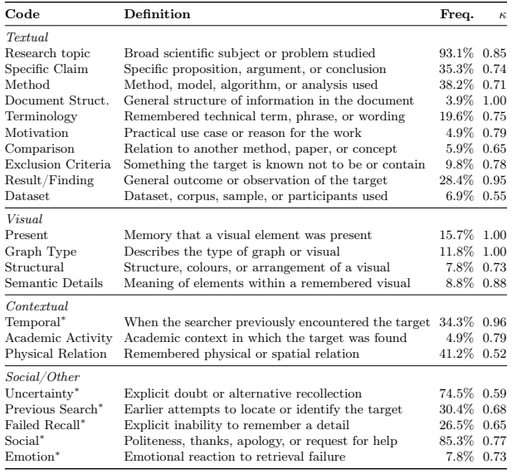
Table 2 : Codebook for characteristics in scientific tip-of-the-tongue queries. Freq. describes the annotated queries containing each characteristic. Cohen’sκmea- sures inter-annotator agreement. Asterisks∗ denote codes reused from [8].
Original paper · CC BY 4.0The same codebook and annotators then label 50 generated queries. Figure 3 places the code frequencies of online queries beside those of generated queries, in three groups. Specific claims are rarer in the generated queries, because the real sample held many requests for proofs. Generated queries mention methods, document structure and applications more often than the real requests do.
The authors tie this to LLM-extracted clues, which tend to emphasize these aspects.
Contextual codes were excluded from generation by design, since they need user history beyond the paper. Visual codes are overrepresented on purpose, so the benchmark stresses multimodal retrieval.
Retrieval setup and baselines
Each query in SciToT has one target document, so the retrieval task is known-item search run separately for each scientific domain. Because of this single target, the authors report MRR@10, Recall@1, Recall@10 and Recall@100 as their metrics. Each domain is evaluated independently, which lets future work study both domain-specific effectiveness and cross-domain generalization.
The retrievers search a collection for a single document given only an incomplete recollection query, so the scoring must work from partial memories.
The textual baselines are BM25 for lexical matching, E5-small-v2 and Qwen3-Emb-0.6B for dense semantic retrieval, and ColBERTv2 for token-level late interaction. Textual methods receive the extracted paper text, truncated to fit each model's input limit. The visual and page-level baselines are OpenCLIP and Qwen3-VL, and ColQwen2.5 covers page-level retrieval as a variant of the ColPali late-interaction method.
Qwen3-VL also runs on multimodal input, combining extracted text and figures. All methods are evaluated without fine-tuning, so the results reflect pretrained models.
For Qwen3-VL, all available inputs of a configuration are encoded jointly into one document-level embedding, which keeps in-document context. ColQwen2.5 is a page-level method, so the authors embed each page individually and rank with max-similarity. OpenCLIP encodes individual figures or pages and scores relevance with maximum cosine similarity.
ColQwen2.5 produces a large index, so the authors apply built-in hierarchical token pooling to shrink it to a size their storage budget allows.
Retrieval results across modalities
Table 5 averages each cell over the five retrieval datasets and leaves out missing values. Qwen3-Emb reached 0.710 MRR@10 on text alone, well above BM25, E5 and ColBERTv2, which landed between 0.115 and 0.128. The authors suggest that noise in queries and short context limits explain the weak lexical and early dense results. E5 read only 512 tokens, and ColBERTv2 used 32 query tokens, which caps what those models can see.
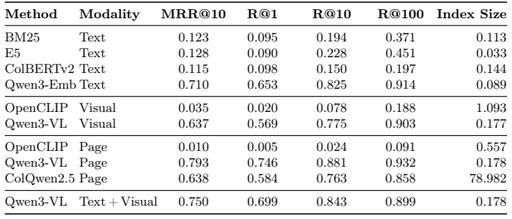
Table 5 : Retrieval effectiveness across methods and modalities. Each cell is an unweighted mean over available results from the five retrieval datasets; missing values are excluded. Index size (decimal GB) is averaged over datasets.
Original paper · CC BY 4.0 · Stan Fris, Sijie Tao, Makoto P. Kato, Maarten de Rijke · SciToT: Multimodal Tip-of-the-Tongue Retrieval for Scientific Papers · Original paper figure · Extracted the figure area from page 11 of the original PDF.OpenCLIP scored 0.035 MRR@10 on visual inputs, against 0.637 for Qwen3-VL on the same modality. OpenCLIP encodes each figure or page separately and ranks by maximum cosine similarity. The authors take this weak result to mean that visual information alone isn't enough without richer semantic representations. Qwen3-VL instead encodes all available inputs of a document into one document-level embedding, which keeps in-document context.
Adding extracted text to those visual inputs lifted Qwen3-VL from 0.637 to 0.750 MRR@10.
Page-level Qwen3-VL gave the best result, with 0.793 MRR@10 and 0.746 Recall@1. Page-level OpenCLIP reached only 0.010 MRR@10, so the page granularity doesn't rescue the weaker encoder. ColQwen2.5 scored 0.638 MRR@10 at page level, below page-level Qwen3-VL's 0.793. Its index reached 78.982 decimal GB, against 0.178 for Qwen3-VL, so the authors apply hierarchical token pooling to shrink it.
The authors note that Qwen3-based models handle both clue extraction and retrieval, which could favor these retrievers. The authors point out that the query generation model differs from the Qwen3 retrievers. Their takeaway is that more expressive document representations beat lexical matching in this setting.
Limitations of the SciToT benchmark and its results
The queries are synthetic, and the generation deliberately emphasizes visual clues, so they may not represent naturally occurring requests. Users should keep these limits in mind when they train or fine-tune retrieval models on SciToT. The real-request comparison rests on 51 annotated requests from CQA platforms and 50 generated queries. The comparison covers the generated queries' characteristics, so it can't establish how representative the full benchmark is.
Human annotators reached only weak agreement on relevance, with a weighted Cohen's κ of 0.210. Well-formedness agreement was even lower, at κ = −0.034, so no meaningful chance-corrected agreement was observed. The LLM judge agreed better with each human annotator than the two humans agreed with each other. The authors therefore treat the judge as a filtering mechanism, not a fine-grained measure of query quality.
Qwen3-based models handle both clue extraction and retrieval, so representational bias may favor these retrievers. The query generation model is a different one, which partly limits this concern. All baselines run without fine-tuning, so the results describe pretrained models only. Temporal and physical contextual clues were excluded from generation, so this part of re-finding is untested.
Paper info
- Authors
- Stan Fris, Sijie Tao, Makoto P. Kato, Maarten de Rijke
- Venue
- arXiv · Preprint
- First published
- 2026-11-4
- Added
- 2026-11-6
- Updated
- 2026-11-4
- Version
- v1
- arXiv
- 2611.05829
- Category
- cs.IR
- Original paper terms
- CC BY 4.0
- What we show
- Paper info, commentary and permitted figures from the original paper
AI commentary is a separate explanation from the original paper and may contain errors. The original paper and figures follow each source's terms of use and any rights noted separately.
Abstract
Researchers frequently encounter difficulties re-finding scientific papers when they remember aspects of the content but cannot recall reliable identifiers, such as titles or author names. This type of re-finding task, known as tip-of-the-tongue (ToT) retrieval, is particularly challenging for scientific documents, where recollections may involve textual information and visual elements, including figures, diagrams, and plots. Existing ToT retrieval benchmarks do not address scientific search. We introduce a multimodal benchmark for scientific ToT retrieval, comprising 108,512 open-access scientific documents across five domains and 11,499 synthetically generated queries. To construct the benchmark, we propose a scalable query elicitation pipeline that independently extracts textual and visual memory cues from source documents and uses large language models to generate queries resembling incomplete human recollections. We characterize scientific ToT information needs through an empirical analysis of publicly available re-finding requests and use the outcomes to assess the generated queries using human annotations and automated quality control. The benchmark includes lexical, dense, late-interaction, and visually grounded retrieval baselines. We release the dataset, extracted document representations, generated memory cues, evaluation splits, and accompanying generation and retrieval pipelines under an MIT license to facilitate research on multimodal scientific paper re-finding.
Quote from the paper
Stan Fris, Sijie Tao, Makoto P. Kato, Maarten de Rijke (2026). SciToT: Multimodal Tip-of-the-Tongue Retrieval for Scientific Papers. arXiv:2611.05829v1. https://arxiv.org/abs/2611.05829v1
BibTeX
@misc{fris2026scitot,
  title = {{SciToT: Multimodal Tip-of-the-Tongue Retrieval for Scientific Papers}},
  author = {Stan Fris and Sijie Tao and Makoto P. Kato and Maarten de Rijke},
  year = {2026},
  eprint = {2611.05829},
  archivePrefix = {arXiv},
  url = {https://arxiv.org/abs/2611.05829v1}
}