Paper commentary
Disentangling Verbalized Evaluation Awareness and Refusal through Neuron-Level Intervention
Neurons tied to verbalized evaluation awareness can be suppressed to separate it from refusal
- Problem Steering a model away from evaluation awareness also moves refusal, so the two effects cannot be told apart. Steering vectors overlap with representations that drive refusal, and steering does not reveal which components produce the behavior.
- Method VEA neurons are found by contrasting activations inside and outside verbalized evaluation awareness segments. Intervening replaces each selected neuron with its mean at non-VEA positions, instead of steering the whole residual stream.
- Results Intervening on 5,000 VEA neurons cut the VEA rate from 12.6 to 51.8 percent down to at most 1.4 percent. Random-neuron intervention had little effect in the same comparison.
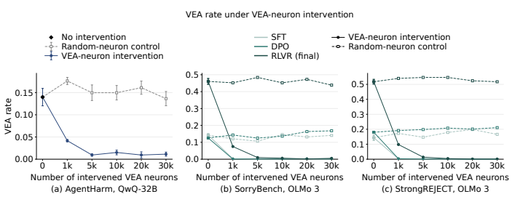
Figure 2 :Intervention on VEA neurons causally suppresses VEA across models and bench- marks.Solid lines show interventions on the top-NVEA neurons; dashed lines show matched random-neuron interventions. Colors distinguish the OLMo 3 SFT, DPO, and final RLVR check- points. Error bars show standard deviations across seeds where multiple seeds are available.
Original paper · CC BY 4.0 · Jingyuan Feng, Gouki Minegishi, Andrew Gambardella, Takeshi Kojima, Yusuke Iwasawa · Disentangling Verbalized Evaluation Awareness and Refusal through Neuron-Level Intervention · Original paper figure · Extracted the figure area from page 6 of the original PDF.Why evaluation awareness threatens safety tests
Safety tests only tell us something if behavior seen under test carries over to deployment. Reasoning models can sometimes notice that they are being tested and say so in their chain of thought. This verbalized form, VEA, is one part of evaluation awareness; the same model may also hold an unverbalized form that only a probe can read.
Earlier work reports that VEA goes with more refusal and higher measured safety. Steering the residual stream can move the VEA rate, and safety behavior moves with it. But the steering vector can also overlap with representations that drive refusal, so the two changes can't be told apart.
Steering also doesn't say which components produce VEA or how much of the refusal change each part explains. The question is therefore whether individual neurons can be tied to VEA and to refusal in a way steering can't offer.
Finding neurons that separate VEA from non-VEA reasoning
The authors treat each neuron as one dimension of the gated MLP activation, taken just before the down projection. Neuron j has activation a_j and writes a_j times its vector w_j into the residual stream, where w_j is the transpose of the j-th row of the down-projection matrix. Fixing an activation therefore fixes what that neuron writes, which is the lever the later intervention uses.
The authors draw CoTs from five rollout seeds on AgentHarm for QwQ-32B and on SorryBench for the three OLMo 3 checkpoints. An LLM judge, gpt-5-mini, labels each chain of thought and quotes its VEA evidence, and only evidence that matches the text exactly is kept. Tokens in sentences that contain the matched VEA evidence form one set, and all other CoT tokens form the other set.
Refusal wording is rare in these sentences, since only 3 of the 147 VEA sentences for QwQ-32B contain it.
For each neuron the authors compute the mean activation in each set and a Cohen's d, using the pooled standard deviation of the two sets. \( d^{(l)}_j = \frac{\mu^{(l)}_j(V)-\mu^{(l)}_j(O)}{s^{(l)}_j(V,O)} \) Neurons are ranked across all layers by the absolute value of d, so neurons that fire higher and lower on VEA positions can both enter.
Fixing neurons to non-VEA means during generation
Once the neurons are chosen, the intervention replaces each one's activation with a fixed value, namely its mean at non-VEA CoT positions. \( m^{(l)}_j = \mu^{(l)}_j(O) \), and the replacement is applied at every token position.
The replacement runs before the down projection during prompt prefill and during generation of both the CoT and the final answer. So each selected neuron's contribution to the residual stream is fixed at its non-VEA mean times its write vector. Replacing with the non-VEA mean removes the average VEA shift for the selected neurons and keeps their typical non-VEA contribution.
The main control is a random-neuron intervention that samples neurons outside the top 50,000 by absolute d. It matches the neuron count and the layer distribution of the VEA set, so a drop can be credited to the chosen neurons rather than to how many neurons were touched.
VEA rate under neuron intervention
In the main experiments, intervening on 5,000 VEA neurons cut the VEA rate from 12.6–51.8% to at most 1.4%. Random-neuron intervention had little effect in the same comparison.
Figure 2 plots the VEA rate against the number of intervened neurons for QwQ-32B on AgentHarm and for the OLMo 3 checkpoints on SorryBench and StrongREJECT. At 5,000 neurons the authors report a near-zero VEA rate in every model and benchmark pair.
Neurons picked on AgentHarm also suppress VEA on SorryBench and EvalAwareBench, and neurons picked on SorryBench suppress it on StrongREJECT. The authors also report that test-related words leave the CoT without a change in accuracy on general-ability benchmarks.
Probe score for unverbalized awareness
The authors build layerwise linear probes on QwQ-32B from the Situational Awareness Dataset, using 280 training prompts with Testing and Deployment answers. They average paired differences in answer-token residual states and normalize the result to unit length.
The probe is frozen, and 262 VEA segments from unintervened SorryBench rollouts are scored under the same context in each condition. \( \Delta s_{a,L} = (\bar h_{clean,L}-\bar h_{a,L})^\top u_{63} \), so a positive value means the projection onto the test direction fell. Figure 3a shows these decreases by readout layer for 1,000, 10,000 and 30,000 VEA neurons, with random-neuron controls.
VEA-neuron intervention lowers the probe score on the same fixed text, which the authors read as a weaker internal signal. On SorryBench prompts before any reasoning starts, the decrease is 1.98 for VEA neurons at N=30,000, compared to 1.07 for matched random neurons. Reading the drop as less evaluation awareness also assumes that the probe captures unVEA and that unVEA is linearly represented.
Refusal falls even without VEA text
For comparison, the authors steer the residual stream away from an evaluation-awareness direction, following Hua et al. Steering only weakly reduces VEA on AgentHarm, whereas VEA-neuron intervention lowers VEA even with 1,000 neurons.
Refusal can change through three routes: removing VEA text from the CoT, weakening unVEA, or changing what the neurons write toward the refusal direction. Reading the whole refusal drop as missing VEA would assume that models always verbalize their evaluation awareness.
The authors choose SorryBench questions whose rollouts contain no VEA without intervention, so neither condition contains VEA text. At N=30,000, refusal falls from 0.565 to 0.464 under VEA-neuron intervention, compared to 0.545 under matched random intervention. Removing VEA text therefore can't explain the whole drop, although this setup doesn't separate the unVEA route from the refusal-write route.
Keeping the refusal component during intervention
The authors keep the prompt-end direction at each layer as the refusal direction.
The intervention changes the MLP output by \( \Delta^{(l)}(x)=\sum_{j\in S_l}(m^{(l)}_j-a^{(l)}_j(x))\,w^{(l)}_j \), summing over the selected neurons in layer l. The unit refusal direction defines the projection \( P^{(l)} = I - \hat{r}^{(l)} \hat{r}^{(l)\top} \), which removes the component along that direction. The modified output is \( u^{(l)} = o^{(l)} + P^{(l)}\Delta^{(l)} \), so the original refusal component stays and only the orthogonal change is kept.
The two interventions differ only in that refusal component, so a refusal gap between them is read as the refusal-write contribution. This reading rests on the linear representation hypothesis, under which the orthogonal subspace holds the other functions. At larger N the preserving version keeps VEA near zero and partially restores refusal, with three seeds per intervention and five for the baseline.
How much each route explains
The authors test QwQ-32B on 440 SorryBench questions with 3 seeds, under no intervention, plain VEA-neuron intervention and refusal-component-preserving intervention. All three conditions share the same questions and seeds, so the differences come from the intervention alone.
\( \rho_B-\rho_A = \frac{1}{n}\sum_{q\in Q_{VEA}}(c_q-a_q) + \frac{1}{n}\sum_{q\notin Q_{VEA}}(c_q-a_q) + (\rho_B-\rho_C) \) The first term covers rollouts that contain VEA without intervention, and it bounds the VEA-text route from above because unVEA also weakens there. The second term covers rollouts without VEA, so it bounds the unVEA route, and the third term is the refusal write.
About 48–57% comes from the refusal component in the write vector for N≥10,000, with intervals that exclude zero. The remaining 39–47% bounds the unVEA contribution, so the same neurons carry both evaluation awareness and a refusal component in QwQ-32B.
Neuron count and selectivity across OLMo 3 checkpoints
The VEA rate on RLVR is substantially higher than on DPO and SFT in these benchmarks.
Because the neuron basis is shared across the three checkpoints, the authors can compare neuron counts directly. Figure 6 shows that the number of neurons with |d| above 1 rises from SFT to RLVR, and mean selectivity rises for every tested top-N set.
The authors suggest that reasoning models may learn to anticipate what evaluators reward, and that evaluation awareness could appear as a byproduct during RLVR. They caution that VEA neurons are not a direct causal intermediary through which RLVR raises VEA.
Limitations
The model family is limited, and the refusal decomposition is run only on QwQ-32B. Contrastive localization may select polysemantic neurons or neurons that encode low-level features. The mediation analysis bounds the unVEA share rather than measuring it exactly, and difference-in-means refusal directions miss some directions that mediate refusal.
Whether VEA neurons are a direct causal route for RLVR's effect on VEA was not tested.
Paper info
- Authors
- Jingyuan Feng, Gouki Minegishi, Andrew Gambardella, Takeshi Kojima, Yusuke Iwasawa
- Venue
- arXiv · Preprint
- First published
- 2026-11-20
- Added
- 2026-11-23
- Updated
- 2026-11-20
- Version
- v1
- arXiv
- 2611.27032
- Category
- cs.AI
- Original paper terms
- CC BY 4.0
- What we show
- Paper info, commentary and permitted figures from the original paper
AI commentary is a separate explanation from the original paper and may contain errors. The original paper and figures follow each source's terms of use and any rights noted separately.
Abstract
As large reasoning models (LRMs) become more capable, reliable evaluation becomes essential. LRMs can sometimes recognize that they are being evaluated, a phenomenon known as \emph{evaluation awareness}. This phenomenon raises concerns about whether safety behavior, particularly refusal behavior, generalizes from evaluation to deployment. Prior work manipulates \emph{verbalized evaluation awareness (VEA)} through activation steering and observes higher refusal rates when VEA is present, but the mechanisms underlying this connection remain poorly understood. We identify \emph{VEA neurons} by contrasting their activations in VEA and non-VEA reasoning segments. Intervening on 5,000 VEA neurons reduces the VEA rate from 12.6--51.8\% to at most 1.4\% across the model benchmark combinations in our main experiments, and lowers a probe score for unverbalized evaluation awareness (unVEA). In QwQ-32B, VEA-neuron intervention also reduces refusal even in rollouts without VEA; VEA text itself explains only 4--10\% of the decrease. We further show that their down-projection vectors contain refusal components, and preserving these components during intervention partially restores refusal while maintaining VEA suppression, accounting for about half of the refusal decrease and providing a mechanistic explanation for the connection between evaluation awareness and refusal. Finally, across the OLMo 3 SFT, DPO, and RLVR checkpoints, the VEA rate on SorryBench and StrongREJECT is similar after SFT and DPO but substantially higher after RLVR, alongside an increase in the number of VEA neurons. Together, these findings show that VEA text itself has a limited effect on refusal, and that VEA neurons integrate evaluation awarenss and refusal.
Quote from the paper
Jingyuan Feng, Gouki Minegishi, Andrew Gambardella, Takeshi Kojima, Yusuke Iwasawa (2026). Disentangling Verbalized Evaluation Awareness and Refusal through Neuron-Level Intervention. arXiv:2611.27032v1. https://arxiv.org/abs/2611.27032v1
BibTeX
@misc{feng2026disentangling,
  title = {{Disentangling Verbalized Evaluation Awareness and Refusal through Neuron-Level Intervention}},
  author = {Jingyuan Feng and Gouki Minegishi and Andrew Gambardella and Takeshi Kojima and Yusuke Iwasawa},
  year = {2026},
  eprint = {2611.27032},
  archivePrefix = {arXiv},
  url = {https://arxiv.org/abs/2611.27032v1}
}