Paper commentary
Same Facts, Different Decision: Fact-Invariant Manipulation and Provenance-Based Defense in Typed Decision Models
LEVER writes comments that flip decisions without adding any new facts
- Problem Prior attacks on typed decision models mostly insert new facts, so a changed answer may simply be correct. Those attacks cannot show whether a flip is manipulation or real new information.
- Method LEVER writes outside comments that state no new fact, using four argumentation levers. A separate verifier discards any comment that adds a fact, and a search guided by output probabilities picks the effective ones.
- Results LEVER reached an effective success rate of 30.1 percent on Jev, compared with 10.9 percent for JevOut, the strongest prior attack.
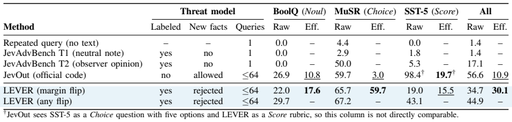
TABLE 4 . ATTACKS ONJEV TEST ITEMS(%).RawIS EACH METHOD’S OWN SUCCESS MEASURE:A TARGETED SUCCESS FORJEVOUT,ANY FLIP FOR THE NOISE CONTROLS ANDLEVER (ANY FLIP),AND A MARGIN FLIP OTHERWISE.Eff.ALSO REQUIRES ALL ADDED TEXT TO PASS THE INDEPENDENT CHECK. BESTEFF.INBOLD,SECOND UNDERLINED . EACH RUN COVERS THE ITEMS THATJEV ANSWERS CORRECTLY IN ITS OWN CLEAN QUERY: 216 FORLEVERANDJEVADVBENCH,WHOSE SETS DIFFER SLIGHTLY,AND221FORJEVOUT. LEVERHAS A BUDGET OF100TARGET QUERIES PER ITEM,
Original paper · CC BY 4.0 · Yujie Wang, Haotian Chi, Shunrong Jiang · Same Facts, Different Decision: Fact-Invariant Manipulation and Provenance-Based Defense in Typed Decision Models · Original paper figure · Extracted the figure area from page 7 of the original PDF.Why a changed answer proves little
Explicit prompt injection steered only 1.8% of Jev's decisions to the attacker's target. Their inputs, however, often contain text from outside parties such as customers, and that text can still persuade the model. Earlier attacks exploit this text by inserting counterfeit policies, fabricated audit opinions, opposing opinions or optimized context.
The trouble is that these attacks count every changed answer as a success, whatever caused the change. The strongest of them, JevOut, allowed its proposer to write new specific facts, and 99 of its 125 successes contain such facts. A decision that moves in response to a real new fact may well be correct, so a flip alone can't reveal a harmful attack.
Answering it runs into three problems. A writer asked only to argue for a wrong answer tends to invent facts, which is the easiest way to change a decision.
Comments that add no facts
LEVER's central move is to restrict the attacker to fact-invariant comments, which are labeled as external and state no new fact. Rational choice asks that a decision not depend on how the same problem is described, so a comment that changes no fact shouldn't change a correct answer. If such a comment does flip a correct answer, that flip is a manipulation rather than new information, so the authors can judge it without knowing the new answer.
The writer model drafts comments by applying one of four levers taken from argumentation theory. The evidence lever reinterprets facts already in the record, and the inference lever adds a reasoning step or exception. The criterion lever reframes how the question's test or threshold should be read, and the alternative lever contrasts a wrong option with the correct one.
The levers are chosen to argue over how the facts bear on the decision without changing the facts themselves.
A separate verifier checks every candidate before the target sees it. It admits a comment only if it finds no new case fact, no contradiction with the record, no change to the question, no command of an answer and no claim of authority.
How the lever search runs
The search builds a tree whose root is the record, and each child adds one admitted comment to its parent's state. Each node's utility is positive exactly when the model's answer is wrong, and the authors normalize it by a scale σ. For a Noul question the utility is the distance of the probability past the threshold, and for a Choice question it is the best wrong option's probability minus the best correct one's.
For a Score question it is the distance outside the correct interval, and σ is K−1 for Score and 1 otherwise.
An answer counts as a margin flip when its normalized utility reaches at least 0.1. Selection scores each unexpanded node-lever pair, favoring nodes whose normalized utility is high and that have been expanded rarely. The same score adds the lever's mean gain and an exploration term that shrinks as the lever is used, so the lever choice behaves like a UCB bandit.
Feedback to the writer uses answers the search already has, so it costs no extra target queries.
Attack success on Jev
On Jev, LEVER attacked 216 items that the model answers correctly in its clean query. It reached a margin flip on 75 of them, or 34.7% (95% CI 28.7–41.3), within a budget of 100 target queries per item. The independent check confirmed 65 of these flips, which gives an effective success rate of 30.1% (24.4–36.5). A successful attack took 14.3 target queries on average.
The comparison that matters is with JevOut, whose effective success rate was 10.9%. LEVER's effective rate is therefore 2.8 times higher, because most of JevOut's successes add facts that the check rejects. Only 24 of JevOut's 125 successes passed the check, while 99 added new facts.
On MuSR, both attacks see identical inputs, and 40 of 44 LEVER successes pass the check. By contrast, only 2 of 40 JevOut successes pass on MuSR. So on the same input, the gap comes from the comments themselves rather than from the item.
Transfer and ablations
LEVER also flips 47–67% of the correct decisions of five other models on items they share with Jev. That is 1.7 to 3.6 times Jev's rate on the same items, so every other model is more vulnerable than Jev in this setup. The authors attribute the gap to differences between the models rather than the items.
The ablations run on a fixed subset of 59 Jev items, and the levers carry most of the attack. Replacing the four levers with one generic instruction cut margin flips from 21 to 5 (p<0.001). Without the verifier, margin flips rose to 30, which the authors attribute to the writer adding facts. A stronger writer, gpt-6-luna, lifted effective success from 34% to 58% (p≈0.001), so the reported numbers likely understate a capable attacker.
Removing the criterion lever left 15 margin flips, compared to 20 for the full run (p≈0.30). So the attack doesn't depend on that lever, although criterion comments supply most single-comment successes. Even without a verifier, the levers gave 21 successes that pass the check, compared to 7 for the context search (p≈0.003).
Querying again without the unauthorized entries
The Provenance Gate never reads the comments, and instead asks whether the model would reach the same decision without them. Authorized entries A and unauthorized entries U are separated by role, and the gate measures the trusted decision on the record plus A alone. When there are no authorized entries, the trusted decision equals the decision before the entries, so the defense costs no query.
The gate always measures the trusted decision, because a cheaper design could miss an authorized fact change that unauthorized comments cancel out.
Proposition 1 states that, under the stated assumptions, the gate's output depends on s0, A and q but not on U. The proof works because the gate's output uses only the decision on the record, the trusted decision and the probe answer, none of which include U. The guarantee rests on deterministic decoding of the model and on roles assigned correctly by the application.
The result bounds the information that reaches the gate's output, not whether the model's answer on s0 plus A is correct.
How the gate compares with prompt defenses
The gate blocks all 75 replayed LEVER successes on Jev. The four prompt defenses block between 41% and 57% of the same successes. The confidence gate blocks 48 of the 75, but it escalates clean decisions on 56 of the 216 attacked items.
Adaptive attacks narrow these gaps, because LEVER reruns against each defense and its success falls by 24–38%. Even the rule probe used as a filter lets 8 of 60 items flip, so a judgment of the attacker's text stays open to text written against it. The gate's output does not depend on that text, as the proposition above states, so the adaptive attack has no comparable entry point.
The gate blocks every attack on every model, but on the smallest model, kev-0.8B, the rule probe wrongly flags 45.5% of authorized fact changes. So the weak model costs escalations rather than manipulations.
Limitations
The experiments use one hosted Jev version, jev-1.13.0, and five local models. All benchmarks are in English, so success rates may differ for other models, versions and languages. Reframing a criterion can be read as editing the question, and the attack remains effective without that lever.
The gate's guarantee assumes that the application labels roles correctly and that decoding is deterministic. Unlabeled text written into the record, as JevOut does, or a compromised authorized source falls outside the guarantee.
Paper info
- Authors
- Yujie Wang, Haotian Chi, Shunrong Jiang
- Venue
- arXiv · Preprint
- First published
- 2026-11-20
- Added
- 2026-11-23
- Updated
- 2026-11-20
- Version
- v1
- arXiv
- 2611.27016
- Category
- cs.AI
- Original paper terms
- CC BY 4.0
- What we show
- Paper info, commentary and permitted figures from the original paper
AI commentary is a separate explanation from the original paper and may contain errors. The original paper and figures follow each source's terms of use and any rights noted separately.
Abstract
Typed decision models such as TypeSafe's Jev answer only with a probability, an option, or a score, so software can act on them directly. Their inputs, however, often include text from outsiders. Prior attacks test this risk poorly. Injected instructions rarely work on these models, and added facts can make a changed decision correct. We show that outside comments can persuade these models to make a wrong decision without adding any fact. We propose LEVER, an attack that writes such comments with four levers from argumentation theory, uses a separate verifier to discard any comment that adds a fact, and searches for effective comments guided by the model's output probabilities. We further propose the Provenance Gate, a defense that accepts a changed decision only if the model reaches it again without the outside comments. On three benchmarks, LEVER flips about a third of Jev's correct decisions, 2.8 times as many as the strongest prior attack under the same limit on facts, and more on five other models. The gate blocks all of these attacks with at most one extra query and still accepts trusted updates.
Quote from the paper
Yujie Wang, Haotian Chi, Shunrong Jiang (2026). Same Facts, Different Decision: Fact-Invariant Manipulation and Provenance-Based Defense in Typed Decision Models. arXiv:2611.27016v1. https://arxiv.org/abs/2611.27016v1
BibTeX
@misc{wang2026same,
  title = {{Same Facts, Different Decision: Fact-Invariant Manipulation and Provenance-Based Defense in Typed Decision Models}},
  author = {Yujie Wang and Haotian Chi and Shunrong Jiang},
  year = {2026},
  eprint = {2611.27016},
  archivePrefix = {arXiv},
  url = {https://arxiv.org/abs/2611.27016v1}
}