Paper commentary
Optimal Labelling Designs for Sequential Decisions on Language Model Updates
SOLD labels fewer prompts to tell whether an LLM update helped
- Problem The usual Neyman allocation rarely labels prompts the judge is confident about, so sequential tests can need far more draws.
- Method SOLD labels one prompt at a time, with probability at least proportional to its downside. It stops once the evidence is conclusive.
- Results On EVOUNA, SOLD needed the fewest labels in 12 of 16 cases, and it needed the fewest in all 8 MMLU-Pro cases.
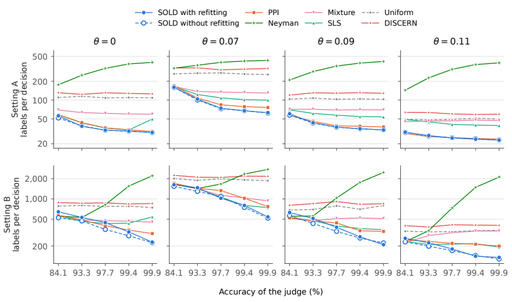
Figure 1 : Mean labels per decision against the accuracy of the judge, for each setting andθ.
Original paper · CC BY 4.0 · Doudou Zhou, Jiahui Xie, Yue Liu · Optimal Labelling Designs for Sequential Decisions on Language Model Updates · Original paper figure · Extracted the figure area from page 25 of the original PDF.Why Neyman allocation stalls
A judge can score both versions on every prompt cheaply, yet its scores are imperfect, so it can guide labelling but cannot replace it. Neyman allocation is the usual target for a fixed budget, because it makes the variance of the estimate as small as possible.
That variance criterion ignores a constraint that matters once labels arrive one at a time. Because the judge is so sure, the variance-minimising design labels such a prompt rarely, and a -1 label would then force every bet to stay small.
The key idea: label by downside
The authors ask which design makes the wealth of a betting test grow fastest, since that design needs the fewest draws to reach its threshold. Their answer labels each prompt at least in proportion to its downside, the largest amount its outcome can fall below the judge's predicted mean. The downside is h(x) = m(x) - l(x), where m(x) is the judge's mean prediction and l(x) is the smallest possible outcome.
This floor comes from the safety condition: a bet stays safe for every possible label only when r(x) is at least t times h(x). Above the floor, the design equalises the marginal gain in growth rate across prompts, and Theorem 1 shows this is the optimal design for a single test. Proposition 3 then bounds the growth rate of any design that labels some prompt rarely relative to its downside, as G is at most (θ - δ) divided by (H(r) - ∆).
One step of SOLD
At each step SOLD draws one prompt with probability r_i(x)/N, where r_i mixes the optimal design with uniform sampling of the candidates.
Once the label Y_i arrives, the increment Z_i = µ + (Y_i - m(X_i))/r_i(X_i) is the prediction-powered estimate of θ from that one label. Each test multiplies its wealth by 1 + λ_i(Z_i - δ), and a prompt drawn again reuses its earlier label, so each label is paid for once.
The four one-sided tests share every draw, and the design follows the decision that the current estimate points to. While the estimate sits within the tolerance, the two negligibility tests must both reject, so the design has to serve both. If the two best designs tie, SOLD picks between them at random with a fixed probability, which can need fewer draws than any single design.
Because the best bet is uncertain, SOLD averages the wealth over multiples of the base bet between 0 and 1, as in the universal portfolio. A test rejects when its wealth reaches 2/α, and labelling stops at the first decision. If every candidate is labelled first, θ is known and the decision is read off.
Simulation evidence
The simulated pools hold 3,000 prompts, with δ = 0.05 and α = 0.05. The authors vary the judge's accuracy from 84.1% to 99.9% and θ over four values, giving 40 combinations.
Wrong decisions stayed rare, since SOLD made 1 in 5,000 runs and SOLD with refitting made 8.
Without refitting, PPI needed 1.16 times the labels of SOLD and Neyman allocation needed 6.49 times, averaged over the 40 combinations. The gap widened with judge accuracy: in the hardest case, Neyman allocation rose from 1,426 labels at 93.3% accuracy to 2,743 at 99.9%. The authors read this rise as the small bets that Neyman allocation forces, which Theorem 4 predicts.
That hardest case is θ = 0.07 in setting B, where SOLD needed 1,535 labels at 84.1% and 518 at 99.9%.
The authors also made the judge's probabilities wrong in eight ways, such as overconfidence or favouring one version. Refitting matters most when the probabilities are overconfident or favour one version. Without refitting, SOLD needed 1.95 times the labels of SOLD with refitting when c = 4 in both settings.
Replays on EVOUNA and MMLU-Pro
The EVOUNA replay uses 3,019 Natural Questions and 1,938 TriviaQA questions, each with human correctness marks for five systems. The judge agreed with the annotators on 95.1% of 24,785 answers.
The authors explain this by Neyman and SLS giving near-zero labelling probabilities to questions the judge is nearly sure about, which limits their growth.
MMLU-Pro has 12,032 multiple-choice questions with keyed answers, and the four updates cover Llama and Mistral versions. The judge, Claude Opus 5.5, gives each option a probability of being the key. SOLD with refitting needed the fewest labels in all 8 cases. Averaged over the cases, Neyman allocation needed 9.47 times the labels of SOLD without refitting.
Limitations
The bound on the number of labels only holds when every prompt is a candidate and the design probabilities stay below a constant. The asymptotic results assume the judge's probabilities are not refitted and that the expected downside is positive. The optimal design result also needs the residual standard deviation to be positive on a set of positive probability.
The simulations draw the judge's scores from a normal model, so its probabilities are correct only on average over the pools. On the real data, 44% of J2's probabilities were exactly 0 or 1, so the authors clipped them. The authors leave open a matching lower bound for refitted predictions and a bound on the number of labels at a fixed level.
In recursive self-improvement, labels of an earlier version could carry over, so later rounds might cost less, a point the authors leave for future design work.
Paper info
- Authors
- Doudou Zhou, Jiahui Xie, Yue Liu
- Venue
- arXiv · Preprint
- First published
- 2026-11-22
- Added
- 2026-11-24
- Updated
- 2026-11-22
- Version
- v1
- arXiv
- 2611.29416
- Category
- stat.ML · cs.LG
- Original paper terms
- CC BY 4.0
- What we show
- Paper info, commentary and permitted figures from the original paper
AI commentary is a separate explanation from the original paper and may contain errors. The original paper and figures follow each source's terms of use and any rights noted separately.
Abstract
When a large language model (LLM) is updated, its developer must decide whether accuracy improved, worsened or stayed within a tolerance. An LLM judge can assess every prompt cheaply but imperfectly, while human labels are costly. We propose Sequential Decisions with Optimal Labelling Designs (SOLD), which labels one prompt at a time, uses the judge to correct the estimate of the change in accuracy and to choose the prompts, and stops once the evidence is conclusive. A wrong decision has probability at most a prespecified level whenever labelling stops. The commonly used Neyman allocation minimises the variance of the estimate and therefore rarely labels prompts that the judge is confident about. It can need far more draws when the outcomes of these prompts could still fall far below the judge's prediction. We instead derive the design that gathers evidence fastest, which labels each prompt with probability at least proportional to how far its outcome could fall below the prediction. As the level tends to zero, no procedure based on the judge-corrected estimates needs fewer draws than SOLD. In simulations and on the EVOUNA and MMLU-Pro datasets, SOLD needed fewer labels than the other methods.
Quote from the paper
Doudou Zhou, Jiahui Xie, Yue Liu (2026). Optimal Labelling Designs for Sequential Decisions on Language Model Updates. arXiv:2611.29416v1. https://arxiv.org/abs/2611.29416v1
BibTeX
@misc{zhou2026optimal,
  title = {{Optimal Labelling Designs for Sequential Decisions on Language Model Updates}},
  author = {Doudou Zhou and Jiahui Xie and Yue Liu},
  year = {2026},
  eprint = {2611.29416},
  archivePrefix = {arXiv},
  url = {https://arxiv.org/abs/2611.29416v1}
}