Paper commentary
Prove What You Can: Hybrid Neurosymbolic Reasoning for Logical Natural Language Inference
Hybrid Reasoning has a theorem prover check each LLM proof step
- Problem Whole-problem translation to first-order logic fails to run when one clause is wrong. LLM proofs also often stop before reaching the hypothesis and answer UNCERTAIN.
- Method Hybrid Reasoning has an LLM propose a proof tree, then a theorem prover checks each derivation separately. It keeps only the validated steps and re-derives UNCERTAIN labels from them.
- Results On FOLIO, Hybrid Reasoning scored 88.4 mean accuracy, compared to 83.1 for Logic-LM, the strongest baseline there.
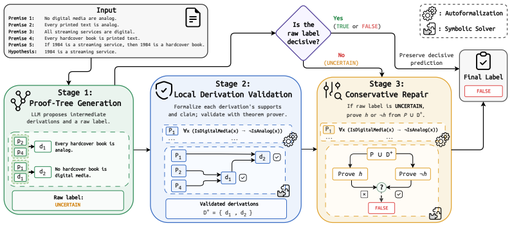
Figure 1 :Hybrid Reasoning. Stage 1an LLM proposes derivations di with supports Si and a raw verdict.Stage 2 each derivation is validated as a local entailment problem Si ⊢d i, yielding the validated set D+ ={d i :S i ⊢d i}. Stage 3if the raw verdict is decisive (TRUE/FALSE) the prediction is preserved; otherwiseuncertainty-gated repair attempts to provehor¬hfromP∪ D +, repairing the label only if one side is discharged.
Original paper · CC BY 4.0 · Ada Canoğlu, Sadiq Qara · Prove What You Can: Hybrid Neurosymbolic Reasoning for Logical Natural Language Inference · Original paper figure · Extracted the figure area from page 3 of the original PDF.Why one bad step breaks logical NLI
Logical NLI needs two things at once: reading the premises correctly and searching for a derivation of the hypothesis, its negation, or neither. Large language models are flexible interpreters, but their multi-step reasoning is often not faithful. An intermediate step may fail to entail its conclusion, and a right final answer can still come from a wrong chain.
Neurosymbolic systems avoid unsound chains by translating the whole problem into a formal language and handing it to a symbolic solver. These methods work when the translation is faithful and executable. Process-level methods instead score or search over individual reasoning steps. They typically rely on learned verifiers, which are approximate and offer no symbolic guarantee.
The two families fail in complementary ways, and the authors build on that difference. A proof-tree model often derives correct intermediate facts, but it stops before the hypothesis and answers Uncertain. A monolithic formalizer, by contrast, fails whenever part of the input is mistranslated. The authors therefore use LLM proof trees as semantic proposal mechanisms and theorem provers as local agreement filters.
Their method validates individual candidate derivations and reuses only those the symbolic stage accepts, instead of trusting a whole tree.
Checking derivations instead of whole proofs
The key idea is to let the LLM propose a proof and let a theorem prover judge each step separately. The authors use proof trees as semantic proposals and the prover as a local agreement filter, rather than trusting a whole generated tree or demanding one global formalization. A step the prover can't discharge is dropped instead of being counted against the model.
In Stage 1 the LLM returns an ordered list of derivations, each with a claim and a support set drawn from the premises and earlier derivations. The same output also carries a raw verdict among TRUE, FALSE and UNCERTAIN. The parser checks required fields and confirms that every support exists and that the dependencies form no cycle. If the object is still malformed after one repair prompt, the instance gets a chain-of-thought prediction, which happened in 2 of 4,085 Hybrid runs.
An autoformalization module writes a shared vocabulary and first-order formulas, which are lowered to Prover9 and run. Derivations that Prover9 proves form the validated set D+, and the rest are simply left out of it.
Stage 3 leaves a decisive raw verdict alone, so validated derivations can't overturn a confident TRUE or FALSE. When the verdict is UNCERTAIN, repair attempts to prove h from the premises plus D+, and then to prove not h. It relabels the instance by whichever side it proves first, and otherwise keeps UNCERTAIN. The symbolic work stays inside the derivational structure the LLM already proposed.
Gains on FOLIO and ProverQA
On FOLIO and ProverQA, the two hardest and least saturated sets, Hybrid Reasoning has the highest accuracy with every model. On FOLIO the mean was 88.4, compared to 83.1 for Logic-LM, which was the strongest baseline there. On ProverQA the mean was 78.8, compared to 73.9 for Logic-LM, with a peak of 81.0 for Grok 4.3. The authors read these numbers as a sign that the pipeline helps most where the task is hardest.
The authors tie these gains to the regimes where whole-problem translation often fails to execute. The raw verdict alone scored 65.0 on ProverQA, so the gain comes mostly after validation and repair. Validation and repair lift that raw verdict to 78.8, which is the source of most of the improvement.
Hybrid's lead on these two datasets is tested against every baseline, not only Logic-LM. The ProofWriter result is different, because the monolithic Autoformalization baseline reaches 97.2 against 96.8 for Hybrid. On PrOntoQA, Hybrid reaches 100.0 accuracy with all five models, as do LINC and Autoformalization.
How firm the margins are
The authors test every gap on paired examples, so each comparison uses the same benchmark items for both methods. Per model, they use a two-sided exact McNemar test, which looks only at examples where the two methods disagree. Holm correction is applied within three families, primary, repair and secondary, so p-values are adjusted together inside each family.
Averaged over the five models, the lead over every baseline on FOLIO and ProverQA is significant, with Holm-corrected p below .001. The smallest lead is over Logic-LM, at +5.3 points on FOLIO with a 95% CI of [2.3, 8.5]. On ProverQA the smallest lead, over Logic-LM, is +4.9 points with a 95% CI of [2.4, 7.3]. The per-model evidence is weaker, so the authors' significance claims concern the mean over models.
On ProofWriter the monolithic Autoformalization baseline is marginally ahead on average, at 97.2 against Hybrid's 96.8. The gap of -0.4 points against Autoformalization has a 95% CI of [-1.2, 0.4], with Holm-corrected p of 1.0. The gap of +0.4 points against LINC, with a CI of [-0.6, 1.4], is not significant either. Hybrid still stays significantly ahead of Logic-LM, CLOVER, Standard and CoT on ProofWriter, with p below .001.
So the authors describe Hybrid as highly competitive on ProofWriter rather than best there.
Hybrid Final's gain over Hybrid Raw is significant on FOLIO, ProofWriter and ProverQA, with Holm-corrected p below .001. On ProverQA the gain is +13.8 points, with a 95% CI of [10.4, 17.3]. The gain is not significant on PrOntoQA, at +0.1 points with p of 1.0, which the authors treat as saturated. The repair step fires on 6.9% of FOLIO instances and 19.4% of ProverQA instances, with precision of 90.5% and 78.4%.
Where the repair step helps
Repair fires only on UNCERTAIN verdicts, which is 6.9% of instances on FOLIO and 19.4% on ProverQA. On those firings, precision is 90.5% on FOLIO, 98.2% on ProofWriter and 78.4% on ProverQA. Across all datasets, repair makes 326 helpful and 19 harmful relabellings, so the net is +307. On PrOntoQA, repair fires on a single instance, and that firing is correct.
The authors vary which derivations enter the repair premise set and whether repair may revise every verdict. Admitting unvalidated derivations lets the prover resolve correct UNCERTAIN verdicts, which causes 89 regressions under the gate. With validated derivations only, the same gate yields 19 regressions.
The regressions from unvalidated derivations are largest for Gemini 3.1 Flash-Lite. Pooled over models, 72 of the 89 harmful relabellings involve a rejected derivation. Ungated repair overturns only 13 of 2,500 decisive verdicts. It breaks more correct verdicts than it fixes, so the gate doesn't cost useful corrections in practice.
Validation status as a reliability signal
The authors bin each instance by its validation status: fully validated, partially validated, not validated, or an empty tree. The share of the proof tree that validates is the signal, computed as the proportion of derivations kept in D+ over k. Because the status uses only the prover's verdicts, it needs no gold labels to compute. Figure 3 pools the results across models, so each bin covers every model's instances.
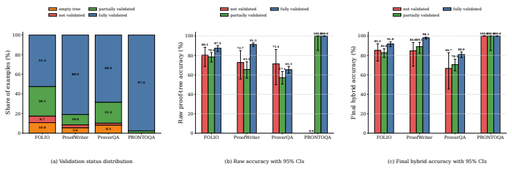
Figure 3 : Validation-status analysis, pooled across models. (a) Share of instances by how much of the proof tree validated. (b) The LLM’srawaccuracy is higher for fully than for partially validated trees, making validation status a label-free reliability signal. (c) The repaired pipeline improves accuracy at every level, most where raw reliability is lowest. Error bars are95%Wilson intervals.
Original paper · CC BY 4.0Raw accuracy is higher for fully validated trees than for partially validated ones. That gap makes validation status a label-free reliability signal for the raw verdict. The authors read the figure's 0.0 raw accuracy bin as a sign of how small and uneven some bins are. Raw accuracy alone does not tell the reader how much of the gap comes from the tree itself.
The repaired pipeline improves accuracy at every validation level, so Hybrid Final lifts the weakest bins most. Gains are largest where raw reliability is lowest, which is where the repair stage has the most abstentions to resolve. The authors don't claim that validation status replaces the repair stage; they use it as an indicator of trust.
Where the results stop
The symbolic stage targets first-order entailment, and every benchmark used here is first-order. Temporal, modal, defeasible and arithmetic reasoning would each need their own translator and solver. The authors didn't test those logics, so the results say nothing about them. Validation can fail silently when a derivation becomes valid but semantically wrong first-order logic.
Similar failures appear in earlier translation-based systems, and they cap the precision of the repair stage.
Repair is least precise on ProverQA, where contradictory formalized premises let the prover prove any goal. An exclusive “either . . . or” premise read as inclusive is one example of such a contradiction. Refusing to relabel when the premise set is unsatisfiable would raise ProverQA repair precision to 96.4% (133 of 138). That refusal would also lower accuracy by 1.5 points, because 27 of the vacuous relabellings matched the gold label.
The gate is conservative, so confidently wrong decisive verdicts stay wrong. A more aggressive policy, such as confidence-thresholded overwrites, could move the precision–coverage frontier. Inference cost grows with proof-tree size, because each derivation needs an autoformalization and a prover call. Long-chain UNCERTAIN instances run the full pipeline, including repair.
Paper info
- Authors
- Ada Canoğlu, Sadiq Qara
- Venue
- arXiv · Preprint
- First published
- 2026-11-6
- Added
- 2026-11-10
- Updated
- 2026-11-6
- Version
- v1
- arXiv
- 2611.10319
- Category
- cs.CL
- Original paper terms
- CC BY 4.0
- What we show
- Paper info, commentary and permitted figures from the original paper
AI commentary is a separate explanation from the original paper and may contain errors. The original paper and figures follow each source's terms of use and any rights noted separately.
Abstract
Logical reasoning over natural language requires both semantic interpretation and deductive search. Large language models (LLMs) can propose plausible intermediate derivations, but they often fail to compose them into a complete proof and overpredict uncertainty. Neurosymbolic methods improve search by translating an entire problem into first-order logic and handing it to a prover, but a single bad clause can make the whole translation nonexecutable. We present Hybrid Reasoning, a three-stage pipeline that decouples proposing a proof, validating its steps, and deciding a label. An LLM proposes a structured proof tree with a raw verdict; a theorem prover validates each derivation locally, keeping only the subset it can prove; and an uncertainty-gated repair attempts to re-derive the label from the premises plus the validated derivations, when the raw verdict is UNCERTAIN. Across four benchmarks (FOLIO, ProofWriter, ProverQA, PrOntoQA) and five contemporary LLMs, Hybrid Reasoning is the top-performing method on the two hardest datasets, improving on the strongest baseline by 5.3 points on FOLIO and 4.9 on ProverQA, and reaches ceiling-level accuracy on the easiest. The repair stage operates at 78-98% precision, producing 326 correct relabellings against 19 regressions.
Quote from the paper
Ada Canoğlu, Sadiq Qara (2026). Prove What You Can: Hybrid Neurosymbolic Reasoning for Logical Natural Language Inference. arXiv:2611.10319v1. https://arxiv.org/abs/2611.10319v1
BibTeX
@misc{canolu2026prove,
  title = {{Prove What You Can: Hybrid Neurosymbolic Reasoning for Logical Natural Language Inference}},
  author = {Ada Canoğlu and Sadiq Qara},
  year = {2026},
  eprint = {2611.10319},
  archivePrefix = {arXiv},
  url = {https://arxiv.org/abs/2611.10319v1}
}