Paper commentary
The Surprising Effectiveness of Deleting Weights in LLM Post-Training
Deletion Tuning learns which pretrained weights to zero, matching full fine-tuning
- Problem Full fine-tuning changes every weight, so each new task leaves a large checkpoint and erodes skills the model already had.
- Method Deletion Tuning keeps the pretrained model frozen and learns a binary mask over gate-projection weights, zeroing the ones it drops. Unlike LoRA, it writes no new values.
- Results Deletion Tuning matches full fine-tuning across three post-training regimes while zeroing fewer than 0.05% of weights. On Llama8B GSM8K it scored 83.55 against 83.24 for full fine-tuning.
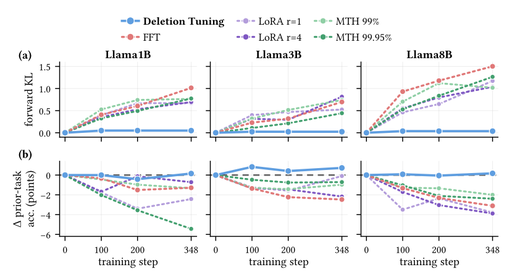
Figure 2 : Deletion Tuning keeps prior-task accuracy at every Llama scale while the baselines drift. (a) Forward KL between the trained and base policies on GSM8K during GRPO training, the forgetting predictor ofShenfeld et al.(2026b). (b) Change in mean accuracy on a six-task prior-task suite from the base model (dashed line).
Original paper · CC BY 4.0 · Jack Lu, Zhenbang Yang, Mike Lasby, Tejas Pote, Yani Ioannou, Mengye Ren · The Surprising Effectiveness of Deleting Weights in LLM Post-Training · Original paper figure · Extracted the figure area from page 10 of the original PDF.Why full fine-tuning is costly to keep
Full fine-tuning can change every parameter, so each new task leaves behind a full checkpoint. On Llama8B with GSM8K, the FFT checkpoint takes 30633 MB, while a Deletion Tuning mask takes 8.4 MB. LoRA writes new values rather than deleting weights, and its rank-1 adapter still needs 10.0 MB on Llama8B.
Full fine-tuning also tends to erode skills the model already had. Forward KL on the new task predicts how much forgetting a fine-tuned model shows. Over the same training, FFT's prior-task accuracy ends 1.3 to 3.1 points below base.
Pruning works in the opposite direction, removing weights from a finished model to make inference cheaper. Deletion writes no new values, so it only chooses which pretrained weights to keep. That raises the question of whether removing weights alone can teach a model something new. Deletion Tuning answers this by learning only a binary mask over gate-projection weights.
Learning which weights to keep
Deletion Tuning keeps the pretrained model frozen and trains one logit per gate-projection weight, so the logits are the only trainable parameters. Each logit decides at deployment whether its weight is kept or set to zero, so the adapter stores one bit per weight. Deletion Tuning adds no new numerical values to the model, because it only chooses which pretrained weights to keep.
Each target matrix gets its own logit matrix of the same shape, and the authors don't constrain the logits to any fixed sparsity level.
During training, the layer multiplies each weight by a sigmoid of its scaled logit, so gradients reach the logits. Gradients flow through the soft mask, while rollouts in on-policy runs use the hard mask.
The logits start from a Wanda prior, so the first mask already reflects which base weights look safe to zero. The Wanda score multiplies a weight's magnitude by the norm of its input activation, computed over calibration prompts. Each logit is drawn from one of two Gaussians, centred at plus or minus 0.03, depending on whether its score falls in the top fraction.
With the default eta of 1/2048, about 0.18% of gate weights are zeroed under the hard mask at initialization.
Training objectives and the stored adapter
The loss that moves the logits depends on the post-training regime, but the trainable parameters stay the same across all of them. For GRPO, the policy before the update samples a group of responses, and a verifier gives each one a reward. GRPO scores each response against its group mean and standard deviation, then gives that advantage to every token in PPO's clipped objective.
Policy rollouts use the hard mask, while gradients flow into the logits through the soft mask. For SDFT, the model acts as its own teacher, whose weights are an exponential moving average of the student's weights. The teacher's prompt includes a reference response that the student never sees, and the loss is a forward KL at each position.
The SDFT regularizer is set to zero, because the EMA teacher already provides an anchor. Its teacher gate is updated with the same exponential moving average, so the teacher's frozen base weights match the student's.
The SFT loss is the negative log-likelihood of fixed target tokens, with the regularizer weight set to 10 to the power of minus 5. The sparse weight regularizer mildly biases the mask toward keeping higher-magnitude weights. The authors impose no fixed sparsity level and let training decide how many weights to delete. At the end of training, the adapter is the hard mask, one bit per masked pretrained weight before compression.
The bits are packed with NumPy and compressed with zstd, which exploits the redundancy of a mask where fewer than 0.05% of weights are deleted. Switching tasks loads only this bit mask and zeroes entries in the base weights, instead of loading a separate full checkpoint.
Matching FFT as models grow
Its adapter came to 8.4 MB, against a full fine-tuning checkpoint of 30633 MB. The authors describe these close scores as matching full fine-tuning at the largest backbone in each family, not as beating it. Tuning the FFT learning rate and KL coefficient didn't change this comparison.
The same pattern holds at larger scale, where Deletion Tuning was tested on Qwen14B and the Qwen3-30B-A3B mixture-of-experts model. For that mixture-of-experts model, the gate projection inside each of its 128 experts is masked in every layer. The router stays unchanged, so only the expert gate weights are candidates for deletion.
At smaller backbones, Deletion Tuning recovers 90% to 99% of the full fine-tuning accuracy, so the gap narrows as models grow. The authors read this as evidence that deletion becomes more effective as models grow. Across the GRPO runs, the adapter is 3,600 to 4,700 times smaller than the corresponding full fine-tuning checkpoint. At Qwen0.5B the Deletion Tuning adapter is 0.5 MB, and it is the smallest adapter in every GRPO scale.
Is the learned mask doing the work
Wanda supplies the prior that seeds the gate logits, so the authors checked whether learning the mask adds anything beyond it. They applied Wanda one-shot pruning with no GRPO training, sweeping eight sparsity levels from 1/2 to 1/8192. Each level was scored on the same validation set, and the best accuracy per backbone was kept. The Wanda scores come from one forward pass over calibration prompts, and the main runs set η to 1/2048.
On Llama8B, the base model scored 60.27 and the best Wanda mask scored 60.65. The trained Deletion Tuning mask reached 83.55 on the same backbone. On Llama1B, the trained mask reached 54.44, while the base model scored 1.21 and the best Wanda mask scored 1.59.
So the gain comes from the learning step, not from the one-shot score that initializes the gates. Pruning with the Wanda prior alone doesn't move accuracy far from the base model. Training the gate logits is what turns a near-base mask into a large gain.
Acquiring new capabilities under pass@k
Pass@k counts the share of problems solved within k attempts, and the paper estimates it from 128 samples per problem at temperature 1.0. This matters because the question is whether deletion adds capability or only preserves what the base model already can do.
Deletion Tuning leads the base model at every k, and the gap persists even at large k.
How much the model forgets
Forgetting is measured with forward KL on the new task and with accuracy on a prior-task suite. The prior-task suite has six benchmarks: HellaSwag, MMLU, TruthfulQA, WinoGrande, IFEval, and HumanEval.
At the same step, FFT's prior-task accuracy ends 1.3 to 3.1 points below base. Deletion Tuning's forward KL stays at or below 0.05 at all three scales. Their prior-task accuracy falls up to 5.4 points below base.
Because the edited-weight counts are similar, the number of edits alone doesn't explain Deletion Tuning's retention. The authors read this as evidence that deletion itself keeps forgetting low.
Why the updates look like FFT's
The authors compare the weight delta against the pretrained weights on three geometric measures at saved GRPO checkpoints. Principal-weight overlap is the fraction of changed positions that fall on the principal weights, which the authors take from the rank-128 approximation of W0.
Figure 3 shows that Deletion Tuning is the closest to FFT on all three measures together.
The authors read low drift and sub-random overlap as the RLVR signature reported by Zhu et al. (2026). LoRA caps the rank of its update, and MTH trains weights chosen at random before training. The authors argue these two freedoms explain why Deletion Tuning reaches FFT-like geometry without setting any weight to a new non-zero value.
SFT and SDFT results
Under SFT, Deletion Tuning scored 22.28 on MMLU-Pro at Llama3B, compared to 21.19 for full fine-tuning. Both methods reached 11.39 on BBEH at Llama3B, so the two tie on that suite. Its adapter was 3.1 MB at Llama3B, while the full fine-tuning checkpoint was 12256 MB.
Under SDFT on Qwen7B, Deletion Tuning scored 69.07 on ToolAlpaca, compared to 68.04 for full fine-tuning. On Science, Deletion Tuning scored 70.61 while full fine-tuning scored 71.20, a small gap in full fine-tuning's favor. The Deletion Tuning adapters were 27.1 MB on ToolAlpaca and 47.1 MB on Science, against 29051 MB for each full fine-tuning checkpoint.
Limits and open checks
Deletion Tuning's training memory sits between the two baselines, because it keeps one logit per masked weight.
The authors call continual learning over a sequence of tasks a natural next test, but they didn't run it. Their forgetting results come from a single GRPO retention setup, so a multi-task sequence remains unmeasured. That sweep ran only on Llama8B GSM8K and Qwen7B SimpleRL-Zoo, so other backbones and settings stay untested.
SFT was run only on Llama1B and Llama3B, with the largest result at 3B. Under SDFT, Deletion Tuning was tested only on Qwen7B, on ToolAlpaca and Science. The mixture-of-experts result covers Qwen3-30B-A3B under GRPO alone, and the authors didn't test it under SFT or SDFT.
The masks are small and discrete, which the authors say could aid interpretability by comparing which weights different tasks delete. They also propose merging masks from different tasks by taking their union, but they didn't test that merge. Restricting the mask to N to M, channel-wise, or block patterns is left as future work.
Paper info
- Authors
- Jack Lu, Zhenbang Yang, Mike Lasby, Tejas Pote, Yani Ioannou, Mengye Ren
- Venue
- arXiv · Preprint
- First published
- 2026-11-7
- Added
- 2026-11-10
- Updated
- 2026-11-7
- Version
- v1
- arXiv
- 2611.10866
- Category
- cs.LG · cs.CL
- Original paper terms
- CC BY 4.0
- What we show
- Paper info, commentary and permitted figures from the original paper
AI commentary is a separate explanation from the original paper and may contain errors. The original paper and figures follow each source's terms of use and any rights noted separately.
Abstract
How little of a pretrained large language model (LLM) has to change for it to acquire new capabilities? We find that zeroing fewer than 0.05% of its weights, with no other modification, matches full fine-tuning (FFT) at scale across three LLM post-training regimes: reinforcement learning with verifiable rewards, supervised fine-tuning, and on-policy distillation. Our method, Deletion Tuning, learns a binary mask over the gate projection of transformer blocks. Two practical advantages follow: the trained mask is hundreds to thousands of times smaller than the corresponding FFT checkpoint, and Deletion Tuning forgets far less, which addresses a central challenge in continual learning. Under reinforcement learning, its prior-task accuracy stays near the base level while FFT, LoRA, and random sparse fine-tuning lose up to 5.4 points. To understand why masking alone suffices, we analyze the geometry of the learned weight changes under reinforcement learning using stable rank, spectrum drift, and principal-weight overlap. Compared with LoRA and random sparse fine-tuning, Deletion Tuning is closest to FFT across the three measures.
Figures from the paper
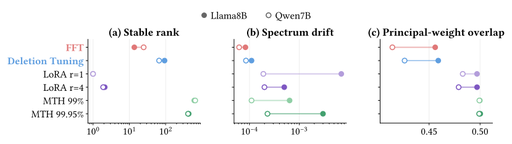
Figure 3 : Deletion Tuning (blue) tracks FFT (red) most closely across three update-geometry metrics. Values at the saved GRPO checkpoint for Llama8B (filled) and Qwen7B (open): (a) stable rank of Δ𝑊, (b) spectrum drift, and (c) principal-weight overlap. Overlap below the random baseline of0.5 is the RLVR signature reported byZhu et al.(2026).
Original paper · CC BY 4.0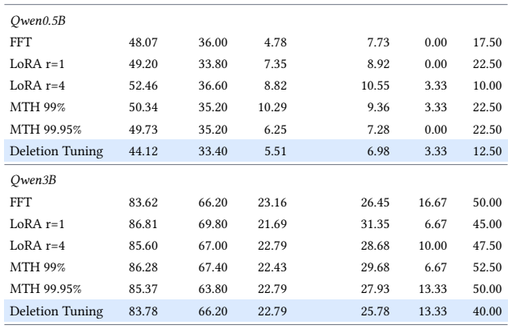
Table 8 : Qwen2.5 on SimpleRL-Zoo: per-benchmark validation accuracy (%) at the best checkpoint. Six benchmarks: GSM8K, MATH500, Minerva Math, OlympiadBench, AIME24, AMC23.
Original paper · CC BY 4.0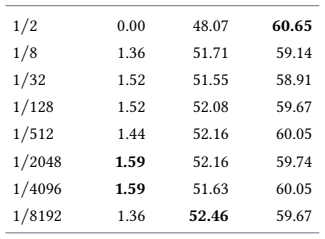
Table 11 : Wanda sweep on Llama (%).
Original paper · CC BY 4.0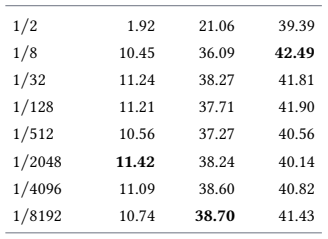
Table 12 : Wanda sweep on Qwen (%).
Original paper · CC BY 4.0Quote from the paper
Jack Lu, Zhenbang Yang, Mike Lasby, Tejas Pote, Yani Ioannou, Mengye Ren (2026). The Surprising Effectiveness of Deleting Weights in LLM Post-Training. arXiv:2611.10866v1. https://arxiv.org/abs/2611.10866v1
BibTeX
@misc{lu2026surprising,
  title = {{The Surprising Effectiveness of Deleting Weights in LLM Post-Training}},
  author = {Jack Lu and Zhenbang Yang and Mike Lasby and Tejas Pote and Yani Ioannou and Mengye Ren},
  year = {2026},
  eprint = {2611.10866},
  archivePrefix = {arXiv},
  url = {https://arxiv.org/abs/2611.10866v1}
}