Paper commentary
UniGraph: A Unified Graph-based Index for Dynamic Hybrid Dense-Sparse Vector Retrieval
- Problem Two-route hybrid retrieval can drop items that rank highly only after dense and sparse scores are combined, and a graph built at one hybrid weight serves other query weights poorly.
- Method Merges the neighbour sets computed at several hybrid weights into one bounded-degree graph, routes each query to sparse-guided or dense-guided entry points by its weight α, and skips exact sparse distances with a norm-based dense-first estimate.
- Results Reached 27.6% to 52.3% higher QPS than the fastest baseline at Recall@100 of at least 0.95, under mixed query weights on five datasets.
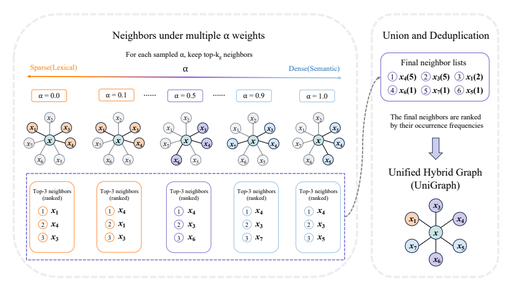
Fig. 3 . Overview of UniGraph construction for one center base vector pairx. Across sampledαvalues ranging from the sparse (lexical) endpoint to the dense (semantic) endpoint, the construction retains the top-k g hybrid neighbors ofxat each weight; the illustration usesk g = 3. The per-αlists are merged and deduplicated, and the number in parentheses indicates each candidate’s occurrence frequency. Ranking the candidates by this frequency produces a single UniGraph neighborhood that favors neighbors selected across multiple dense-sparse trade-offs.
Original paper · CC BY 4.0 · Keyu Chen, Xiaoyao Zhong, Jiabao Jin, Peng Cheng, Wangze Ni, Jingkuan Song, Heng Tao Shen · UniGraph: A Unified Graph-based Index for Dynamic Hybrid Dense-Sparse Vector Retrieval · Original paper figure · Extracted the figure area from page 5 of the original PDF.Why two separate indexes lose candidates
Hybrid retrieval scores each item with one distance that blends a dense term and a sparse term, and the query-level weight α sets how the two are blended. The usual practical route keeps a dense index and a sparse index, pulls candidates from each, merges the two sets and reranks the union under the hybrid distance. The candidate budget per index is the weak point: a small budget can drop an item that reaches the hybrid top-k only after the two signals are combined, while a large budget raises the cost of both searches and of reranking.
A graph built directly under the hybrid distance avoids that early cut, because traversal ranks items by the combined score from the start. The catch is that such a graph is tied to the weight it was built with. Changing α changes the nearest neighbours of an item, so a graph built at one fixed weight serves other query weights poorly unless the search visits many more vertices.
Rebuilding a graph for every query weight is the cost this study sets out to avoid.
Figure 1 shows the kind of case at stake: an item that is not first under dense or under sparse ranking can become the top hybrid result, while the dense, sparse and hybrid neighbourhoods still share many of their top neighbours.
What α does to the hybrid distance
Each base item carries a dense vector and a sparse vector, and each query carries the same two parts. The hybrid distance is a weighted sum of the dense distance and the sparse distance. \[ D_h(q,x;\alpha)=\alpha\, D_d(q^d,x^d)+(1-\alpha)\, D_s(q^s,x^s) \] Both parts are distances, so a smaller value means a closer match. The dense part is the inner-product distance 1 minus the dense inner product, and the sparse part is 1 minus the sparse inner product.
A larger α puts more weight on the dense part, and a smaller α puts more weight on the sparse part.
Fix a centre item x_i and let a candidate x_j vary. Written with the sparse distance as the base and the gap between dense and sparse distances as the slope, the hybrid distance is a straight line in α. \[ D_h(x_i,x_j;\alpha)=D_s(x_i^s,x_j^s)+\alpha\big(D_d(x_i^d,x_j^d)-D_s(x_i^s,x_j^s)\big) \] Two candidates can swap order only where their lines cross, and only crossings inside the interval from 0 to 1 affect the ranking.
Because the dense and sparse distances are partly correlated, many candidate pairs never cross, which limits the number of changes in the neighbour set.
Why neighbourhoods can be shared across weights
For the exact hybrid top-100, each item is classified by whether it also appears in the exact dense top-100, the exact sparse top-100, both, or neither. At intermediate weights both dense-only and sparse-only items take large shares, so neither modality dominates the hybrid ranking across the datasets shown. The authors read this as a sign that the dense and sparse distance scales are reasonably compatible.
The Neither share is the part that two-route retrieval can miss. On NQ at α = 0.3 and α = 0.5, 24% of the exact hybrid top-100 appears in neither single-modality top-100 set. The Both share stays comparatively stable as α changes, which fits items that rank highly in both modalities.
The overlap points to a shared core of neighbours plus weight-specific parts. The α-cover construction keeps both: connections common across weights and connections that only particular weights select.
Building the unified graph
Construction discretises α on the grid A = {0, δ, 2δ, ..., 1} with the sampling step δ = 0.1. For each item x_i and each grid value α, the top-k_g hybrid neighbours are chosen from the other items, with k_g = 32 in the experiments. \[ N_i^{\alpha}=\arg\min_{S\subseteq X\setminus\{x_i\},\,|S|=k_g}\ \sum_{x_j\in S} D_h(x_i,x_j;\alpha) \] The union over the grid gives U_i, and each candidate's occurrence count across the grid gives f_i(x_j).
\[ U_i=\bigcup_{\alpha\in A} N_i^{\alpha}, \qquad f_i(x_j)=\sum_{\alpha\in A}\mathbf{1}[x_j\in N_i^{\alpha}] \]
The final out-neighbour set of x_i keeps at most M candidates, chosen by the highest counts, with M = 64 in the experiments. \[ N_G(x_i)=\arg\max_{S\subseteq U_i,\ |S|=\min\{M,|U_i|\}}\ \sum_{x_j\in S} f_i(x_j) \] A neighbour counted at many weights matters under many dense-sparse trade-offs, so it is kept ahead of one that only a single weight selects.
Computing exact distances between all pairs is too costly, so construction draws candidates from a dense index and a sparse index, merges them into a pool, and computes exact dense and sparse distances only on that pool. The dense and sparse candidate counts are 100 and 100, with HNSW and SINDI as the indexes.
Figure 3 traces this for one centre item: the top-3 lists at several α values are merged and deduplicated, and the counts in parentheses set the final frequency-ranked order.
Traversal and dense-first pruning
Search is greedy beam search over the unified graph, with a candidate set C and a result set R of size efs. Each step expands the closest unexpanded candidate, and the search stops when the nearest remaining candidate is farther than the worst item in R. Entry points come from a random start or from a guide index, and every vertex is ranked by the query-specific hybrid distance.
The sparse inner product is costly because query terms must be matched against irregularly stored nonzero entries. Base norms are precomputed and the query norm is computed once per query. By the Cauchy–Schwarz inequality, the sparse distance is at least 1 minus the product of the two norms. \[ L_s(q^s,x^s)=1-\|q^s\|_2\,\|x^s\|_2\le 1-\langle q^s,x^s\rangle=D_s(q^s,x^s) \] Combining that bound with the dense part gives a hybrid lower bound that needs only the dense distance and the norms.
\[ L_h(q,x;\alpha)=\alpha D_d(q^d,x^d)+(1-\alpha)L_s(q^s,x^s)\le D_h(q,x;\alpha) \]
A pruning scale γ in [0, 1] defines the estimate \[ \widehat{D}_h(q,x;\alpha,\gamma)=\alpha D_d(q^d,x^d)+(1-\alpha)\big(1-\gamma\|q^s\|_2\|x^s\|_2\big) \] Once R is full, the estimate is compared with the current worst distance τ in R. If the estimate is at least τ, the exact sparse distance is skipped; otherwise it is computed.
When γ equals 1, the estimate equals the lower bound L_h, so an estimate at or above τ implies that the exact hybrid distance is at least τ. Under that condition, the exact-distance insertion rule would reject the candidate anyway, so skipping its sparse distance does not change the insertion. For γ below 1 the estimate is no longer a lower bound, so pruning can differ from exact-distance search.
The main experiments use γ = 0.3.
Guided entry points and α routing
A guide index returns the query-dependent entry points, and traversal then ranks the vertices by the hybrid distance. The guide can be the sparse index or the dense index, and any index that ranks by its own component distance can serve.
The route depends on α alone. A weight at or below the threshold α_t uses the sparse-guided path, and a weight above it uses the dense-guided path. \[ \mathrm{Path}(q,\alpha)=\begin{cases}\text{sparse-guided path}, & \alpha\le\alpha_t\\ \text{dense-guided path}, & \alpha>\alpha_t\end{cases} \] The threshold is α_t = 0.5, where the two parts of Eq.
(1) have equal weight, which matches the comparable scales seen in the experiments. Both paths run the same traversal and differ only in the guide index.
The argument is coarse-to-fine: a single-component search reaches the result region cheaply, and hybrid traversal then refines the result on the unified graph. The authors reason that for small α, items returned by the sparse guide are more likely to be or lie near highly ranked hybrid results, and the dense guide plays that role for large α.
Datasets, encoders and baselines
Five BEIR datasets are used: NQ, HotpotQA, MS MARCO, FEVER and DBpedia-Entity. BGE-M3 encodes each document and query into a 1024-dimensional dense vector and a weighted sparse vector, and the dense embeddings are ℓ2-normalised. NQ, HotpotQA, MS MARCO and FEVER each have 1,000 queries, while DBpedia-Entity uses all 467 available queries.
Ground truth is the exact hybrid top-k under Eq. (1) for each query and weight. Mixed-α runs report Recall@50, Recall@100 and Recall@200, fixed-α runs report Recall@100, and QPS is measured end to end over the complete query set. Recall is the overlap between the approximate result set and the exact result set, divided by k.
HNSW serves as the dense index and SINDI as the sparse index across the evaluated methods. The baselines are two-route HNSW+SINDI, dense-only HNSW, sparse-only SINDI, Naive Hybrid and Opt Hybrid built at α = 0.5, and LADR. Opt Hybrid's sparse vector pruning was disabled because preliminary runs showed only marginal throughput gains.
At search time the pruning scale is γ = 0.3, and the ablations use efs = 300.
Mixed-weight results
Mixed weights are drawn uniformly from [0.3, 0.7] for each dataset, a range chosen because more extreme weights leave the hybrid distance driven by one modality. At Recall@100 of at least 0.95, UniGraph reaches 27.6% to 52.3% higher QPS than the fastest baseline on each of the five datasets.
On DBpedia-Entity, it reaches about 2.3× the QPS of LADR at Recall@100 ≈ 0.95. Each ratio is read at the recall level named beside it and against the baseline named with it, so the three ratios are not one shared figure.
Fixed-weight results
Fixed-weight runs cover NQ, MS MARCO and DBpedia-Entity at the five weights 0.3, 0.4, 0.5, 0.6 and 0.7. Among the single-modality baselines, sparse-only is faster at matched recall for smaller α, and dense-only is faster for larger α.
At α = 0.5 the advantage persists, even though that weight matches the construction weight of both hybrid baselines.
At α = 0.5 on DBpedia-Entity, it keeps about 1.6× the QPS of two-route retrieval at comparable recall.
Guided entry-point ablation
This comparison holds the hybrid graph, γ = 0.3 and efs = 300 fixed, and varies only the entry point: one random entry for unguided search, sparse-guided search at α = 0.3, and dense-guided search at α = 0.7. Unguided search reaches 83.6% to 92.6% Recall@100, while the guided variants reach 94.7% to 98.1%.
The two weights are tested separately, and the gain is shown for each dataset in the per-dataset panels.
Dense-first pruning ablation
The comparison uses the same prebuilt UniGraph and the same α-adaptive routing in the mixed-α setting at efs = 300, with pruning at γ = 0.3 against no pruning. Only the pruning test is turned off; candidate insertion and termination still use the current threshold τ.
Pruning raises QPS on every dataset, by 10.3% on average. The largest decrease in Recall@100 is 0.055 percentage points. The authors describe this as faster search with almost no effect on result quality.
One graph versus a fixed-weight graph
The comparison pits UniGraph against a fixed-weight graph built only at α = 0.5 with M = 64, with query weights drawn uniformly from [0, 1]. Both methods use graph-only search from the same random entry point for each query, with guided entries and pruning disabled.
At Recall@100 = 0.90, UniGraph's QPS gains over the fixed-weight graph range from 7.95% on DBpedia-Entity to 25.46% on MS MARCO, with a mean gain of 15.49%. At Recall@100 = 0.95, the gains range from 4.48% to 26.71%, with a mean gain of 15.77%.
Construction time and index size
Construction time is compared across two-route HNSW+SINDI, UniGraph, Naive Hybrid, Opt Hybrid and LADR. UniGraph needs 6.6% to 21.9% less construction time than Opt Hybrid, but more than the two-route baseline, and adds only 4.5% to 5.3% storage over two-route. The authors attribute the higher construction cost of the graph-based hybrid methods to extra hybrid-distance evaluations and graph processing, while UniGraph builds neighbourhoods at several weights and merges them.
Index size is compared across the five datasets. UniGraph uses 14.7% to 18.7% more index space than Naive Hybrid, 16.3% to 20.2% more than Opt Hybrid and 4.5% to 5.5% more than LADR.
Limitations
The pruning guarantee in the lemma is stated only for γ equal to 1. With γ below 1 the estimate may prune more candidates and can change the search path, so recall can move. The main runs use 0.3, and the pruning ablation shows a Recall@100 decrease of at most 0.055 percentage points.
The mixed-weight comparison covers only [0.3, 0.7], and the graph-only multi-weight test covers [0, 1] but compares against one fixed-weight graph at α = 0.5. Fixed-weight results cover NQ, MS MARCO and DBpedia-Entity, and HotpotQA and FEVER are not included in that comparison. The guided-entry ablation covers only the two weights α = 0.3 and α = 0.7.
All five datasets use BGE-M3 encodings, and all timing uses one search thread on one server. Encoders other than BGE-M3 are not tested. The text states that UniGraph is compatible with other dense and sparse indexes, but the experiments use only HNSW and SINDI. The authors judge DEG unsuitable for high-dimensional inner-product sparse vectors, so it is not compared.
Paper info
- Authors
- Keyu Chen, Xiaoyao Zhong, Jiabao Jin, Peng Cheng, Wangze Ni, Jingkuan Song, Heng Tao Shen
- Venue
- arXiv · Preprint
- First published
- 2026-11-16
- Added
- 2026-11-17
- Updated
- 2026-11-16
- Version
- v1
- arXiv
- 2611.20758
- Category
- cs.IR · cs.DB
- Original paper terms
- CC BY 4.0
- What we show
- Paper info, commentary and permitted figures from the original paper
AI commentary is a separate explanation from the original paper and may contain errors. The original paper and figures follow each source's terms of use and any rights noted separately.
Abstract
Hybrid dense-sparse vector retrieval combines semantic signals from dense representations with lexical signals from sparse representations, typically ranking items by a query-dependent weighted sum of dense and sparse vector distances. Existing systems commonly search separate dense and sparse vector indexes and rerank the union of their candidates, incurring two retrieval passes and potentially discarding items that rank highly only after the semantic and lexical signals are combined. Constructing a graph-based index directly under a hybrid distance can mitigate this premature candidate loss. However, because varying the hybrid weight alters the underlying neighborhood relationships, a single static graph built at a fixed weight cannot accommodate dynamic query-specific weights. Therefore, we propose a Unified Hybrid Graph (UniGraph), which merges neighbor sets computed at multiple hybrid weights into a single bounded-degree graph index, enabling hybrid vector retrieval with different query-specific weights without index reconstruction. We further develop an adaptive weight-guided search framework that chooses between sparse- and dense-guided entry points according to the query weight, together with a dense-first hybrid distance pruning strategy that avoids unnecessary exact sparse distance computations. Extensive experiments show that UniGraph provides a favorable Recall-QPS trade-off across different query weights. In the mixed-weight setting, UniGraph delivers 27.6%~52.3% higher QPS than the fastest baseline on each dataset at Recall@100 greater than or equal to 0.95. UniGraph has been deployed at scale in Ant Group's production environment, where hybrid retrieval with query-dependent weights is in strong demand.
Quote from the paper
Keyu Chen, Xiaoyao Zhong, Jiabao Jin, Peng Cheng, Wangze Ni, Jingkuan Song, Heng Tao Shen (2026). UniGraph: A Unified Graph-based Index for Dynamic Hybrid Dense-Sparse Vector Retrieval. arXiv:2611.20758v1. https://arxiv.org/abs/2611.20758v1
BibTeX
@misc{chen2026unigraph,
  title = {{UniGraph: A Unified Graph-based Index for Dynamic Hybrid Dense-Sparse Vector Retrieval}},
  author = {Keyu Chen and Xiaoyao Zhong and Jiabao Jin and Peng Cheng and Wangze Ni and Jingkuan Song and Heng Tao Shen},
  year = {2026},
  eprint = {2611.20758},
  archivePrefix = {arXiv},
  url = {https://arxiv.org/abs/2611.20758v1}
}