Paper commentary
From Weapons to Events: Evaluating Evidential Support in Multimodal AI for Policing
Event-level evaluation shows multimodal AI pipelines miss or invent events in police body-worn video
- Problem Police body-worn video is still reviewed by people, and existing AI tools use only its audio. Nobody has checked whether the events an AI reports really occur in a recording, or at the right time.
- Method The authors score complete event-level pipelines on whether each predicted event is supported by the footage. A judge labels each event, and the judge is checked against blinded human labels.
- Results The hybrid NarrativeBridge-PAL-GPT-5 pipeline reached an event F1 of 63.1 on UKBWV-27, against 60.6 for Gemini 3.1 Pro. It still left 13.6% of predicted events unsupported.
Why BWV review gets stuck
Body-worn video is meant to make policing accountable, yet manual review can't keep up with the volume. Manual review therefore becomes selective, driven by complaints or incidents rather than systematic sampling.
Video AI could change this, but the tools already in BWV workflows work only from the audio track. Those tools analyse transcripts or draft reports, so they never look at the picture. Their evaluations measure adoption and time saved, rather than whether their outputs are correct. Nobody has tested whether the events an AI reports really occur in a recording, or at the right moment.
The authors argue that video AI could make computer vision a realistic aid to BWV review that reduces cost and time. Its failures must also be visible, and people must be able to contest it. They call these three conditions traceability, failure visibility and contestability, and treat them as design goals rather than results. The paper addresses these conditions through research question RQ1, which asks how multimodal AI can be evaluated for them.
Judging each AI claim against the footage
The paper asks that every AI claim about body-worn video point back to a time interval in the footage before a record relies on it. The authors name three conditions for such use: traceability, failure visibility and contestability. These are design goals, so the authors measure properties of outputs that each goal needs, not whether people can really trace or contest errors.
Traceability is measured with the unsupported-event rate U, which divides the number of predicted events labelled unsupported by the total number of predicted events. The judge labels each predicted event as supported or unsupported, and the authors check that judge against blinded human labels. Because U can drop when fewer events are reported, the authors read it together with event F1.
Traceability also needs time, so the protocol scores how well events are located in time with temporal IoU. Failure visibility comes from reporting results per recording condition, so that failures don't disappear into one average. Contestability is approached through speaker attribution, since that decides whose words a record contains.
Each output carries an evidence anchor, a time interval, so a reviewer can move from a claim to the part of the footage that should support it. Every element of the output, events and utterances alike, carries such an interval. A chapter is a shared context interval rather than a predicted event, so chapters are not scored.
How a recording becomes scored events
A recording enters the event-level pipeline as frames and audio, with non-BWV parts removed beforehand. ARC-Chapter divides each recording once into chapters, using Qwen2.5-VL-7B on its frames and audio. The chapter identifiers and timestamps are frozen and passed unchanged to every base system, so all systems share the same context intervals.
Chapters are shared context intervals rather than predicted events, and the chapteriser is not part of the model comparison.
GPT-5 then works on text only, mapping each event to one of the 16 types or to unmapped, and linking utterances to events. It may revise labels and roles, but it can't create, delete, merge or split events, or change any timestamp. The same prompt goes to every base system, so the comparison is between complete pipelines rather than raw base models.
The hybrid pipeline runs NarrativeBridge on the frames and PAL on the audio in parallel on each recording. NarrativeBridge's cause-effect network produces timestamped causal-temporal event descriptions within each supplied chapter. PAL, with a Llama 3.2 3B language model, produces the transcription, and GPT-5 combines both outputs. Condition C1 uses NarrativeBridge alone, while C2 adds the PAL audio branch and its fusion.
The PAL transcript also informs GPT-5's mapping, so the C1 and C2 comparison doesn't isolate audio.
Scoring covers three tasks on the post-processed output: T2 finds and times events, T3 counts unsupported events, and T4 scores transcripts. T2 uses event F1 and mIoU, while T4 uses word error rate and speaker accuracy. Predicted and reference events are matched one-to-one with Hungarian matching at temporal IoU of at least 0.3.
KnifeHunter: ranking catalogue matches
KHNet ranks a knife photograph against a catalogue of 25,250 images covering 543 knife classes. Cosine similarity between global descriptors sets the ranking of each query against the stored images. Every model trains end to end with sub-center ArcFace.
The Medium set has 443 query images, and the Hard set has 150 queries drawn from harder conditions. The +D protocols add about 125,000 distractors from nine UK police forces and unlabelled COCO images to the database. EVA02-Base was the strongest of the four backbones under every protocol, so Table 1 compares aggregation heads on it. Without distractors, KHNet scores 86.5 mAP on Medium and 65.3 on Hard, a drop of 21.2 points.
With distractors, KHNet reaches 85.7 on Medium and 63.4 on Hard, while GeMNet reaches 81.5 and 57.9. On Hard+D, KHNet beats GeMNet by 5.5 points and SENet by 1.9 points. The backbone matters too: EVA02-Base sits 12.4 points above EfficientNet-B7 under GeMNet. Distractors cost KHNet 0.8 points on Medium and 1.9 points on Hard, so a larger gallery hurts more when query evidence is weaker.
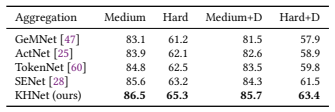
Table 1 . Knife retrieval mAP (%) onKnifeHunterwith the EVA02-Base backbone. +D: with about 125,000 distractor images.
Original paper · CC BY 4.0In the ablation, orthogonal fusion of local and global features gives the largest gain on Hard+D, lifting mAP from 58.9 to 62.1.
The Hard queries come from investigations, where a wrong match matters most, and Hard mAP sits 21 to 22 points below the Medium figure. They didn't analyse open-set queries or calibration of match scores.
Pipeline scores on UKBWV-27
The event-level case runs complete pipelines on all 27 UKBWV-27 recordings, which total 118 minutes of footage. Each system processes the recordings in the same 120 s windows, so all of them receive the same frames. The hybrid pipeline, NarrativeBridge with PAL and GPT-5, is tested against three omni-modal models.
The hybrid pipeline reaches an event F1 of 63.1, against 60.6 for Gemini 3.1 Pro. It also records the lowest WER, at 5.7% against 7.9% for Gemini 3.1 Pro. Its speaker accuracy of 72.3% is the highest, compared with 69.2% for Gemini 3.1 Pro. Its mIoU of 0.44 exceeds the 0.41 that Qwen3.5-Omni-Plus reaches. Without the PAL branch under condition C1, F1 falls to 56.5, below Gemini's 60.6, and mIoU drops to 0.39.
The PAL transcript also informs GPT-5's mapping, so this drop doesn't isolate the audio alone.
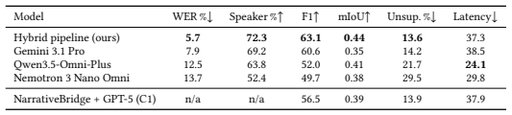
Table 2 . Main results on UKBWV-27 (27 videos). WER: word error rate against the human-corrected transcript. Speaker: speaker accuracy. F1: event F1 attIoU≥0.3, weighted by video count over the release conditions of Table 3 (22 pure BWV, 3 with overlays, 2 with other sources). n/a: not applicable without audio. mIoU: temporal IoU of matched predicted and reference events; chapters are shared context intervals, but event intervals are generated independently within chapters. Unsup.: share of predicted events the validated judge labels unsupported by the footage (Eq. 2). Latency: wall-clock seconds per minute of footage, including the shared chapterisation run, the GPT-5 post-processing step and network and queueing for hosted API calls, so not directly comparable across access modes. Best per column in bold. Models above the line use condition C2 (vision with audio); the last row is NarrativeBridge with GPT-5 post-processing but without the PAL audio branch (C1). All rows pass through the same GPT-5 post-processing.
Original paper · CC BY 4.0 · Armin Mustafa, Syed Sameed Husain · From Weapons to Events: Evaluating Evidential Support in Multimodal AI for Policing · Original paper figure · Extracted the figure area from page 11 of the original PDF.Even the hybrid pipeline leaves 13.6% of predicted events unsupported by the footage. Qwen3.5-Omni-Plus has the lowest latency, at 24.1 seconds per minute, against 37.3 for the hybrid pipeline. Latency includes network and queueing for hosted calls, so local and hosted figures aren't directly comparable.
Every pipeline degrades on recordings with overlays, where F1 drops by 9.3 to 12.2 points. Long recordings lose 12.7 to 16.9 points of F1 relative to short ones. With only 27 videos, these descriptive comparisons can't confirm either hypothesis in general.
How far the judge can be trusted
Doubao Seed 2.0 Pro labels each predicted event as supported or unsupported after GPT-5 post-processing. The judge is a different model from GPT-5 and the evaluated systems, but it may share their failure modes. Because such judges have documented biases, the authors validated it against human labels and kept it out of the evaluated panel.
Partially supported, uncertain and duplicate events counted as unsupported, the same conservative rule the judge applies. The authors call this a diagnostic sample, so its precision and recall depend on its stratified composition.
Under that rule, the 100 events split into 75 supported and 25 unsupported, with an uncertainty rate of 5%. The judge matched the settled human labels on 96 events, with Cohen's kappa of 0.90 and a 95% bootstrap CI of 0.78 to 0.98. For unsupported events, the judge reached 96.0% recall and 88.9% precision, with macro-F1 of 0.95. Its false-positive rate is 4.0%, with a Wilson 95% interval of 0.7% to 19.5%.
One of the 25 human-unsupported events passed as supported, which is the error that lets an unsupported statement through.
The three supported events it rejected count against a class of only 25, which lowers unsupported precision. The authors didn't assess this error by event type, condition or model. So the rates in Table 2 rest on a validated but imperfect instrument.
What the limitations leave open before any output is used
The reference annotations are machine-assisted and human-corrected, so they aren't gold-standard labels. Two open omni-modal models generated the first event annotations, and two human annotators then corrected them. Annotators didn't first label the raw footage on their own, and agreement before adjudication wasn't measured. Transcripts started from Whisper output and were then corrected against the audio, which may favour Whisper-like transcripts.
Each pipeline ran once, with no ablations of post-processing, components or chapters. Errors aren't attributed to stages, so the paper can't say which step causes a given unsupported event. Run-to-run variation wasn't measured, and the benchmark reports no confidence intervals or per-recording results. KnifeHunter's field accuracy, open-set queries and calibration haven't been evaluated.
They didn't run a reviewer study, so verification time and workload remain unmeasured.
A deployment would need a human check of every output against the footage before it enters a record. Assistive and Verify are readiness levels the authors propose as a governance proposal, not a validated workflow. Group differences are unmeasured, and affected-party input and per-event-type analysis are missing. The combined pipeline of Figure 2 hasn't been evaluated, so the linked knife case record is only illustrative.
Paper info
- Authors
- Armin Mustafa, Syed Sameed Husain
- Venue
- arXiv · Preprint
- First published
- 2026-11-6
- Added
- 2026-11-10
- Updated
- 2026-11-6
- Version
- v1
- arXiv
- 2611.10245
- Category
- cs.CV · cs.AI · cs.CY
- Original paper terms
- CC BY 4.0
- What we show
- Paper info, commentary and permitted figures from the original paper
AI commentary is a separate explanation from the original paper and may contain errors. The original paper and figures follow each source's terms of use and any rights noted separately.
Abstract
Computer vision (CV) for policing has centred on recognising objects such as seized weapons, while body-worn video (BWV) is still reviewed by people, with existing AI tools using only its audio. Multimodal video AI could make BWV review faster and cheaper. At the object level, we present the KnifeHunter dataset, developed with UK law enforcement, with over 25,000 images of 543 knife classes and a protocol reflecting investigative conditions, and KHNet, a retrieval architecture fusing local and global features, which with about 125,000 distractor images attains 85.7% and 63.4% mean Average Precision (mAP) on the medium and hard protocols. At the event level, we present an evaluation protocol for video understanding pipelines, which describe a video as events and a transcript, that scores transcription, speaker attribution, event detection, temporal localisation and unsupported events. Whether each event is supported by the recording is labelled by a judge validated against blinded human labels. We apply it to complete pipelines, three 2026 omni-modal models and our hybrid NarrativeBridge-PAL-GPT-5 pipeline, on UKBWV-27, a pilot stress-test set of 27 publicly released UK BWV recordings (118 minutes). On this set the hybrid pipeline leads on five of six measures, yet it leaves 13.6% of predicted events unsupported and misattributes 27.7% of utterances, and every pipeline degrades on recordings from edited releases, long recordings and noisy audio. We propose readiness levels separating assistive tasks from those requiring verification of every output.
Quote from the paper
Armin Mustafa, Syed Sameed Husain (2026). From Weapons to Events: Evaluating Evidential Support in Multimodal AI for Policing. arXiv:2611.10245v1. https://arxiv.org/abs/2611.10245v1
BibTeX
@misc{mustafa2026from,
  title = {{From Weapons to Events: Evaluating Evidential Support in Multimodal AI for Policing}},
  author = {Armin Mustafa and Syed Sameed Husain},
  year = {2026},
  eprint = {2611.10245},
  archivePrefix = {arXiv},
  url = {https://arxiv.org/abs/2611.10245v1}
}