Paper commentary
DAPS: Dependency-Aware Premise Selection for LLM Theorem Proving
DAPS ranks premises by dependencies instead of text similarity for theorem proving
- Problem Similarity-based premise selectors bury rare lemmas under popular foundational ones. They rank candidates by text similarity, so rarely used premises get pushed out of the top K.
- Method DAPS adds each candidate's position in the dependency graph to its text embedding, then trains the selector to rank all gold premises together.
- Results On Mathlib4-Heldout, DAPS reaches 89.25 mean Recall@32, 11.41 points above LeanHammer.
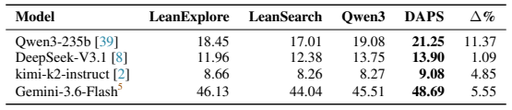
Table 4 : Downstream utility performance. Pass@8 of different LLMs on IMO-ProofBench [ 19] using premises from compared premise selectors. In this table, we strictly follow the original grading prompts from the IMO-ProofBench paper and use the identical grading model. Qwen3: Qwen3-Embedding-8B.∆%:∆% vs best baseline
Original paper · CC BY 4.0 · Zixuan Chen, Wenyuan Jiang, Junling Wang, Mrinmaya Sachan, Yinya Huang · DAPS: Dependency-Aware Premise Selection for LLM Theorem Proving · Original paper figure · Extracted the figure area from page 8 of the original PDF.Why similarity-based selectors miss rare premises
Provers struggle to use lemmas added recently, because they mostly reuse constants they already know. Existing neural premise selectors treat selection as semantic retrieval, so a candidate is scored by how close its text is to the query. That framing has three limits: frequency-skewed retrieval, isolated pairwise ranking, and weak transfer to out-of-distribution queries.
Popular foundational lemmas take the top-K slots, so a rare premise with little text overlap gets pushed out.
The authors argue that these three limits share one cause, namely that usefulness in mathematics follows dependencies rather than similarity. A lemma matters because of what it presupposes, what it composes with, and how far it sits from known premises. The Mathlib4 graph is heavy-tailed: the top 10% of nodes capture 56% of in-edges, so frequency skew can be measured directly.
Dependencies as the signal
Dependency graphs carry the signal that text similarity misses, because mathematics is organised by what each lemma uses rather than by how its wording looks. DAPS puts this graph into both the training data and the model instead of relying on text alone. Two resources supply the signal: a typed Mathlib4 graph with 6.5M edges, and 3,805 nodes mined from 53 Blueprint projects.
The Mathlib4 graph is dense, since each node averages 24 edges, and it is directionally asymmetric. The Blueprint graphs are much sparser, with an average degree of 1.2, yet they hold research-level declarations that Mathlib4 lacks.
In the Mathlib4 graph, theorem and lemma together make up 56% of all declarations. Their average in-degree is 3 to 5, while their average out-degree is 27 to 31. So DAPS encodes in- and out-degree as separate features, since selection matches queries with many outgoing dependencies against premises with many incoming ones. Figure 2 shows both the edge spectrum and this asymmetry.
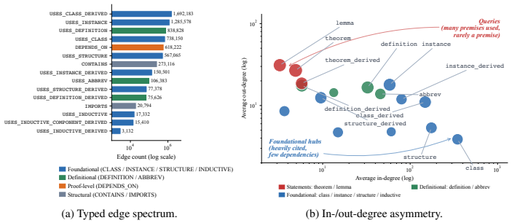
Figure 2 : Mathlib4’s dependency graph carries a rich, asymmetric, frequency-skewed structure. (a) 15 typed edge categories totaling 6.5M edges. (b) Average in- vs. out-degree per node category (bubble area ∝log 10 #nodes). Statements (red) sit at the high-out/low-in extreme, foundational type-defining constructs (blue) at the opposite extreme.
Original paper · CC BY 4.0The Blueprint corpus adds what Mathlib4 leaves out, because its dependencies are recorded in the blueprint rather than in Mathlib. Each Blueprint node carries a high-quality informal statement and proof. The corpus holds 3,805 nodes and 4,651 edges, split 71.7% formal and 28.3% informal. Project sizes are long-tailed, with a median of 35 nodes and a mean of 72.
How DAPS scores candidates
DAPS ranks a candidate pool by Recall@K, the share of a query's positive premises that land in the top K. The positives P⋆(q) are the declarations that the verified proof of q depends on, so the metric rewards placing the actual proof dependencies near the top. Premise selection produces a ranking r over the candidate pool C(q), and the score is the fraction of positives inside Top K(r).
In- and out-degree enter as separate features, because the graph is asymmetric: statements have high out-degree and foundational constructs have high in-degree. Sampled subgraphs are scored and then trimmed by a dynamic budget before they are fused with the text representation. The dynamic budget keeps m and n as the sampling counts, with random sampling and keeping applied after FFN scoring.
Mathlib4 pretraining starts by warming up the semantic encoder, initialized from MGTE, with the masked contrastive loss of LeanHammer. Queries come from theorem and lemma declarations, and their positives are ordered by category before the top ℓ are kept. The encoder is then frozen, and the structural fusion is trained with the multi-positive contrastive loss and all three negative-sampling strategies.
That second phase uses a constant learning-rate schedule, per-device batch size 16, and gradient accumulation of 8, giving an effective per-step batch of 2048. Because the loss pulls all gold premises of a query toward its embedding as one group, the model learns to rank jointly useful sets near the top.
The Blueprint continual training stage adapts the selector to informal and research-level queries after the Mathlib pretraining. The query is encoded from the Blueprint node's informal LaTeX statement only, while the candidate uses its identifier and any available fields. This continual stage runs on a single GPU with batch size 16 and no gradient accumulation, for an effective per-step batch of 16.
Retrieval against LeanHammer
DAPS reaches a mean Recall@32 of 89.25 on Mathlib4-Heldout, which sits 11.41 points above LeanHammer. It sits alongside Mathlib4-Random, DAPS-Collection, and DAPS-Blueprint, the four benchmarks that cover increasing distribution shift. The same lead holds on two out-of-distribution benchmarks, so the gain doesn't depend on in-distribution queries alone.
On Mathlib4-Random, DAPS and LeanHammer reach broadly comparable hit rates in each frequency bucket. LeanHammer narrowly leads on the head bucket and on singletons, while DAPS leads in the four middle buckets. ReProver trails consistently on this split, so the baselines separate less on Mathlib4-Random than on the harder split. Plain semantic similarity holds up when training and test premises look alike, which is the case on Mathlib4-Random.
On Mathlib4-Heldout the picture changes, because file-level isolation adds a moderate shift on the query side. DAPS beats LeanHammer in every frequency bucket, scoring 91.6 against 89.3 on the head bucket. On the rarest bucket DAPS reaches 50.1 where LeanHammer gets 39.4, a gap of 10.7 points. The gap widens toward the tail, which fits the idea that rare premises carry less text signal.
So baselines miss rare premises more often once the query distribution moves, while DAPS lifts performance across the whole frequency spectrum.
Which parts of DAPS carry the gain
The ablation on the training objective swaps the group-level contrastive loss for single-positive InfoNCE. Recall@32 drops to 56.48 on Mathlib4-Random, 56.00 on Mathlib4-Heldout, and 15.25 on DAPS-Collection. Against the full DAPS configuration, these are absolute decreases of 23.14, 33.30, and 9.13 points. The authors read this as evidence that group-level relevance is a useful training signal, rather than a detail of the loss.
Further ablations sit in Appendix H.3, which the authors point to for the remaining components.
The premise frequency breakdown shows where the baselines differ on the two Mathlib splits. On Mathlib4-Random, DAPS and LeanHammer stay close, so semantic similarity is enough when the distributions match. The structural ablations come next, and removing structural fusion entirely drops Recall@32 by 23.34, 45.46 and 18.85 points. Replacing MGTE with a warmed ReProver/ByT5 encoder keeps much of the Mathlib performance but lowers DAPS-Collection from 24.38 to 1.08.
The subgraph design is tested by shrinking or changing the neighbourhood that DAPS sees. Uniform random sampling replaces dynamic subgraph sampling (DySS), which causes further losses.
Under that dummy graph, DAPS falls to 28.93 and 32.61 on the two Mathlib benchmarks. On DAPS-Collection, it falls to 6.77 Recall@32. So the graph signal itself carries the gain, not only the warmed text encoder. Appendix H.4 then moves from these aggregate ablations to individual retrieval cases.
Downstream proving with DAPS premises
Better premises only help if the prover turns them into proofs that Lean accepts, so the authors test whole-proof generation with retrieved premises. Each selector returns its top 16 premises, which the prover receives in context. With Goedel-Prover-V2-8B at Pass@4, LeanHammer premises give 48.93, below the 49.90 no-premise baseline. DAPS premises raise this to 54.03 under the same setting.
Retrieval metrics and proof success can diverge, because Recall@K uses one reference proof while Pass@k accepts any Lean-verified proof. The authors therefore also measure end-to-end proof success.
The prover prompts report Pass@k for k in {1,2,4}, since each premise list is supplied once and several samples explore different strategies. Goedel-Prover-V2-8B runs at temperature 0.7 with top_p 0.95, while DeepSeek-Prover-V2-7B runs at temperature 0.93 with top_p 1. Both provers use a 16,384 max-token limit and are evaluated on miniF2F-test with Kimina-Lean-Server verification.
The in-context prompt tells the prover that the premises are hints, and the prover may use a different lemma or tactic. The authors note that these provers were not trained to use recommended premise lists, so the downstream potential of DAPS is not yet fully realized.
Each selector then returns the top-16 Mathlib premises, and a general-purpose LLM writes an informal proof from the original query plus those premises. On IMO-ProofBench, DAPS premises give the highest Pass@8 for all four general LLMs. The authors report Pass@8 only, because the IMO-ProofBench autograder is costly.
The authors also vary the formalizer while keeping Gemini-3.6-Flash as the proof generator. At Pass@4, Gemini-3-Pro formalization scores 46.55, Goedel-Formalizer-V2-32B scores 47.50, and manually curated formalizations score 48.27. So the benefit doesn't hinge on one formalizer, though better formalizations leave room for further gains. The earlier frequency analysis showed that on Mathlib4-Random, semantic similarity already matches DAPS for common premises.
Where the results stop and where graph-based retrieval fails
The main retrieval numbers are single-run point estimates, which the authors attribute to compute budget. Seed variance isn't quantified, so the stability claims rest on stratified breakdowns instead. Per-bucket and per-category breakdowns show how results hold across frequency strata, not across repeated runs.
On the paul_2_mod_5 query from DAPS-Collection, DAPS retrieves none of the 17 gold premises in its top 32. LeanHammer retrieves 2 of 17 on the same query, because its top ranks include Nat.Prime and several Nat.Prime lemmas. The authors suspect that DAPS's structural features collapse Nat and Rat into one neighborhood, so its top ranks fill with Rat and Real instances.
On a brownian-motion query from DAPS-Blueprint, DAPS retrieves 0 of 2 gold premises in its top 32. DAPS drifts toward thematically related lemmas from unrelated projects, such as BonnAnalysis and PrimeNumberTheoremAnd. LeanHammer ranks the lexically close A_uniform_integrable second, and ReProver ranks it first. The authors suggest DAPS would need a stronger text-side anchor to suppress structural neighbors that share context but sit in distant parts of the corpus.
Recall@K uses dependencies from one reference proof, while Pass@k accepts any Lean-verified proof. The two metrics can therefore diverge, so a gain in retrieval doesn't guarantee a gain in proofs. The authors note that the evaluated provers weren't trained to use recommended premise lists, which limits how far gains carry into proofs.
Paper info
- Authors
- Zixuan Chen, Wenyuan Jiang, Junling Wang, Mrinmaya Sachan, Yinya Huang
- Venue
- arXiv · Preprint
- First published
- 2026-10-30
- Added
- 2026-11-3
- Updated
- 2026-10-30
- Version
- v1
- arXiv
- 2610.41536
- Category
- cs.LO · cs.CL · cs.LG
- Original paper terms
- CC BY 4.0
- What we show
- Paper info, commentary and permitted figures from the original paper
AI commentary is a separate explanation from the original paper and may contain errors. The original paper and figures follow each source's terms of use and any rights noted separately.
Abstract
LLM-based theorem proving in Lean 4 has advanced rapidly, but provers are difficult to leverage newly contributed lemmas, because retrieval skews toward popular foundational lemmas, leaving the right premises buried among hundreds of thousands of candidates. Existing neural selectors rank candidates by semantic similarity, with three intrinsic limitations: frequency-skewed retrieval, isolated pairwise ranking, and degradation on out-of-distribution queries such as competition problems and informal language. Given that mathematics is structured by dependencies rather than similarities, we restore this signal to both the training data and the model. We curate two underused dependency resources. We conduct the first systematic mining of 53 Lean Blueprint projects, a previously untapped corpus of 3,805 manually curated informal+formal nodes that capture rare, research-level premises absent from Mathlib4. We further pair it with the extraction of comprehensive, typed, multi-level Mathlib4 dependencies. We then introduce DAPS, a dependency-aware premise selector with a structural neighborhood encoder, a group-level contrastive objective, and a Mathlib-then-Blueprint adaptation procedure. DAPS reaches mean Recall@32 of 89.25 on Mathlib4-Heldout (+11.41 over the strong selector LeanHammer), and maintains this lead on two out-of-distribution benchmarks. Further experiments demonstrate that DAPS premises improve theorem proving on miniF2F and IMO-ProofBench. Project page: https://daps-eth.github.io/.
Quote from the paper
Zixuan Chen, Wenyuan Jiang, Junling Wang, Mrinmaya Sachan, Yinya Huang (2026). DAPS: Dependency-Aware Premise Selection for LLM Theorem Proving. arXiv:2610.41536v1. https://arxiv.org/abs/2610.41536v1
BibTeX
@misc{chen2026daps,
  title = {{DAPS: Dependency-Aware Premise Selection for LLM Theorem Proving}},
  author = {Zixuan Chen and Wenyuan Jiang and Junling Wang and Mrinmaya Sachan and Yinya Huang},
  year = {2026},
  eprint = {2610.41536},
  archivePrefix = {arXiv},
  url = {https://arxiv.org/abs/2610.41536v1}
}