Paper commentary
Can Ideologues Agree on Quality? From Non-identifiable Latent Factors to Collective Outcomes
Biased matrix factorization cannot recover note quality without choosing an ideological anchor
- Problem Community Notes ranks fact-checks by separating note quality from reviewer ideology, but the split is not unique. Ratings alone cannot say which reviewers are neutral, so different anchors give different rankings.
- Method The authors show that L2 regularization pins the anchor to a scaled mean reviewer ideology, so BMF anchors quality at a point proportional to that mean.
- Results BMF recovers objective quality if and only if the mean reviewer is neutral, assuming note quality is uncorrelated with note leaning.
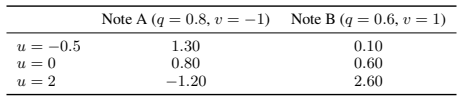
Table 1 : Running example ratings rij =q j +u ivj (simplified model, c=b i = 0). The neutral reviewer (u= 0 ) rates by quality alone; all other rows reflect ideological alignment. True quality ranking:A > B.
Original paper · CC BY 4.0 · David Gamba, Seura Ha, Daniel M. Romero, Grant Schoenebeck · Can Ideologues Agree on Quality? From Non-identifiable Latent Factors to Collective Outcomes · Original paper figure · Extracted the figure area from page 20 of the original PDF.Why a ratings-only quality score needs an anchor
Community Notes decides which fact-check notes to show by running Biased Matrix Factorization on volunteer ratings. BMF learns an ideology for each reviewer and each note, then treats quality as what is left after ideological alignment. The intuition is that a note praised by both left and right reviewers is probably good, while one praised by a single side may just match that side's ideology.
That intuition only holds if the split between quality and alignment is well defined, and this paper asks whether BMF's split recovers objective quality.
The split isn't unique, though: shifting every reviewer's ideology by a constant and compensating in note quality leaves every rating unchanged. The data alone cannot say which reviewers are neutral, so different anchor choices give different quality rankings. Yet BMF returns one ranking, so something inside the objective must settle the anchor.
That hidden choice matters because notes are shown when their estimated quality passes a threshold.
A shift that leaves every rating unchanged
The key idea is that a constant shift of reviewer ideology can be absorbed into note quality, so the ratings can't tell the two versions apart. Formally, for any \(\gamma\), the shifted parameters use \(u'_i = u_i - \gamma\) and \(q'_j = q_j + \gamma v_j\), with \(v'_j = v_j\). The \(\gamma v_j\) added to quality cancels the \(-\gamma v_j\) carried by the shifted ideology, so every rating is identical.
The term gauge comes from physics, where observable quantities stay fixed under changes of representation.
This is one of five rating-preserving transformations of the full BMF model, which add offsets, an item-side shift and a rescaling. Among them, only the reviewer-side shift \(\gamma\) can reorder notes, because the other four either cancel in pairwise differences or leave quality alone. This reduces the anchor question to a single scalar, namely which ideology is called neutral.
In the running example, Note A has quality 0.8 with left-leaning framing, and Note B has quality 0.6 with right-leaning framing. Setting \(\gamma = 1\) moves the neutral point to ideology 1, giving quality estimates of -0.20 for Note A and 1.60 for Note B. Note B then ranks above Note A even though its true quality is lower, and every rating stays the same.
Where L2 regularization places the anchor
The key idea is that the L2 penalty pulls the anchor two ways: toward centering reviewers at zero, and toward small quality scores. Penalizing squared reviewer ideologies favors centering them, which moves the anchor toward the mean reviewer ideology \(\mu_u\). Penalizing squared quality favors small quality estimates, which moves the anchor toward zero.
The ratio \(\kappa = \lambda_q/\lambda_u\) sets how strongly each pull counts.
Since the risk can't change along the gauge orbit, the question becomes which point on that orbit the penalty prefers. The paper calls this point the min-min solution, the zero-risk setting with the smallest penalty. As the penalty weight goes to zero, the regularized fit converges to this point.
A minimizer must also satisfy first-order conditions along each gauge direction, which the paper calls balance equations. The two that matter for quality are the agent-centric balance \[\lambda_u \sum_i \hat u_i = \lambda_q \sum_j \hat q_j \hat v_j\] and the scale balance. If quality and ideology are uncorrelated, the right side vanishes, so the reviewer ideologies must sum to zero.
Otherwise the balance pulls the anchor away from zero in proportion to the quality-ideology covariance.
The main result, Theorem 10, covers the simplified model with zero-mean notes and no covariance between quality and leaning. It gives the anchor as \[\gamma^* = \frac{\mu_u}{1+\kappa\rho\sigma_v^2/\tau^{*2}}\] Here \(\rho = m/n\) is the note-to-reviewer ratio, and \(\sigma_v^2\) is the uncentered mean of squared note leanings. Because \(\kappa\), \(\rho\), \(\sigma_v^2\) and \(\tau^{*2}\) are positive, the denominator exceeds one, so \(\gamma^* = s\mu_u\) with \(s\) between 0 and 1.
The proof first argues that the item-side shift and the global offsets vanish at the minimum, leaving two unknowns, \(\gamma\) and \(\tau\). Substituting the shifted parameters into the agent-centric and scale balances gives two equations in those unknowns. The resulting system reduces to one monotone equation in \(\tau^2\) with exactly one root, so the solution is unique.
Truth recovery, welfare and the limits of ratings
When the reviewer pool is neutral, \(\mu_u = 0\), the anchor vanishes and BMF recovers the correct quality ranking. Corollary 17 states the converse under the same conditions: BMF recovers quality for every configuration if and only if \(\mu_u = 0\). The converse is shown by building notes whose qualities are close enough that the anchor reverses their order.
Anchoring at \(\mu_u\) therefore ranks notes by average reviewer satisfaction, whereas anchoring at 0 ranks them by objective quality. As \(\kappa\) goes to zero, the ranking moves fully toward the average reviewer, and as \(\kappa\) grows it approaches the true quality ordering while the estimates shrink toward zero.
Whether that counts as social welfare depends on whether the reviewer pool represents the population the platform cares about. The welfare anchor survives nonzero covariance between quality and leaning, while the recovery anchor at zero shifts.
Theorem 15 shows that for any two notes with different leanings, some gauge shift reverses their quality order without changing any rating. So a mechanism that sees only the rating matrix can't get both orderings right. The authors argue this follows from the ratings themselves, so helpfulness assessments built on ratings inherit the same confound.
A skewed reviewer pool, which is likely given self-selection, means notes aligned with the majority can rank higher for that reason.
Simulation evidence for the anchor
The authors simulate the ground truth model with 101 reviewers, 100 notes and one ideological dimension. Ratings carry noise variance 0.25, and BMF is fit with L2 regularization using the Adam optimizer. They sweep \(\mu_u\) from -2 to 2 with \(\lambda_u = \lambda_q = 0.01\), so \(\kappa = 1\), and estimate the anchor two ways. The item-side estimate regresses note quality on leaning, while the user-side estimate regresses reviewer ideology on fitted ideology.
Both estimators track \(\gamma^*\) from Theorem 10 across the sweep, and both sit close to the theory line. At \(\mu_u = 2\), the prediction is 0.80, compared to 0.72 for the item-based estimate and 0.78 for the user-based estimate.
Quality recovery was scored with the quality gap at 10, a top-10 measure against the oracle. At \(\mu_u = 0\) BMF gets near-optimal recovery, and the gap grows monotonically as \(|\mu_u|\) rises. Notes leaning toward the average reviewer are the ones that get overrated.
Community Notes uses categorical ratings, so the authors also passed scores through a logistic link and sampled Bernoulli ratings. The user-based estimate came to 0.77 at \(\mu_u = 2\), compared to 0.79 on the theory curve. The item-based estimate compressed to 0.57 at large \(|\mu_u|\), which the authors suspect is saturation of the logistic link.
Three departures from the bilinear form were also tested: a Euclidean utility, a higher-order interaction and an unmodeled confounder. The anchor still tracks \(\mu_u\) under all three, and quality recovery at \(\mu_u = 0\) survives the confounder but fails under the other two.
Limits of the setting
The core analysis is noiseless, uses a correctly specified model and has one ideological dimension. A general treatment of misspecification remains open.
Theorem 10 requires zero-mean notes and no covariance between quality and leaning, and dropping that covariance moves the recovery anchor. Community Notes' minimum rating counts and tag-based weighting are not modeled here.
A deployment also adds missing ratings, weighting and display thresholds, and filtering which reviewers count moves \(\mu_u\). The analysis is a static snapshot, so reviewer entry and exit and feedback loops are left for future work.
Paper info
- Authors
- David Gamba, Seura Ha, Daniel M. Romero, Grant Schoenebeck
- Venue
- arXiv · Preprint
- First published
- 2026-11-21
- Added
- 2026-11-24
- Updated
- 2026-11-21
- Version
- v1
- arXiv
- 2611.28615
- Category
- cs.CY · cs.LG
- Original paper terms
- CC BY 4.0
- What we show
- Paper info, commentary and permitted figures from the original paper
AI commentary is a separate explanation from the original paper and may contain errors. The original paper and figures follow each source's terms of use and any rights noted separately.
Abstract
To surface "objective" fact-check notes, X's Community Notes uses Biased Matrix Factorization (BMF) on crowd-sourced ratings to separate note quality from reviewer ideology. We show that for any correctly specified model that decomposes ratings into quality and ideological alignment, this separation requires fixing an ideological anchor: a reference point for what counts as neutral. We give a characterization for the standard implementation: with $L_2$ regularization, BMF anchors quality at a point proportional to the mean reviewer ideology, recovering objective quality if and only if the mean reviewer is neutral, assuming note quality is uncorrelated with note leaning. This parallels the Condorcet Jury Theorem: collective judgment recovers truth when the pool is unbiased on average. When that assumption fails, BMF's recovered ranking shifts toward maximizing aggregate reviewer satisfaction, which coincides with social welfare only when the pool is representative. This is not specific to BMF; the rating matrix admits a continuous family of gauge-equivalent decompositions, each implying a different quality ranking, so no mechanism based on ratings alone can recover quality without implicitly choosing such an anchor. What appears to be routine hyperparameter tuning is in fact a normative choice about whose preferences define quality.
Quote from the paper
David Gamba, Seura Ha, Daniel M. Romero, Grant Schoenebeck (2026). Can Ideologues Agree on Quality? From Non-identifiable Latent Factors to Collective Outcomes. arXiv:2611.28615v1. https://arxiv.org/abs/2611.28615v1
BibTeX
@misc{gamba2026ideologues,
  title = {{Can Ideologues Agree on Quality? From Non-identifiable Latent Factors to Collective Outcomes}},
  author = {David Gamba and Seura Ha and Daniel M. Romero and Grant Schoenebeck},
  year = {2026},
  eprint = {2611.28615},
  archivePrefix = {arXiv},
  url = {https://arxiv.org/abs/2611.28615v1}
}