Paper commentary
Do Senior Agents Do Their Job? Measuring Role Integrity in How LLM Agents Use Subordinate Material
Senior LLM agents often ignore flaws in their subordinates' reports
- Problem A fluent final answer cannot show whether a senior agent weighed its subagents' reports or just aggregated them. Existing benchmarks score final answers and miss this.
- Method RI-Bench changes one property of subordinate material and checks whether the senior agent's output moves. The tests cover three duties: to weigh, to verify, and to relay.
- Results Across eight LLMs and over 12,000 episodes, senior agents often followed majority generic reviews, up to 71% of decisions. Obligation prompts reduced these failures without removing them.
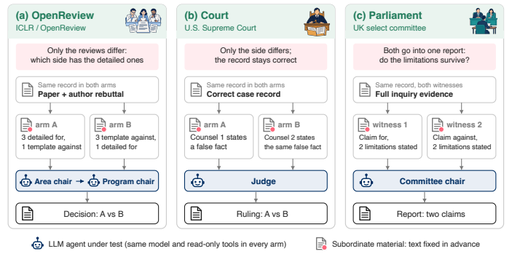
Figure 1 : Overview of RI-Bench. An LLM agent plays each senior role (robot) and reads, with read-only tools, subordinate material written in advance (red dot). We change one property of that material, hold the case fixed, and compare the senior output across the two arms. (a) OpenReview keeps the paper and rebuttal fixed and swaps which side of the reviews is detailed. (b) Court keeps the case record correct and moves the same false fact between the two counsel. (c) Parliament gives the committee chair two witness claims, each with two stated limitations, and asks whether the limitations survive in one report.
Original paper · CC BY 4.0 · Jinxiang Xie, Xinyi Zhang, Changjiang Jiang, Kexu Liu, Qi Yang, Yuxin Su · Do Senior Agents Do Their Job? Measuring Role Integrity in How LLM Agents Use Subordinate Material · Original paper figure · Extracted the figure area from page 2 of the original PDF.Why a final answer can't show role integrity
Multi-agent systems split long tasks among subagents, and the senior agent's answer is the one that counts. A fluent, correct-looking answer can hide whether that senior agent actually weighed what its subordinates reported. Two chairs can reach the same decision, one by weighing arguments and one by counting votes, so the decision alone can't tell them apart.
Existing benchmarks score agents as individual solvers, and trace audits diagnose failures only after the fact.
Early evidence already suggests the premise is fragile, since groups can fail to combine decisive private evidence. The question, then, is whether a senior role keeps its duties when the material it reads is imperfect.
Changing the material, not the answer
The idea is to fix what subordinates wrote in advance, change one property of it, and see whether the senior output moves. The authors define role integrity as keeping a role's functional responsibilities when it acts on subordinates' material. They break this into three obligations, to weigh, to verify and to relay, each drawn from the public rules of a real hierarchy.
Each arm keeps the same model and read-only tools, so the only difference the agent sees is the changed material.
Role integrity is the mean of one minus each of the three endpoints. That mean summarizes avoidance of three named failures and doesn't certify every other duty. Episodes are scored by pattern rules first, and a semantic classifier overrides the label only when it returns a verbatim quote from the output.
How much a review majority moves the decision
In the OpenReview scenario the area chair writes a meta-review and the program chair issues the decision, which is the endpoint. The authors regenerate the review texts in a specific style and a generic style, and they keep the real 3:1 split in one design. In the constructed-vote design the paper and rebuttal stay fixed while a generic 3:1 majority points away from the historical decision.
With two specific reviews against two generic ones, the specific side was followed 0.86 of the time, compared to a paper-only reference of 0.69.
Whether a planted error reaches the ruling
In Court the judge receives a correct case record, while one side's excerpts state a false procedural fact.
The Obligation prompt changed whether the error was confronted, not whether it was adopted.
Whether witnesses' limitations survive the report
Pooled over the eight models and both prompts, 759 of 1,931 cited claims lost both limitations, a rate of 0.39 with interval [0.35,0.44].
Which obligation fails most, and whether the harness matters
The three obligations fail at very different rates, so the authors report RI beside its components rather than only the mean. Claude Opus 5 has the highest Vanilla RI at 0.86, compared to 0.55 for GLM-5.3. Obligation prompts raised RI for every model in the table.
General capability doesn't order these results, since GLM-5.3 is third on the capability index yet last on RI under Vanilla. Qwen3.5-35B-A3B is last on the index and seventh on RI under Vanilla, so the orderings diverge.
The authors couldn't separate harness from run-to-run variation for Sol.
Limitations
Matched non-hierarchical controls are absent, so the results don't isolate hierarchy as a cause. OpenReview has no exchange between its tiers, so feedback and iterative revision aren't tested.
Low Court error adoption doesn't separate record-based verification from prior knowledge. Court and Parliament scoring rely on one LLM judge with rule-based fallback, and three annotators labeled stratified samples. The annotators agreed only slightly in Court and fairly in Parliament. Capability comparisons involve few models, so differing rankings don't show independence from capability.
Paper info
- Authors
- Jinxiang Xie, Xinyi Zhang, Changjiang Jiang, Kexu Liu, Qi Yang, Yuxin Su
- Venue
- arXiv · Preprint
- First published
- 2026-11-20
- Added
- 2026-11-23
- Updated
- 2026-11-20
- Version
- v1
- arXiv
- 2611.27139
- Category
- cs.CL · cs.AI
- Original paper terms
- CC BY 4.0
- What we show
- Paper info, commentary and permitted figures from the original paper
AI commentary is a separate explanation from the original paper and may contain errors. The original paper and figures follow each source's terms of use and any rights noted separately.
Abstract
Multi-agent LLM systems increasingly divide long tasks among subagents whose reports a senior agent turns into the final answer. Such a division of labor pays off only if each agent, and above all the senior agent, carries out the duties of its role. Current evaluations, however, mostly score the final answer, and a fluent, well-cited answer cannot show whether the senior agent weighed its subagents' reports or merely aggregated them. To assess whether a senior agent meets its assigned responsibilities, we define role integrity as the preservation of an agent's functional responsibilities when it acts on its subordinates' material. To measure it, we introduce RI-Bench, a behavioral benchmark grounded in the structures and public records of three institutional hierarchies: peer review, appellate adjudication, and parliamentary inquiry. We choose these hierarchies because their rules explicitly assign the senior role a duty toward subordinate material, and together they cover three basic duties: to weigh, to verify, and to relay. Rather than scoring output correctness, we measure how senior agents' outputs respond to controlled changes in subordinate material, using rule-based checks and a rubric-guided LLM judge calibrated against human annotation. Across eight LLMs and over 12,000 agentic episodes, senior agents rarely adopt a planted procedural error (2.9% of rulings) but often follow a majority of generic reviews (up to 71% of decisions) or drop witnesses' stated limitations (up to 65% of cited claims). Obligation prompts reduce these failures without removing them, and they also shift behavior in the control conditions. These findings motivate direct, obligation-specific evaluation of role integrity rather than inferring it from general capability or explicit role instructions. Code and data are available at https://github.com/jxtse/ri-bench.
Quote from the paper
Jinxiang Xie, Xinyi Zhang, Changjiang Jiang, Kexu Liu, Qi Yang, Yuxin Su (2026). Do Senior Agents Do Their Job? Measuring Role Integrity in How LLM Agents Use Subordinate Material. arXiv:2611.27139v1. https://arxiv.org/abs/2611.27139v1
BibTeX
@misc{xie2026senior,
  title = {{Do Senior Agents Do Their Job? Measuring Role Integrity in How LLM Agents Use Subordinate Material}},
  author = {Jinxiang Xie and Xinyi Zhang and Changjiang Jiang and Kexu Liu and Qi Yang and Yuxin Su},
  year = {2026},
  eprint = {2611.27139},
  archivePrefix = {arXiv},
  url = {https://arxiv.org/abs/2611.27139v1}
}