Paper commentary
Demographic Encoding is Not Exposure: Fairness and Privacy in Chest X-ray Foundation Models
Demographic encoding does not drive leakage in chest X-ray foundation models
- Problem Fairness gaps and privacy leakage in medical foundation models were assumed to share one cause, but no earlier study had linked demographic encoding to patient-level membership risk.
- Method The authors train 200 linear or MLP heads on frozen chest X-ray embeddings, then measure encoding, fairness gaps and membership leakage on the same heads.
- Results Demographic encoding explained almost no variance in patient vulnerability, and leakage tracked head capacity and training length instead.
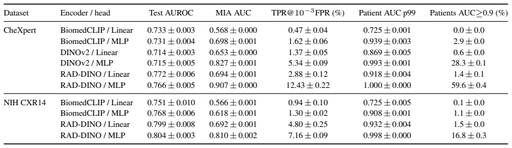
Table 3 : Utility and leakage (mean ± s.d. over three seeds). The column Patients AUC≥0.9 gives the share of patients whose max-over-records membership AUC is at least 0.9.
Original paper · CC BY 4.0 · Askari, Sahar, Golnari, Amin · Demographic Encoding is Not Exposure: Fairness and Privacy in Chest X-ray Foundation Models · Original paper figure · Extracted the figure area from page 6 of the original PDF.Why fairness and privacy get audited together
The fairness worry is that chest X-ray classifiers miss disease more often in under-served patient groups. The privacy worry is that membership inference can show whether a patient's record was part of the training data.
The two worries are usually linked by an implicit causal story. If that story holds, demographic encoding, fairness gaps and membership vulnerability should move together.
This matters for practice, because one mitigation such as removing demographic information would then serve both goals. Earlier studies covered encoding versus linear use, persistent demographics in embeddings and fairness-privacy trade-offs, but none linked encoding strength to patient-level membership risk. The open question is therefore whether the three quantities are aligned when measured on the same models.
A joint audit on the same heads
The authors measure all three quantities on the same frozen embeddings and the same heads, and then test how they relate. The design therefore has to make the three numbers comparable, which is why the heads are shared across all measurements.
The study uses two public datasets, CheXpert-small and NIH ChestX-ray14, and samples 15,000 patients from each. Each run splits patients into audit (10,500), validation (1,500) and test (3,000) sets, so no patient appears in two splits. Three frozen encoders are used, BiomedCLIP, DINOv2 as a general-domain control and RAD-DINO as a radiology-specific model, but NIH uses only BiomedCLIP and RAD-DINO.
Because RAD-DINO's pretraining data include CheXpert, its CheXpert results are treated as an upper bound rather than a clean test of generalization.
A head is either a linear layer or a one-hidden-layer MLP with GELU, and the main configurations use 512 hidden units trained for 30 epochs. Training draws minibatches of 2048 records with replacement and optimizes with AdamW, with a cosine schedule to zero.
From record statistics to patient scores
For each record, the audit compares its score across the models that trained on it with its score across the models that did not. Both sets of scores are treated as Gaussians, and the resulting statistic equals the AUC that would separate the two distributions. A random re-draw of membership gave a patient-level 99th percentile of about 0.606 in every run, which the authors used as a calibration check.
Each patient's score takes the maximum of its record statistics, so the patient counts as exposed if any one record stands out. \[ \theta_p = \max_{i \in R_p} \theta_i \] The authors also score patients by the mean over records and by one random record, to check whether record count drives the result.
A separate aggregate attack computes a log-likelihood ratio for each model-record pair, and its AUC is taken over at most four million such pairs. Encoding comes from linear probes fitted on patient-mean embeddings with five-fold cross-validation, and each patient's score is the prior-corrected posterior of the true class. The underdiagnosis rate is the record-level false-positive rate for the No Finding label, and the gap is measured against the reference group.
An association counts as equivalent to zero only if the 95% CI of the partial rank correlation lies within plus or minus 0.1 and the upper bound of the ∆R2 CI is below 0.01.
Leakage follows the head, not utility
The MLP head leaked more than the linear head for all three encoders, while test AUROC barely moved. Test AUROC was 0.766 for the MLP and 0.772 for the linear head, so utility does not explain the leakage gap.
Seed variation is small, with a standard deviation of at most 0.002 in MIA AUC.
Capacity and training length, separately
A 512-unit MLP trained for 5 epochs matched the linear head's 0.694 MIA AUC at a test AUROC of 0.770.
Width alone does not explain it either, because an 8-unit MLP leaked little at 0.552 but lost utility at a test AUROC of 0.665. A 64-unit MLP leaked about as much as the linear head, at 0.689. The authors' reading is that leakage depends on head capacity and training length together.
Shorter training was not free on NIH ChestX-ray14, where the 5-epoch MLP for BiomedCLIP lost about 0.02 in test AUROC against the 30-epoch MLP, at 0.741 versus 0.762.
Encoding strength against vulnerability
Within a model, however, stronger encoding of a patient's demographics did not predict that patient's vulnerability. Yet this is the central test, because encoding strength is the quantity the intuitive causal story would link to leakage.
Table 5 lists the equivalence results by dataset, head regime and attribute.
On NIH ChestX-ray14, 22 of 28 associations passed the partial correlation criterion and 27 of 28 passed the ∆R2 criterion. All six partial correlation exceptions were fully trained MLP runs for age, with values between -0.145 and -0.088. Their sign is negative, so stronger age encoding went with lower leakage, and the authors claim only that encoding did not raise leakage in these runs.
At the model level, RAD-DINO ranks first, DINOv2 second and BiomedCLIP third for both encoding strength and leakage.
What does predict vulnerability
That effect largely disappears under the mean over records or one random record, where ∆R2 is at most 0.04, except for the RAD-DINO linear head at 0.143 and 0.108. So the record-count effect mostly reflects taking a maximum over more draws, not a property of the patient.
The remaining explained variance comes from patient atypicality, such as the number of findings, which explains up to 0.124 for the RAD-DINO MLP under the mean-over-records score. Rare findings and sparse embedding neighborhoods add up to 0.064, and demographic encoding contributes approximately zero under every score.
Erasure changes fairness, not leakage
LEACE removes a concept in closed form, so that no linear classifier can recover that concept from the erased embeddings. The authors applied it jointly to one-hot sex, race and age on CheXpert, fitting it on all records, including validation and test patients, because it serves as an analytical intervention.
Linear probes lose most of their power, with RAD-DINO sex falling from 0.998 to 0.683 for the linear probe. Table 6 gives the probe results before and after erasure.
Leakage did not change: the BiomedCLIP linear head stayed at 0.568, and the RAD-DINO MLP moved from 0.907 to 0.913.
Fairness responded: the underdiagnosis gap for patients under 40 on BiomedCLIP MLP heads fell from 0.167 to 0.054, a difference of 0.113 with a 95% CI of 0.073 to 0.153. On RAD-DINO the same gap fell from 0.136 to 0.101, and the gap for patients aged 40 to 60 fell from 0.086 to 0.035 on BiomedCLIP.
Limitations
LEACE removes only linear information, and the encoding scores are linear too. LEACE was fitted on test patients as well, so its numbers describe an analysis, not a deployable mitigation.
NIH ChestX-ray14 has no race labels and a different fairness pattern, so the authors do not pool fairness findings across datasets. Intersectional subgroups were not analyzed.
Paper info
- Authors
- Askari, Sahar, Golnari, Amin
- Venue
- arXiv · Preprint
- First published
- 2026-11-23
- Added
- 2026-11-25
- Updated
- 2026-11-23
- Version
- v1
- arXiv
- 2611.31014
- Category
- eess.IV · cs.CV · cs.LG
- Original paper terms
- CC BY 4.0
- What we show
- Paper info, commentary and permitted figures from the original paper
AI commentary is a separate explanation from the original paper and may contain errors. The original paper and figures follow each source's terms of use and any rights noted separately.
Abstract
Medical foundation models encode patient demographics and can reveal whether a patient was in the training set, and these properties are often treated as one problem. We tested whether they are aligned by measuring demographic encoding, diagnostic fairness gaps and membership-inference vulnerability on the same models. We trained 200 linear or multilayer-perceptron (MLP) heads on frozen BiomedCLIP, DINOv2 and RAD-DINO embeddings, with three seeds, and audited them on CheXpert and NIH ChestX-ray14. Demographic encoding explained almost no variance in patient vulnerability, and all 72 CheXpert associations were statistically equivalent to zero. Erasing linearly decodable demographics left leakage unchanged but reduced age-related underdiagnosis gaps. Leakage depended instead on head capacity and training length. On RAD-DINO, a linear head reached a membership-inference area under the curve (AUC) of 0.694, compared with 0.907 for a 30-epoch MLP, at similar test performance. Fairness and privacy should therefore be audited separately, and linear heads or shorter training reduce leakage with little or no loss of utility. The code is available on GitHub for public use.
Quote from the paper
Askari, Sahar, Golnari, Amin (2026). Demographic Encoding is Not Exposure: Fairness and Privacy in Chest X-ray Foundation Models. arXiv:2611.31014v1. https://arxiv.org/abs/2611.31014v1
BibTeX
@misc{sahar2026demographic,
  title = {{Demographic Encoding is Not Exposure: Fairness and Privacy in Chest X-ray Foundation Models}},
  author = {Askari, Sahar and Golnari, Amin},
  year = {2026},
  eprint = {2611.31014},
  archivePrefix = {arXiv},
  url = {https://arxiv.org/abs/2611.31014v1}
}