Paper commentary
Can an Agent Trust Its Own Zoom? Cross-Magnification Provenance Verification for Whole-Slide Images
ZoomTrace checks whether a zoomed slide view really came from its claimed location
- Problem Visual agents cannot tell whether a magnified whole-slide view came from the location it claims. Repeated tissue patterns make a plausible match point to the wrong spot, and that error stays silent.
- Method ZoomTrace estimates the source box from the images alone, before reading the claim. It aligns physical scale, retrieves candidate windows, refines them with a homography, and scores reliability against spatially separate rivals.
- Results ZoomTrace reaches 0.969 AUPRC and 0.987 AUROC on the PyraFault test split, compared with 0.789 and 0.903 for Efficient LoFTR.
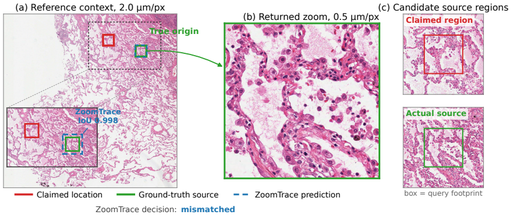
Figure 1 .Cross-magnification provenance verification in a whole-slide pathology image.(a) The reference context shows the claimed location (red), ground-truth source (green), and ZoomTrace prediction (blue dashed). (b) The returned high-magnification observation originates from the true source rather than the claimed location. (c) The claimed and actual source regions exhibit visually similar tissue structures. ZoomTrace independently recovers the source (IoU = 0.998) and correctly identifies the provenance mismatch.
Original paper · CC BY 4.0 · Yan Wang, Yiran Song, Zizhuo Gong, Jianxiang Qi, Zhongxing Xu, Lingfei Qian, Minquan Lin · Can an Agent Trust Its Own Zoom? Cross-Magnification Provenance Verification for Whole-Slide Images · Original paper figure · Extracted the figure area from page 2 of the original PDF.Why a plausible zoom isn't proof of origin
Visual agents inspect a whole-slide image by requesting magnified views, and each view arrives tagged with the location it claims to come from. That tag can be wrong, and the damage is quiet: a correctly read zoom attached to the wrong place becomes misleading spatial evidence. Pyramid-coordinate conversion errors and mismatched content-metadata associations are two ways this happens.
Matching is harder here because a 512×512 query covers only 128×128 context pixels, so cellular detail may be missing.
Repeated tissue patterns also let a plausible match point at a second location, and the true source may sit outside the context. Figure 1 shows this case: the returned zoom matches the true source, while the claimed region holds similar tissue. A verifier therefore has to judge spatial agreement and be allowed to abstain, which is the task the authors call cross-magnification provenance verification.
What the verifier sees and returns
The key idea is to decide where an observation came from before reading the claim, so the claim can't pull the estimate toward itself. The verifier receives the context C, the query Q, the claimed box ℓ and both resolutions, but never the true source. From the images alone it returns an estimated box B̂ and a reliability r, and the claimed box is left out of that step.
The claim is compared only afterward, through the discrepancy \\( d(\\hat B,\\ell)=\\lVert c(\\hat B)-c(\\ell)\\rVert_2 / w_q \\), which divides the distance between box centres by the query footprint width. A reliability threshold τ and a spatial tolerance δ then produce one of three decisions. The decision is unverifiable when r is below τ, verified when r reaches τ, B̂ exists and d is at most δ, and mismatched otherwise.
A missing box with high reliability counts as a mismatch, and the ground truth stays binary, so unverifiable is only the model's choice to abstain.
The spatial tolerance δ is set to the 99th percentile of clean localization residuals. Both values are then frozen before the test set is scored.
Matching scale, then finding candidates
The general rule is \\( h=H_q\\,m_q/m_c \\), the query side length times its resolution, divided by the context's resolution. The authors match scale because a common physical scale exposes tissue structure that query and context share.
Context windows of side h are laid on a grid with stride h/2, and each window is encoded by frozen UNI. Cosine similarity with the aligned query ranks the windows, and the top ten form the candidate set K. The overlapping grid keeps an off-grid source close to some candidate, which gives refinement a starting point. For the evaluated geometry the bank holds 961 windows, and it can be reused for later queries on the same reference.
RANSAC then fits a homography from window to query coordinates with a three-pixel threshold, and each candidate is scored by its inlier fraction s_j. The best window j* gives the refined box: its origin is shifted by the fitted translation, and the side length stays h. The origin is rounded to context pixels and mapped to slide coordinates, and a failed fit returns no box.
Why a strong match can still be untrustworthy
The reliability idea is that a strong match means little when another, spatially separate location fits almost as well. Windows that overlap the winner are dropped from the rival set, because they can describe the same source at a shifted origin. The rival set is \\( R=\\{j\\in K:\\,W_j\\cap W_{j^*}=\\emptyset\\} \\), so only windows whose footprints miss the winner's window count as rivals.
The reliability is \\( r=\\max\\bigl(0,\\,1-\\max_{j\\in R}s_j/s_{j^*}\\bigr) \\), so the best rival's score is divided by the winner's score. A tie gives zero reliability, and a clear winner over weak rivals gives a value near one. The score is zero when the winner's score is zero, and it is set to one when a positive winner has no disjoint rival.
No extra matcher calls are needed, because the scores already exist from the geometric matching step.
The claim enters only at the decision step, so a reliable estimate away from the claim gives both a mismatch and a local correction.
Building PyraFault from known coordinates
PyraFault takes its true source from pyramid coordinates and slide identity, so the answer never depends on the claim. The benchmark has 3.06 million examples from 2,200 cases across five TCGA cohorts, drawn from TCGA-LUAD, LUSC, LGG, BLCA and UCEC. Splits are assigned by case, giving 1,540, 330 and 330 cases for development, calibration and test, so no case leaks across splits.
Three within-context faults keep the source recoverable: adjacent drift of 0.25 to 6 query widths, random substitution, and hard substitution mined by appearance similarity. Together with clean pairs, the eight conditions are sampled equally, with 62,915 test examples each, and correct claims make up 12.5% of the test set.
Each pair also receives one of four viewing conditions: none, mild, moderate or severe. Rotations of ±5°, ±10° or ±15° and scale changes of ±2%, ±4% or ±6% come with those levels. Because the perturbations keep the provenance label, they separate geometric robustness from source correctness.
Discrimination and source recovery against Efficient LoFTR
The first question is whether ZoomTrace separates correct from incorrect claims better than the baseline Efficient LoFTR. On the test pairs, ZoomTrace scored AUPRC 0.969 and AUROC 0.987, compared to 0.789 and 0.903 for Efficient LoFTR. Both metrics use all pairs, abstentions included, and the continuous score \\( v=r\\,\\mathrm{IoU}(\\hat B,\\ell) \\) is set to zero when no box is returned, so the comparison doesn't depend on one chosen threshold.
Source recovery is the second question, and it counts missing estimates as failures across all 188,745 incorrect in-context claims. At IoU of at least 0.5, ZoomTrace localizes 97.26% of those claims, compared to 82.75% for Efficient LoFTR. The median IoU is 0.799 for ZoomTrace and 0.962 for Efficient LoFTR, but these are medians over 251,660 and 208,334 returned estimates, so they don't measure the same set.
At calibrated thresholds the ordering flips on answered items: ZoomTrace has balanced accuracy 0.985 at 34.39% coverage, while Efficient LoFTR has 0.998 at 36.14%. Ranking subsets by reliability changes the picture again: Efficient LoFTR leads at 5–25% matched coverage, and ZoomTrace leads at 50%, 75% and 100%, reaching full-coverage BA 0.980.
These are exact rank selections rather than deployable thresholds, so they describe the ranking, not an operating point.
Which components carry the gains
Each variant is calibrated separately, so its numbers show what happens when one part is removed. Removing scale alignment is the most damaging change: AUPRC falls to 0.201 and median IoU drops to zero. The authors' rationale is that the physical scale exposes tissue structure shared between query and context.
Removing geometric refinement drops AUPRC to 0.920 and median IoU to 0.590, because the estimate is then tied to the candidate grid. Using only one candidate (K=1) keeps median IoU at 0.787, but clean residual p99 rises from 0.387 to 5.464 query widths. That tail pushes calibration to zero test coverage, even though AUPRC stays at 0.932.
The winning score is stronger on aggregate, with AUPRC 0.982 and AUROC 0.992, and it uses the same ten matches. The disjoint margin is steadier across perturbations, with a coverage range of 0.023, compared to 0.166 for the winning score. So the two rules trade aggregate discrimination against uniform coverage, and neither dominates on every metric.
Viewing changes, VLMs and CAMELYON16
Under viewing perturbations ZoomTrace's coverage stays between 0.321 and 0.361, and its conditional BA stays between 0.983 and 0.985. Its median IoU falls from 0.990 to 0.607 across the levels, so the decision stays steady while localization precision drops. Efficient LoFTR's coverage falls from 0.476 to 0.103 under the same perturbations.
The authors also asked seven VLMs to localize the query without the claim, on 2,000 items with 11.8% positives. ZoomTrace scores AUPRC 0.962 on the same items.
On CAMELYON16 with 68,400 test items, Efficient LoFTR scores AUPRC 0.7849 at K=10, above ZoomTrace's 0.676. ZoomTrace's median IoU drops to 0.654 and its coverage to 0.013, so source-specific calibration gives almost no answers. Two diagnostics separate retrieval from calibration: recall of windows with IoU at least 0.5 is 81.7% on TCGA and 35.9% on CAMELYON16 at K=10.
Widening to K=50 raises AUPRC to 0.792, but clean residual p99 stays at 12.618 query widths and coverage stays at 0.011.
Withholding corrupted observations in agent tool paths
The key idea is to place the verifier between crop extraction and delivery, and hold back anything it flags as mismatched. Two thresholds are compared: the benchmark threshold τ_b ≈ 0.501 controls false verification, and τ_w = 0 controls how many clean views are withheld. Under τ_w the calibration false-withhold rate is 0.009, and both thresholds keep the same spatial tolerance.
The paired runs connect Claude Code, Codex and DeepSeek Harness to one visual tool server, using 78, 79 and 106 common episodes. For Claude Code, exposure falls from 1.000 to 0.538 under τ_w, and silent failures fall from 0.769 to 0.423. Its verdict accuracy rises from 0.521 to 0.756, with 19 verdicts corrected and 3 made newly incorrect.
DeepSeek shows the threshold trade-off: under τ_b its accuracy is 0.689, compared to 0.755 without protection. Under τ_w it rises to 0.829, but that change rests on 20 corrected verdicts and 12 newly incorrect ones, with p = 0.22. Codex stays at 0.987 across its arms, so for that agent protection changes exposure without changing verdict accuracy.
The PathAgent bridge, run at τ_b, withholds 12 of 31 adjacent-drift observations, 0 of 31 within-context and 2 of 31 out-of-slide, with no clean view withheld. Its precomputed navigation features limit how much of a substituted pixel's effect can reach the agent. Verification takes 0.5 s per check, after 2.3 s to read a reference context and 5.7 s to build its descriptor bank.
Limits and open constraints
The CAMELYON16 results show the first in practice, since clean p99 residual grows with K while coverage stays near zero. The agent evaluations cover three harnesses with 78, 79 and 106 paired episodes, and the effects differ across them.
The reliability trade-off means no single rule wins on every metric, so a deployment has to choose which property matters. Efficient LoFTR keeps the higher conditional balanced accuracy on answered items, so ZoomTrace's advantage lies in discrimination and recovery. Seven VLMs show limited claim-free localization in the tested settings, so that result doesn't cover other prompts or models.
Paper info
- Authors
- Yan Wang, Yiran Song, Zizhuo Gong, Jianxiang Qi, Zhongxing Xu, Lingfei Qian, Minquan Lin
- Venue
- arXiv · Preprint
- First published
- 2026-11-22
- Added
- 2026-11-24
- Updated
- 2026-11-22
- Version
- v1
- arXiv
- 2611.29150
- Category
- cs.CV · cs.AI
- Original paper terms
- CC BY 4.0
- What we show
- Paper info, commentary and permitted figures from the original paper
AI commentary is a separate explanation from the original paper and may contain errors. The original paper and figures follow each source's terms of use and any rights noted separately.
Abstract
Visual agents navigate whole-slide images through magnified observations associated with claimed locations. However, a visually plausible observation does not necessarily originate from its claimed location, particularly across magnifications and in regions with similar tissue structures. We formulate cross-magnification provenance verification (CMPV) to evaluate whether visual evidence supports a claimed spatial association, recover the source when possible, and abstain when evidence is insufficient. We introduce PyraFault, a benchmark of 3.06 million coordinate-supervised examples from 2,200 cases across five TCGA cohorts, covering within-context substitutions, absent-source faults, and geometric perturbations. We further propose ZoomTrace, a claim-independent verifier that estimates the observation's source before evaluating its agreement with the claimed location. It combines physical-scale alignment, visual retrieval, geometric refinement, and reliability estimation using spatially disjoint competing matches. On 503,320 test examples, ZoomTrace achieves 0.969 AUPRC and 0.987 AUROC, compared with 0.789 and 0.903 for Efficient LoFTR. Further evaluations reveal trade-offs in reliability estimation and limitations in vision-language models, cross-dataset retrieval, and calibration. Integrating ZoomTrace into visual agent tool paths reduces exposure to corrupted observations and silent failures, while downstream accuracy improvements depend on the agent and verification threshold.
Quote from the paper
Yan Wang, Yiran Song, Zizhuo Gong, Jianxiang Qi, Zhongxing Xu, Lingfei Qian, Minquan Lin (2026). Can an Agent Trust Its Own Zoom? Cross-Magnification Provenance Verification for Whole-Slide Images. arXiv:2611.29150v1. https://arxiv.org/abs/2611.29150v1
BibTeX
@misc{wang2026agent,
  title = {{Can an Agent Trust Its Own Zoom? Cross-Magnification Provenance Verification for Whole-Slide Images}},
  author = {Yan Wang and Yiran Song and Zizhuo Gong and Jianxiang Qi and Zhongxing Xu and Lingfei Qian and Minquan Lin},
  year = {2026},
  eprint = {2611.29150},
  archivePrefix = {arXiv},
  url = {https://arxiv.org/abs/2611.29150v1}
}