Paper commentary
VideoMemBench: How Well Do MLLMs Remember in Video Conversations?
VideoMemBench tests whether MLLMs reuse what earlier turns established
- Problem Existing video QA benchmarks ask independent questions, so they never check whether a model reuses earlier turns.
- Method VideoMemBench pairs each video with a long multi-turn dialogue and links turns by typed dependencies. Episodic edges point back to what the model saw, and Answer edges point back to what it said.
- Results Claude Opus 5 is the best of over 20 MLLMs tested, at 45.7% overall, versus 86.1% for human annotators.
Why video QA benchmarks leave dialogue memory untested
Existing video QA benchmarks can't test whether a model reuses earlier turns, because their questions never depend on one another. The authors call the ability to retrieve and reuse what earlier turns established in-context video memory. Text-only evaluations already probe this ability for LLMs, so the open question is whether video can be tested the same way.
The difficulty is that many video questions can be answered from the clip alone, so a dialogue test can't separate memory from vision. Video benchmarks such as MVBench, Video-MME and LVBench each ask one question per video, so they never need a dialogue history. Existing video benchmarks avoid the problem by making every question independent, so no answer has to be carried across turns.
Table 1 shows that multi-turn benchmarks such as MMDU and MT-Video-Bench add turns but no dependency graph. MMDU uses images rather than video, and MT-Video-Bench reaches 8 turns per dialogue with no typed or multi-parent edges. Their earlier turns are never needed to answer later ones, so the dialogue never becomes load-bearing. VideoMemBench instead links each video to one dialogue whose turns are joined by typed cross-turn dependencies, rather than independent questions.
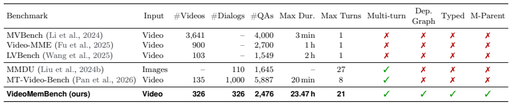
Table 1 Comparison with existing benchmarks.Max Dur.is the maximum video duration in the benchmark.Multi-turn indicates multi-turn dialogue evaluation.Max Turnsis the largest number of QA turns in one dialogue.Dep. Graph denotes structured dependency graphs for individual turns;Typeddistinguishes answer and episodic dependencies; M-Parentindicates multiple parents.
Original paper · CC BY 4.0Episodic and answer dependencies as the test
VideoMemBench makes each dialogue a chain, so a dependent turn can't be answered from its video frames alone. Each sample pairs one video with a long multi-turn dialogue, and its turns link through typed cross-turn dependencies. The design asks the dialogue and the video to answer a dependent turn jointly. The dialogue supplies what an earlier turn established, while the video supplies the visual facts for the current turn.
Episodic Dependencies probe what the model has seen, so the model must recall which scene an earlier turn described.
Figure 1 shows the episodic case: T2 asks about the hippo officers in the scene from T1 without naming the briefing room. Without remembering that T1 concerned the briefing room, the model can't locate the scene the question refers to. Answer Dependencies probe what the model has said, because a question builds on the answer the model gave at an earlier turn.
Three requirements keep these links honest, because a reference to an earlier turn isn't enough by itself. Necessity means a dependent question becomes unanswerable once its parent turns are removed, even with the video and the remaining dialogue. Non-leakage means the question can't restate its parents' episode descriptions or answers, even partially.
A turn can satisfy necessity yet still violate non-leakage, so the two checks are needed separately. Visual grounding requires every turn, dependent or not, to rest on a verifiable visual fact in the video.
The benchmark holds 326 video dialogues with 2,476 turns, and 1,387 of those turns are dependent. Under these rules, the best model scores 45.7% overall, which the authors read as an open gap in in-context video memory. Figure 2 shows the three LLM roles and the human review that enforce these requirements.
A planner, generator and judge build each dialogue
The construction runs three LLM roles, and a plan is fixed before any question is written. The planner first samples keyframes across the video, then writes a global dialogue plan. That plan has four components: a video synopsis, dialogue guidelines, a dependency graph, and per-turn intents. Each per-turn intent names the information to establish, the video segment, and what the turn needs from its parents.
Because the parents are set in advance, the planner makes dependencies structural rather than incidental, which serves Req-1. In the example plan, T2 is an Episodic child of T1, and T3 is an Answer child of T1.
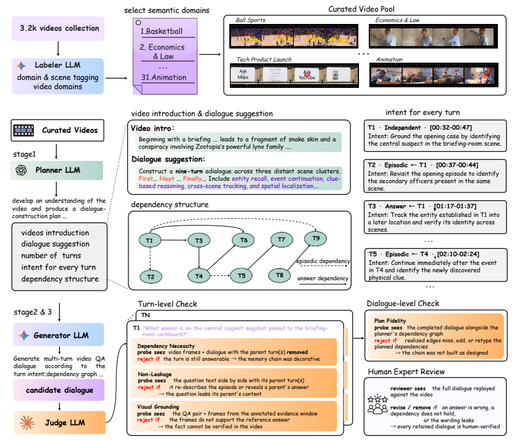
Figure 2 The VideoMemBench construction pipeline.Starting from a curated video pool, a planner specifies turn intents and a typed dependency graph. A generator constructs the dialogue turn by turn, while a judger checks necessity, non-leakage, and visual grounding, returning failed turns for regeneration. Completed dialogues are checked against the plan and reviewed by human experts.
Original paper · CC BY 4.0 · Zhengdong Hu, Chao Wang, Kaituo Feng, Huanjin Yao, Mingfei Lu, Hehe Fan, Yi Yang · VideoMemBench: How Well Do MLLMs Remember in Video Conversations? · Original paper figure · Extracted the figure area from page 5 of the original PDF.The generator writes the dialogue turn by turn, and it first picks a verifiable visual fact as the reference answer. Dependent questions point back through referring expressions, so they don't restate what their parents supplied. The judger runs a necessity probe by removing the parent turns and rejecting any question that stays answerable.
A non-leakage probe sets each question beside its parent turns and rejects restated episode descriptions or disclosed answers. A visual grounding probe checks frames from the evidence window against the reference answer.
The pipeline starts from a pool of about 3.2k videos, collected from Video-MME, VSI-Bench, Video-MMMU, LongVideoBench, and the web. A labeler LLM tags each video's domains and scene composition, so the selection spans different semantic domains. A plan fidelity check compares each completed dialogue with the planner's dependency graph and rejects missing, added, or retyped edges.
Eight human experts then replay each passing dialogue against its video. They revise or remove turns that have wrong answers, invalid dependencies, or leaked information. So every retained dialogue is human-verified, not only checked by the models.
What the 326 dialogues contain
VideoMemBench holds 326 dialogues, each paired with one video, and the dialogues total 2,476 QA turns. Of those turns, 1,089 are independent, which is 43.98% of the set. The remaining 1,387 turns, or 56.02%, depend on earlier turns. These dependent turns carry 1,794 typed dependencies, split into 1,200 Episodic edges and 594 Answer edges.
Dependent turns therefore form the larger share of the benchmark, so cross-turn memory is central to its design.
Dialogues run from 4 to 21 turns, averaging 7.6 turns per dialogue. Among dependent turns, 348 have multiple parents, with 289 turns having two parents and 59 having three. Dependency distance ranges from one to nine turns, so a turn can reach back across most of a dialogue. The longest chain depth is seven, so an answer can be carried forward through several consecutive turns.
The 326 videos come from five existing benchmarks and the web, and they span 31 semantic domains. Videos last up to 23.47 hours each, which gives the dialogues far more visual material than typical short-clip benchmarks. By length, 143 videos (43.9%) are under 15 minutes, 98 (30.1%) run 15 to under 30 minutes, and 85 (26.1%) reach 30 minutes or more.
How models see the dialogue and get scored
Every model gets the same 128 timestamped frames, drawn across the full video and held fixed for all models. The frames sit at the start of the conversation, and they stay reachable for every later turn. Questions arrive strictly in dialogue order, and the model's own earlier responses stay in the history. At turn t, the input is the frame sequence V, then each earlier question with its response, then the current question.
GPT-5.4 mini judges open-ended responses and extracts the predicted option for multiple-choice questions. TurnAcc averages over all turns, and each response is scored on its own, whatever its parents' answers were. EpiDepAcc covers turns with at least one Episodic dependency, and it ignores whether the parent answers were right. The authors make this choice because an Episodic dependency points to the visual context of a parent question, not to its answer.
AnsDepAcc covers turns with at least one Answer dependency and uses chain crediting. A turn gets credit only when its own response and every response on its Answer-dependency ancestry are correct. The formula averages over the Answer-dependent turns, multiplying each turn's correctness by the correctness of its ancestors. Ancestors come from recursively following only Answer edges toward earlier turns, so Episodic edges are excluded.
A turn with both dependency types counts toward both EpiDepAcc and AnsDepAcc, each under its own rule.
Overall is the arithmetic mean of TurnAcc, EpiDepAcc, and AnsDepAcc, and the authors use it to rank models. Human annotators reach 86.1 overall, which sets the reference point for the models. The overall score combines overlapping subsets, so it doesn't measure a separate set of questions.
How the models score on VideoMemBench
Claude Opus 5 posts the highest overall score among the models tested, at 45.7%. On TurnAcc it reaches 52.3%, the top closed-source score on that metric. On EpiDepAcc it reaches 49.1%, while its AnsDepAcc of 35.7% is its lowest of the three scores. Human annotators reach 86.1% overall, compared with 45.7% for Claude Opus 5.
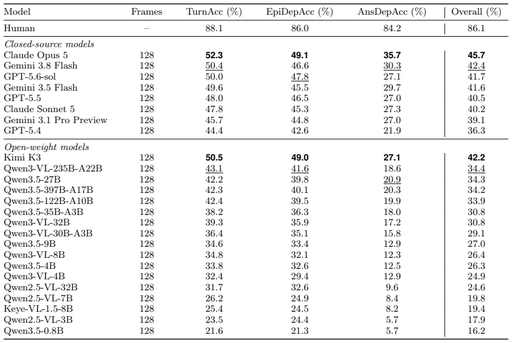
Table 2 Main results on VideoMemBench.Models are evaluated under the self-rollout protocol. TurnAcc: accuracy over all turns, scored individually. EpiDepAcc: accuracy on turns with at least one Episodic dependency. AnsDepAcc: accuracy on turns with at least one Answer dependency under chain crediting. Overall: the arithmetic mean of the three metrics. The best and second-best results in each metric within each model group areboldandunderlined, respectively.
Original paper · CC BY 4.0Across the closed-source models, AnsDepAcc sits 16.6 to 22.9 percentage points below TurnAcc. Human annotators show a gap of only 3.9 percentage points between the same two metrics. Chain crediting gives a turn credit only when every earlier answer in its Answer-dependency chain is also correct. So part of the closed-source gap comes from upstream turns, not only from the current answer.
Kimi K3 is the strongest open-weight model, with an overall score of 42.2%. It ranks third overall among all 25 models that the authors evaluated. Kimi K3 scores 50.5% on TurnAcc, which is second only to Claude Opus 5 across all evaluated models. Every other open-weight model scores below GPT-5.4, which reaches 36.3% overall.
The runner-up, Qwen3-VL-235B-A22B, reaches 34.4% overall, which is 7.8 points behind Kimi K3. Within the dense Qwen3.5 models, the overall score rises with size, from 16.2% at 0.8B to 34.3% at 27B. At comparable scales, Qwen3-VL-32B beats Qwen2.5-VL-32B by 6.2 percentage points. These results show that Kimi K3 is competitive with frontier closed-source models, while the other open-weight models remain behind.
What makes dependent turns harder
Dependency distance is the first factor, measured from the current turn back to its earliest parent. Averaged over all evaluated models, accuracy drops from 30.2% at distance 1 to 23.1% at five turns or more. The longest-distance group shows the larger decline, so the loss grows as the gap widens. Gemini 3.8 Flash falls fairly steadily, from 41.1% to 30.2%.
Qwen3.5-35B-A3B drops more sharply after distance 3, from 27.8% to 19.2%.
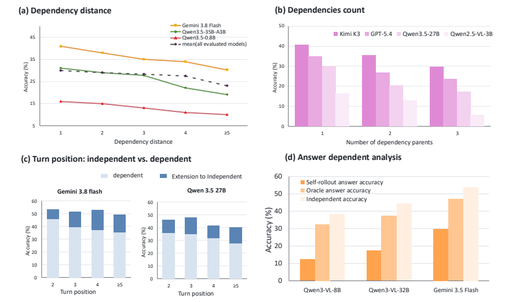
Figure 4 Analysis of factors affecting in-context video memory.(a) Accuracy on dependent turns by dependency distance, measured from the current turn to its earliest parent; the dashed line shows the mean across all evaluated models. (b) Accuracy on dependent turns by the number of parents. (c) Independent- and dependent-turn accuracy by dialogue position for two models: the light segment shows dependent-turn accuracy, the full bar height shows independent-turn accuracy, and the dark segment represents their difference. (d) Accuracy on answer-dependent turns under self-rollout and oracle histories. Oracle histories replace previous model responses with ground-truth answers.
Original paper · CC BY 4.0The number of parents lowers accuracy too, and the decline appears across all four models plotted. GPT-5.4 drops from 34.9% to 23.7%, while Qwen3.5-27B drops from 30.1% to 17.3%.
Dialogue position matters as well, and dependent turns lose more accuracy than independent ones. Gemini 3.8 Flash's dependent-turn accuracy declines from 46.1% at turn 2 to 35.2% at turn 5 and later. Its independent-turn accuracy falls more gently, from 53.8% to 49.2%. Qwen3.5-27B shows the same pattern, dropping from 36.2% to 28.1% on dependent turns.
Across five reported models, the mean of EpiDepAcc and AnsDepAcc sits 13.1 to 17.3 points below independent accuracy.
The oracle test swaps each earlier model reply for the reference answer and reruns the answer-dependent turns. Qwen3-VL-8B rises from 12.3% to 32.4%, and Qwen3-VL-32B rises from 17.2% to 37.3%. Gemini 3.5 Flash climbs from 29.7% to 47.2% under the same swap. Wrong earlier replies therefore account for much of the difficulty on answer-dependent questions.
Even so, oracle accuracy stays below independent-turn accuracy, so correct history isn't enough for reliable memory.
Limits of the evidence
The overall score is a plain average of TurnAcc, EpiDepAcc and AnsDepAcc, so it ranks models without measuring one question set. Its three subsets overlap, because a turn with both dependency types counts toward both EpiDepAcc and AnsDepAcc. So the 45.7% for Claude Opus 5 should be read alongside its three component metrics, not as a single accuracy figure.
Every model is run with 128 frames, so the rankings don't show how the scores shift under a different frame budget. The authors ran frame-count ablations with 16, 32 and 64 sampled frames, which appear in Appendix E.1. Open-ended answers are graded by GPT-5.4 mini, so the scores also depend on that judge's decisions. The human baseline of 86.1 comes from a separate evaluation in Appendix D, not under the same model protocol.
Every result comes from one benchmark of 326 dialogues, each grounded in its own video. Humans drop only 3.9 percentage points from TurnAcc to AnsDepAcc, while the models drop 16.6 to 22.9 points. Chain crediting is stricter by design, so part of that gap reflects the scoring rule rather than memory alone. The Table 3 comparison covers only five of the 25 models, so the independent versus dependent gap isn't established across the full set.
The distance and parent-count trends are described as suggestions, not as proof that longer chains cause the drop. Oracle histories raise answer-dependent accuracy for the three models tested, yet oracle accuracy stays below independent-turn accuracy. So correct history alone doesn't seem to be enough for reliable memory, though the paper doesn't isolate the remaining cause.
They didn't test whether these findings carry over to video sources beyond the five benchmarks and the web used here.
Paper info
- Authors
- Zhengdong Hu, Chao Wang, Kaituo Feng, Huanjin Yao, Mingfei Lu, Hehe Fan, Yi Yang
- Venue
- arXiv · Preprint
- First published
- 2026-10-29
- Added
- 2026-11-1
- Updated
- 2026-10-29
- Version
- v1
- arXiv
- 2610.40131
- Category
- cs.CV
- Original paper terms
- CC BY 4.0
- What we show
- Paper info, commentary and permitted figures from the original paper
AI commentary is a separate explanation from the original paper and may contain errors. The original paper and figures follow each source's terms of use and any rights noted separately.
Abstract
Multimodal large language models (MLLMs) can now process hour-long videos, making extended multi-turn dialogue over a single video a natural mode of use. Sustaining such a dialogue requires more than answering each question in isolation: the model must retrieve and reuse information established earlier in the conversation, both what it has seen and what it has said, an ability we term in-context video memory. Existing video QA benchmarks leave this ability unmeasured: their questions are mutually independent, never reference one another, and each is answerable from the video alone, so nothing ever requires carrying information across turns. We introduce VideoMemBench, in which each sample pairs a single video with a long multi-turn dialogue, whose turns are connected by typed cross-turn dependencies: an Episodic Dependency refers back to a visual episode described in an earlier turn, probing memory of what the model has seen, while an Answer Dependency builds on the model's own earlier answer, probing memory of what the model has said. Every dependency is verified considering two properties: 1) necessity, meaning the question cannot be answered without its earlier turns, and 2) non-leakage, meaning the question does not restate the information from its earlier turns. To enforce these properties, we design a construction pipeline with three LLM roles: a planner, a generator, and a judger, with each dialogue reviewed by human experts. VideoMemBench comprises 326 videos with 2,476 turns, of which 1,387 depend on earlier turns, including multi-parent dependencies and long-range call-back. Among over 20 evaluated open- and closed-source MLLMs, Claude Opus 5 performs the best with an overall score of only 45.7\%, highlighting the challenge of in-context video memory. Our dataset and evaluation are released.
Quote from the paper
Zhengdong Hu, Chao Wang, Kaituo Feng, Huanjin Yao, Mingfei Lu, Hehe Fan, Yi Yang (2026). VideoMemBench: How Well Do MLLMs Remember in Video Conversations?. arXiv:2610.40131v1. https://arxiv.org/abs/2610.40131v1
BibTeX
@misc{hu2026videomembench,
  title = {{VideoMemBench: How Well Do MLLMs Remember in Video Conversations?}},
  author = {Zhengdong Hu and Chao Wang and Kaituo Feng and Huanjin Yao and Mingfei Lu and Hehe Fan and Yi Yang},
  year = {2026},
  eprint = {2610.40131},
  archivePrefix = {arXiv},
  url = {https://arxiv.org/abs/2610.40131v1}
}