Paper commentary
Equal Steps, Unequal Curvature: Where Muon's Update Goes Wrong
- Problem Muon gives every singular direction of a momentum matrix the same step length and spreads per-neuron steps by leverage scores, without checking either choice against the loss curvature.
- Method Splits Muon's step into singular-value bands and neuron groups, estimates held-out gradients and curvature, and tests norm-matched interventions with tuned baselines and paired seeds.
- Results Split-QKV Muon lowered the final held-out loss by 0.0250 nats against fused-QKV Muon at 100.7M tokens in a 124M decoder (three paired seeds). A cooldown spectral tilt lowered split-QKV Muon's loss by a further 0.0120 nats under the same conditions.
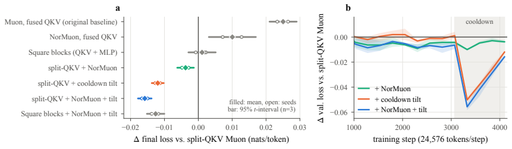
Figure 2 : Controlled results at 100.7M tokens(124M, three paired seeds).(a)Paired difference in final loss against split-QKV Muon. Splitting Q, K and V explains the whole square-block gain; NorMuon on fused QKV is worse than the split; the tilt and NorMuon add on top of the split.(b)Paired difference over training (mean, with the seed range shaded). Intermediate points use 98k held-out tokens; the last point uses 4.18M. Before the cooldown the tilt arm is mathematically identical to its baseline (A/A differences ≤0.009). The tilt’s lead peaks at−0.050 nats 256 steps into the cooldown and settles at−0.0120.
Original paper · CC BY 4.0 · Biswa Sengupta, Jinhua Wang, Léo Maxime Brunswic · Equal Steps, Unequal Curvature: Where Muon's Update Goes Wrong · Original paper figure · Extracted the figure area from page 7 of the original PDF.What Muon's step leaves unexamined
Muon takes its step for each hidden matrix from the polar factor of the momentum, a choice that follows from steepest descent under the spectral norm. That argument fixes the norm of the step. It says nothing about how the step is distributed over singular directions or over neurons.
The open question is whether these two allocations match the curvature of the loss, and steepest descent alone cannot answer it.
Several recent variants rebalance neurons, reshape the spectrum or orthogonalize blocks, and a few measure the optimizer's behavior against held-out loss.
Splitting the step and measuring its curvature
For a hidden matrix, the momentum B_t is updated as \(B_t=\beta B_{t-1}+G_t\), the Nesterov-style input is \(N_t=G_t+\beta B_t\), and the weight moves by \(W_{t+1}=(1-\eta_t\lambda)W_t-\eta_t s\,\mathrm{NS}_5(N_t)\), with shape factor \(s=\sqrt{\max(1,m/n)}\). NS5 normalizes its input by the Frobenius norm and applies five quintic iterations with coefficients (3.4445, -4.775, 2.0315).
On singular values it acts as a scalar map that is close to 1 across most of the spectrum and well below 1 on near-null directions, so it approximates the polar factor.
The gradient and the Hessian–vector products are computed on held-out tokens, not on the training minibatch, so the estimates carry finite-sample noise. Because c^⋆ is the minimizer of q only when H is positive semidefinite, and is unique when H is positive definite, the stationary point is read as an optimum under that curvature condition.
Separating scale from shape, and when a same-norm reallocation helps
The first term is the step-size part, the best uniform rescaling of Muon's step. The second term is the shape part, which is strictly positive unless c^⋆ is flat. The identity needs only symmetry and \(Hc^\star=g\), and positive definiteness is what makes both optima.
For this reason the shape is treated as a one-step diagnostic whose implications have to be tested in training.
A positive shape term does not by itself mean that a same-norm step beats Muon. Proposition 4 states that if the model gradient has a component p orthogonal to N1, some same-norm c lowers q below q(1). If the gradient is a multiple of N1 and H minus a multiple of N is positive semidefinite, no same-norm c does. The shape term does not decide between these two cases.
In the example with H equal to diag(1,3), g equal to (0,2) and N equal to the identity, the shape term is 1/6, yet Muon is optimal among all same-norm steps.
The authors therefore compute the best same-norm step as a trust-region problem on the ellipsoid, which is certified globally optimal, and use the model's prediction for the norm-matched filters that were trained.
Every theorem and proposition in the paper is proved in Lean 4, and Section A states them in full.
Where Muon's step is over-stepped
Across 12 test steps, covering Muon and c^⋆, bands and neurons, and three checkpoints, the predicted and realized loss changes had the same sign in every case and agreed within a factor of three. The c^⋆ step realized a much larger decrease on unseen tokens than Muon's step, -0.00730 against -0.00054 at step 1,024, which the authors use only through realized losses and Theorem 3.
Per-neuron update norms vary most in the fused QKV matrix, with a coefficient of variation of 0.43 and a per-layer range of 0.14–0.73. The MLP has 0.18 and the square attention-output matrix 0.02.
Block-wise polar steps and the cooldown tilt
NorMuon, the stateful alternative from prior work, instead normalizes rows by an exponential moving average of their second moments.
The exact spectral tilt would need an eigendecomposition for each matrix and step. The implementation instead takes O = NS5(N), with singular values fi, and S = O N^⊤, and applies a polynomial in S, so that \(D=P(S/\Lambda)\,O\), which acts in the same singular basis. With P(x) approximately equal to x^p, the filter is proportional to f_i^{1+p} σ_i^p, which is the exact tilt σ^p up to a factor of [0.96, 1.10] on the Newton–Schulz plateau where f_i lies in [0.68, 1.20].
Near-null directions are lifted further.
Training setup and fairness controls
The screen runs 2,048 steps (50.3M tokens) and the confirmations 4,096 steps (100.7M tokens). The final loss is measured on 4.18M held-out tokens, and a 355M model with 24 layers, width 1024 and 16 heads tests scale.
Splitting QKV accounts for the block-wise gain
Table 1 lists the means and paired differences of every arm, against fused-QKV Muon and against split-QKV Muon. Per-head blocks, which equalize rows exactly, do worse than three blocks, at -0.0172 against -0.0255 on the screen. NorMuon on fused QKV is worse than the split, at +0.0100 [+0.0031, +0.0170], and on top of the split it adds -0.0038 [-0.0062, -0.0013].
Figure 2a shows the paired differences in final loss against split-QKV Muon for each arm, and Figure 2b shows the same differences over training.
Scale and the interventions that did not help
At 355M parameters, the split-QKV baseline's learning-rate screen peaks again at 0.005, with final losses of 4.0642, 4.0547 and 4.0647 for 0.0035, 0.005 and 0.007. Against the baseline at the same seeds, NorMuon with the tilt changes the final loss by -0.0188 nats [-0.0202, -0.0175], with per-seed values of -0.0188, -0.0183 and -0.0194. The baseline's three seeds span only 0.0008 nats.
The published Toner recipe gives -0.0068 in a single seed, which the authors note has the sign of its reported gain at a smaller size. Three extra cubic Newton–Schulz iterations change the loss by -0.0020, which is within noise and consistent with the authors' expectation that changes that barely alter the allocation do not help.
With the energy-matched coefficient, Schatten-1 weight decay is additive with the method: -0.0052 [-0.0066, -0.0038] on top of split QKV with NorMuon and tilt at 100.7M tokens, and -0.0210 against split-QKV Muon, at +26% more wall time.
Limitations
The diagnostic is second-order, one step ahead and drawn from a single run without intervals. The g and H estimates come from separate held-out folds, and the joint optimum is ill-conditioned.
Paper info
- Authors
- Biswa Sengupta, Jinhua Wang, Léo Maxime Brunswic
- Venue
- arXiv · Preprint
- First published
- 2026-11-18
- Added
- 2026-11-20
- Updated
- 2026-11-18
- Version
- v1
- arXiv
- 2611.24644
- Category
- cs.LG
- Original paper terms
- CC BY 4.0
- What we show
- Paper info, commentary and permitted figures from the original paper
AI commentary is a separate explanation from the original paper and may contain errors. The original paper and figures follow each source's terms of use and any rights noted separately.
Abstract
Muon updates each hidden weight matrix along the polar factor of its momentum, the steepest-descent direction under the spectral norm. That choice fixes two allocations without consulting the loss: every singular direction of the momentum receives the same step, and in a non-square matrix each neuron's step is set by its leverage score. Whether they are good is a question about curvature, which steepest-descent arguments do not answer; we measure it. Using held-out gradients and Hessian-vector products, we decompose Muon's step by singular-value band and by neuron group and compute each group's second-order optimal multiplier. In a 124M-parameter decoder trained on FineWeb-Edu, the multipliers rise monotonically from the top singular directions to the tail: Muon over-steps the high-curvature top of its spectrum. We prove in Lean when such a diagnostic licenses an intervention at Muon's own update norm. On the measured curvature, the criterion predicts, and held-out losses confirm, that moving step length off the top helps mid-training and early in the cooldown, but not at its end. We then test interventions under per-step norm matching, tuned baselines and paired seeds. Orthogonalizing Q, K and V separately rather than as one fused matrix lowers the loss by 0.0250 nats and accounts for all of the gain of block-wise variants. A matmul-only, rotation-equivariant spectral tilt $σ^{-1/4}$ applied in the cooldown lowers the loss of this stronger baseline by a further 0.0120 nats, additively with NorMuon (0.0158 nats together, three seeds; the baseline needs about 4.3% more tokens to match), and by 0.0188 nats at 355M parameters (three seeds). Energy-matched Schatten-1 weight decay adds a further 0.0052 nats. Geometrically principled changes that do not act on the measured miscalibration, namely exact polar factors, steepest-descent input whitening and top-heavy decay, do not help.
Quote from the paper
Biswa Sengupta, Jinhua Wang, Léo Maxime Brunswic (2026). Equal Steps, Unequal Curvature: Where Muon's Update Goes Wrong. arXiv:2611.24644v1. https://arxiv.org/abs/2611.24644v1
BibTeX
@misc{sengupta2026equal,
  title = {{Equal Steps, Unequal Curvature: Where Muon's Update Goes Wrong}},
  author = {Biswa Sengupta and Jinhua Wang and Léo Maxime Brunswic},
  year = {2026},
  eprint = {2611.24644},
  archivePrefix = {arXiv},
  url = {https://arxiv.org/abs/2611.24644v1}
}