Paper commentary
D&A: Decoupling Description and Assessment Enables VLMs as Zero-Shot Robotic Reward Models
D&A makes zero-shot VLM rewards more reliable for robot task progress
- Problem Zero-shot vision-language models often report progress in failed robot runs. Naive prompts push them toward all-zero scores or a binary success detector, and fixing that usually needs costly robot data.
- Method D&A splits progress estimation into two prompts with no shared context. A describer narrates the robot's trajectory without seeing the instruction, then an assessor scores each timestep against a criterion it writes.
- Results D&A reaches 0.67 Kendall τα on D&A-Bench, compared with 0.56 for the post-trained Robometer model. Across three benchmarks, D&A with Gemini 3 Flash matches post-trained models on some of them.
Why zero-shot reward estimates go wrong
A zero-shot VLM can score a robot video without any robotics-specific training, which makes it an appealing reward model. A plain prompt, however, makes the model hallucinate progress even when a run has made little or no real advance. Ranking shuffled frames in GVL and reading token logits in TOPReward don't remove this bias, and the authors' experiments show both favor task success.
Naive prompting often collapses into outputting all zeros, or into a binary success detector that interpolates from 0 to 1.
The paper gives a concrete case in which GPT-5.3 was asked for per-timestep rewards on a video of a robot unfolding a shirt. That video actually shows a π 0 policy folding a shirt, so the model was judging the wrong outcome. Instead of judging task completion, the model wrote a reward function over normalized mean pixel differences between consecutive frames.
That signal rewards motion rather than progress, which is the wrong signal for catching failed executions.
When the robot performs the task correctly, zero-shot VLMs produce reasonable per-frame rewards that end at 1.0.
Post-trained models like Robometer and RoboReward avoid this bias through fine-tuning, but they inherit the cost of collecting robot data. Those models also have to be retrained as stronger base models appear, which adds a recurring cost. The authors propose D&A to test that question by decoupling a description step from an assessment step.
Describe first, then assess against a success criterion
The key idea is to make the VLM describe what the robot did before it judges progress, so the judgment is anchored to an explicit standard rather than to the video's own timeline. The authors expect this to help because psychology research shows that structured description before assessment reduces bias in people. D&A applies this in two prompts that share no context.
The describer never sees the instruction, which is how the authors try to keep the description from bending toward the intended task.
Formally, the reward is \(R(o_{1:T}, l) = A(l, D(o_{1:T}))\), where the describer produces \(d_{1:T} = D(o_{1:T})\) and the assessor produces \(r_{1:T} = A(l, d_{1:T})\). Instead of predicting one reward per prefix of the video, as prior work does, the describer reads the whole trajectory in one pass. To keep inference cheap, the frames are downsampled to H frames, with H = 8 as the example value, and the rewards are linearly interpolated back to length T.
The two functions can use the same VLM, but they receive different inputs and prompts and share no context.
The describer is split into an entity extractor and a grounded describer. The extractor lists every scene entity from the video and instruction, both task-relevant and task-irrelevant, and the grounded describer narrates the trajectory anchored to that list. Without knowing the task, a plain describer might drop a detail, such as the exact target object, that the assessor later needs.
Because the list covers both kinds of entity, the grounded describer can't tell which ones matter, so the full describer stays effectively blind to the instruction.
A naive assessor fails in a characteristic way: it collapses to all zeros when it can't see progress, or it turns into a binary success detector that jumps from 0 to 1. To prevent that, the assessor first writes a success criterion c, a description of the observable world state once the instruction is fully done. Both steps run in one call through system prompting, with chain-of-thought reasoning used to write an implicit rubric.
Anchoring to a criterion lets the score express partial progress rather than a yes or no.
For online RL, the D&A progress score is the dense environment reward, optimized by any online RL algorithm. For offline RL, the authors treat the bounded scores as a potential function and derive advantages as \(A_t = r_{\min(t+C,T)} - r_t\), with action chunk size C. Those advantages filter training data or condition the policy, as in CFGRL and RECAP.
Code-as-Policies uses the feedback between attempts, so the planner can revise its code plan.
Benchmark results against zero-shot and post-trained rewards
The authors test D&A on three offline benchmarks: their own D&A-Bench and two external ones, RBM-EVAL-OOD and RoboRewardBenchmark. D&A-Bench has 54 trajectories, 27 success and 27 failure, over 14 YAM tasks, and each instruction has 10 paraphrases. RBM-EVAL-OOD and D&A-Bench are scored with the Kendall τα coefficient, while RoboRewardBenchmark is scored with Mean Absolute Error, where lower is better.
The post-trained baselines all use Qwen-3-VL as the base model, and the zero-shot baselines use off-the-shelf VLMs.
The zero-shot TOPReward and GVL score 0.24 and 0.27. D&A also improves by +0.23 over the Naive VLM, which the authors call a surprisingly strong baseline on this benchmark. The authors explain that D&A-Bench rewards scene and language generalization, which unstructured prompting already handles well, while GVL and TOPReward don't compare trajectories reliably.
Across the three benchmarks, D&A with Gemini 3 Flash is the strongest zero-shot method and matches the post-trained models on some of them. It outperforms RoboReward on RBM-EVAL-OOD, Robometer on RoboRewardBenchmark, and SOLE-R1 on both. The authors scale the base model to GPT-6 Astra and report that it tops every benchmark.
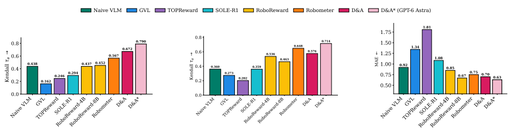
Fig. 5 :Results onD&A-Bench,RBM-EVAL-OOD[16], andRoboRewardBenchmark[15].D&A(Gemini 3 Flash) emerges as the strongest zero-shot method, outperforming (SOLE-R1) and matching the performance (Robometer/ RoboReward) of post-trained models. Scaling up the base model,D&A ∗ (GPT-6 Astra), tops every benchmark.
Original paper · CC BY 4.0 · Marius Memmel, Shawn Yin, Urvi Rutia, Angad Wadhwa, Eldon Li, Gavin Angeloff, Ankit Goyal, Jesse Zhang, Dieter Fox, Fabio Ramos, Anqi Li, Abhishek Gupta · D&A: Decoupling Description and Assessment Enables VLMs as Zero-Shot Robotic Reward Models · Original paper figure · Extracted the figure area from page 5 of the original PDF.On 'hit the enter key', D&A separates a success from a visually similar failure, while Robometer gives both nearly the same reward. In the confusion matrices, D&A gives zero progress to mismatched video and instruction pairs and scores correct matches accurately. Zero-shot models, by contrast, can't separate the pairs, which matches their bias toward non-zero progress.
How D&A changes with the base VLM
Across the model families, D&A's Kendall τα on RBM-EVAL-OOD rises with cost per million tokens, which the authors use as a proxy for model capability. The authors state that stronger VLMs discriminate trajectory optimality better. TOPReward and RoboReward show an inverse relation between performance and model capability. TOPReward faces a barrier on closed-source models because token logprobs are unavailable for Gemini 3.
To separate model capability from the method's gain, the authors compare Naive VLM and D&A on each base model. On Qwen3.6-Plus, Kendall τα on RBM-EVAL-OOD rises from 0.349 to 0.583, a gain of +0.234. On Gemini 3 Flash, the same metric rises from 0.360 to 0.576, a gain of +0.216. On D&A-Bench, the gains are +0.156 for Qwen3.6-Plus and +0.234 for Gemini 3 Flash.
For GPT-6 Astra, the gain shrinks to +0.043 on RBM-EVAL-OOD, moving from 0.671 to 0.714. On D&A-Bench, the GPT-6 Astra gain is +0.022, moving from 0.768 to 0.790.
The authors read the largest gains on smaller models as making D&A competitive in small open-source and closed-source settings. With GPT-6 Astra as the base, D&A still leads to smaller but substantial gains. The authors chose Gemini 3 Flash as the default base model to balance cost and performance.
Real-robot RL and imitation results
The online experiment fine-tunes a frozen π0 policy, trained on DROID, using the D&A progress score as its dense reward. The policy keeps grasping the ice cream cone, so the reward must separate good state transitions from bad ones.
For offline RL, the authors condition π0.5 on advantages computed from D&A rewards, using CFGRL and RECAP. The advantages are centered on a global value baseline over the full dataset, so each state-action pair ranks against the dataset-wide outcome distribution. The authors LoRA-fine-tune π0.5 for 50k steps on this data.
The advantage-filtered behavior cloning setting collects 50 optimal and 100 suboptimal demonstrations for the nudge-and-place book task. A single dataset-wide threshold ranks all chunks by advantage, so chunks are compared against the full outcome distribution. The baseline trained on the full dataset is competitive but often performs suboptimal actions, which makes its execution slow.
D&A also shows markedly lower variance across rollouts, which the authors read as filtering out suboptimal chunks.
Rich feedback for Code-as-Policies
The Code-as-Policies planner in this experiment runs as an open-loop code generator on the LIBERO goal suite. At every attempt, the planner sees the initial scene state and writes a code plan that runs open-loop in the environment. Across attempts, the planner keeps its earlier plans, and D&A supplies feedback that names the failure modes.
The planner's history holds its past code and binary success, and D&A's language feedback is added on top of that history.
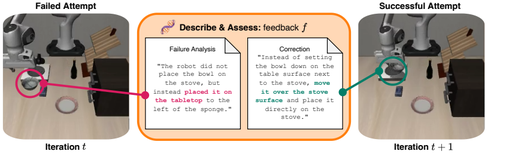
Fig. 10 :CaP with rich feedback.Example of iterative improvement withD&Afeedback in LIBERO.
Original paper · CC BY 4.0Giving the planner its attempt history raises success to 40.6%. Adding D&A's rich language feedback to that history reaches 51.4%, with p = 0.00076 against the history baseline.
The paper's example comes from an iterative improvement loop on a LIBERO task. The figure contrasts this failed attempt with a later successful one.
The feedback experiment covers one benchmark, the LIBERO goal suite. They didn't test other feedback sources against D&A's critique in this setting.
What the ablations show
The ablations on RBM-EVAL-OOD use the Kendall τα coefficient and switch three components: an explicit success criterion, decoupling, and grounding in entities. The authors ran these ablations with Gemini 3.7 Flash, while their main comparisons use Gemini 3 Flash. With none of the three components, the score is 0.486, and with all three it reaches 0.626.
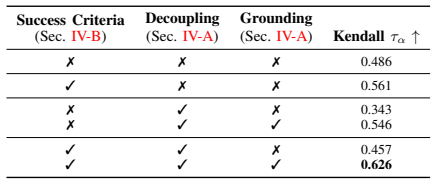
Figures from the paper TABLE I:Ablations onRBM-EVAL-OOD.
Original paper · CC BY 4.0Adding only an explicit success criterion to the Naive VLM raises the score to 0.561. The text reports a gain of +0.18 for this step, which doesn't match the 0.486 to 0.561 change in Table I. Decoupling alone drops the score to 0.343, below the 0.486 of the row with no components. The authors attribute this drop to task-relevant objects being unidentifiable or missing from the language description.
Adding the success criterion to decoupling gives 0.457, which is below the 0.561 of the criterion alone. Grounding the description in entities on top of decoupling lifts the score to 0.546. The text says grounding the description in objects present in the video improves performance by +0.26 over the Naive VLM. The authors also say this outperforms post-trained models in some cases.
In both decoupled rows, adding grounding raises the score, from 0.343 to 0.546 and from 0.457 to 0.626. The full three-part design gives the highest score in Table I. Table I covers only RBM-EVAL-OOD, so these gains aren't shown on the other benchmarks.
Where D&A's evidence and constraints stop
Its base frontier models bring high latency, per-token cost, and limited context windows along with them. Access through closed APIs adds stochasticity and leaves little granular control over the model. The models also stay prone to occasional semantic hallucinations, which can degrade the description and the reward assessment built on it.
The reward is capped by how finely natural language can describe the task. The authors name precise spatial relationships and absolute geometric distances as hard cases. These are rewards that are difficult to verbalize, so a text-based route struggles to capture them.
The Code-as-Policies result uses only the LIBERO goal suite, where D&A feedback lifted success from 40.6% with history to 51.4%. The ablations in Table I run on RBM-EVAL-OOD with Gemini 3.7 Flash as the base model.
The main experiments default to Gemini 3 Flash, while the ablations name Gemini 3.7 Flash. They didn't test further online RL tasks, so the benefit there rests on a single scene. Despite these challenges, the authors argue that D&A scales with advances in frontier VLMs.
Paper info
- Authors
- Marius Memmel, Shawn Yin, Urvi Rutia, Angad Wadhwa, Eldon Li, Gavin Angeloff, Ankit Goyal, Jesse Zhang, Dieter Fox, Fabio Ramos, Anqi Li, Abhishek Gupta
- Venue
- arXiv · Preprint
- First published
- 2026-11-2
- Added
- 2026-11-4
- Updated
- 2026-11-2
- Version
- v1
- arXiv
- 2611.03622
- Category
- cs.RO · cs.AI · cs.CL · cs.LG · eess.SY
- Original paper terms
- CC BY 4.0
- What we show
- Paper info, commentary and permitted figures from the original paper
AI commentary is a separate explanation from the original paper and may contain errors. The original paper and figures follow each source's terms of use and any rights noted separately.
Abstract
Vision-Language Models (VLMs) hold promise for zero-shot video task-progress estimation in robot learning, yet existing frameworks frequently suffer from confirmation bias, hallucinating progress in failed executions due to implicit success assumptions or relative temporal ranking designs. Naive prompting of frontier models collapses into a binary success detector that fails to capture nuanced, non-linear progress and failures. While post-training approaches can mitigate this through explicit training, they demand expensive real-world robotics data and require computationally intensive post-training for every individual base model. To resolve these limitations, we introduce D&A (Describe & Assess): our approach decouples progress estimation into an objective, task-grounded textual description of scene dynamics followed by an assessment phase using explicit rubrics. By compelling the VLM to synthesize an explicit, text-based definition of absolute success before scoring, the framework anchors evaluations to an external, global criterion rather than the video's internal timeline. Empirical results demonstrate that our method calibrates zero-shot estimates and mitigates confirmation bias, providing fine-grained, partial progress metrics that accurately penalize failed executions while correctly interpolating successful runs. Being purely prompt-based, D&A generalizes across tasks, embodiments, and benchmarks---matching or surpassing post-trained reward models---and its reward estimates enable efficient downstream reinforcement learning.
Quote from the paper
Marius Memmel, Shawn Yin, Urvi Rutia, Angad Wadhwa, Eldon Li, Gavin Angeloff, Ankit Goyal, Jesse Zhang, Dieter Fox, Fabio Ramos, Anqi Li, Abhishek Gupta (2026). D&A: Decoupling Description and Assessment Enables VLMs as Zero-Shot Robotic Reward Models. arXiv:2611.03622v1. https://arxiv.org/abs/2611.03622v1
BibTeX
@misc{memmel2026decoupling,
  title = {{D&A: Decoupling Description and Assessment Enables VLMs as Zero-Shot Robotic Reward Models}},
  author = {Marius Memmel and Shawn Yin and Urvi Rutia and Angad Wadhwa and Eldon Li and Gavin Angeloff and Ankit Goyal and Jesse Zhang and Dieter Fox and Fabio Ramos and Anqi Li and Abhishek Gupta},
  year = {2026},
  eprint = {2611.03622},
  archivePrefix = {arXiv},
  url = {https://arxiv.org/abs/2611.03622v1}
}