Paper commentary
BabyTheorist: A Benchmark for Learning to Theorize the World from Observation Alone
Benchmark tests whether machines can learn theories from raw visual observations alone
- Problem Visual reasoning benchmarks give learners pre-grouped few-shot examples of a rule, so the step of acquiring reusable theories from ungrouped observations is never tested.
- Method BabyTheorist generates continual streams of before-after grid pairs from hidden compositional programs. Learners see only the transitions, with no program labels, and advance through a curriculum of increasing depth.
- Results Seven baselines plateau well below ceiling, and the gap widens as the curriculum advances. NEO reaches Level 2 only in the Single modes.
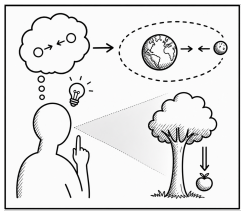
Figure 1 : Observational theory learning.Humans learn about the world through theory acquisition and theory application. For example, ob- servations of falling objects can lead to a theory of gravity, which can then be applied to explain orbital motion.
Original paper · CC BY 4.0 · Doojin Baek, Junyeob Baek, Mingyu Jo, Hosung Lee, Taegu Kang, Gyubin Lee, Sungjin Ahn · BabyTheorist: A Benchmark for Learning to Theorize the World from Observation Alone · Original paper figure · Extracted the figure area from page 2 of the original PDF.Why theory acquisition gets skipped
Few-shot visual benchmarks start after the hard part has already happened. The model then has to infer that rule and apply it to a query. The process that accumulates reusable and composable primitives from many ungrouped observations stays outside the evaluation.
The authors separate two capabilities: theory acquisition from raw observation, and theory application to new situations. Children show both, since they build theories from ordinary phenomena and then recombine them for novel situations. The paper's central goal is a benchmark for the acquisition phase, which they call observational theory learning.
Learning-to-Theorize, or L2T, comes closer to the raw setting, since each before-after pair is a phenomenon. The learner gets no program labels, action labels or task groupings, only raw (x, y) pairs. BabyTheorist extends that setting to a continual curriculum of increasingly complex phenomena.
BabyTheorist asks how the observations arrive as a continual curriculum of deeper programs. Three design controls shape that stream: a hidden DSL, frequent subprograms, and a level-based curriculum. Frequent subprograms give recurring primitive sequences that a learner can discover and reuse. The level-based curriculum introduces increasingly complex compositions as the levels advance.
Each level opens with an entry evaluation, and a learner that passes skips that level's training observations. Level skipping tests whether acquired theories transfer to more complex phenomena without further training on those levels.
Hidden programs built from selectors and primitives
BabyTheorist builds each hidden program from steps, and the learner sees only the grids those steps produce. Each observation pairs a before grid x with an after grid y, and each grid is a 15×15 array of colors. Color 0 is the background, and objects use the non-background colors 1 to 9. Each step pairs a selector, which picks the objects to change, with a primitive, which specifies the change.
The number of steps sets the program's depth, so the depth-6 program in Figure 3b has six steps.
Selectors come in four kinds: global rules over all objects, attribute-based rules, spatial rules and index-based rules. Attribute-based rules use properties such as color or hollowness, while spatial rules use positions like topmost or leftmost. Index-based rules follow a fixed raster-scan ordering of the objects in the scene. Primitives split into transformation, movement and relational groups, so one step can recolor an object, move it, or act on a second object.
BabyTheorist keeps a hidden frequent subprogram pool for each depth, and the depth-1 pool holds all primitives. For depths 2 to 10, each of the two options is chosen with 50% probability. Targets are placeholders, so the same subprogram can recur across scenes while keeping its target relationships.
The primitive vocabulary grows in the B modes, from 8 to 11 primitives in Single-B and from 11 to 14 in Multi-B. The B modes add one new transformation primitive at each of Levels 2, 4 and 6.
Level skipping and the SCORE metric
BabyTheorist measures progress with a continual train-test protocol over eight official levels. Each level starts with an entry evaluation, and the learner receives 250,000 training observations only if it fails that check. Each level evaluation consists of 10,000 tasks, and each task gives a support set of 2 to 5 before-after pairs plus a query input.
If those rules disagree on the query, the protocol adds more supports, up to five.
A learner passes a level by reaching at least 80% accuracy, and a failing learner ends the curriculum. A learner that passes the entry evaluation skips that level's training observations, so the protocol tests whether earlier theories already explain the next depth. Level skipping lets the learner advance without training on that level, which rewards transfer to more complex phenomena.
SCORE is the primary ranking metric, and it measures how much of the curriculum a learner solves. Let a_ℓ be the exact-match accuracy of the evaluation that concludes level ℓ, which is the entry evaluation when the level is skipped. SCORE sums 100 times a_ℓ over the levels up to L_reached, the last level attempted, which is written as SCORE = sum of 100 a_ℓ.
Each training stage counts once per level trained on, so a skipped level adds points without using up a stage. S_t is the cumulative SCORE after t training stages, and the eight-level curriculum allows at most T_max = 8 stages. A learner that stops early keeps its final SCORE, S_t = S_final, for the remaining stages. EFFICIENCY averages the fraction of the final SCORE that each stage has accumulated.
The authors intend high SCORE and EFFICIENCY as behavioral evidence for observational theory learning, without fixing one theory representation.
Baselines stall in the first two levels
The authors evaluated seven baselines, spanning black-box predictors, monolithic latent models and the compositional model NEO. The implicit models include an autoregressive Transformer trained on the same observation stream and pretrained LLMs that aren't trained on the stream. The monolithic latent models, Cont-Mono and Disc-Mono, infer a single latent program from a before-after pair.
NEO was the strongest baseline, reaching Level 2 only in the Single modes. Every learned baseline, NEO included, failed Level 1 in the Multi modes. General-purpose reasoning doesn't close this gap, because the models never learn the environment's rules from the observation stream. The LLMs failed Level 1 in every mode, with GPT-OSS 120B reaching at most 59% and Qwen 3.5 27B at most 8%.
Even the frontier model GPT-5.6 Sol reached only 51–64%, well below the 80% threshold.
A diagnostic learner, PPO with Known DSL, was given the ground-truth primitives, selectors and executor. With those components supplied, PPO with Known DSL clears all eight levels of Single-A. It isn't a matched comparison, because the learner never has to discover the operations. The authors then turn to where the learned baselines fail, which motivates three challenges for future methods.
Explaining the supports but missing the query
Learners can explain every support pair and still miss the query, which is the gap this part of the paper examines. Disc-Mono fails in 8.48% of tasks and NEO in 2.36%, compared with Cont-Mono's 23.51%.
Figure 7 shows five failure patterns on Lv1 tasks, and in each one both supports are predicted correctly. Cont-Mono's wrong flip axis and two color shifts instead of one show a latent that fits supports yet misstates the change. Disc-Mono's rotation-only output shows a learner that captures part of a change where rotation must be followed by a flip.
Cont-Mono-Opt refines the inferred latent to fit the supports at test time, yet it gives no consistent SCORE gain over Cont-Mono.
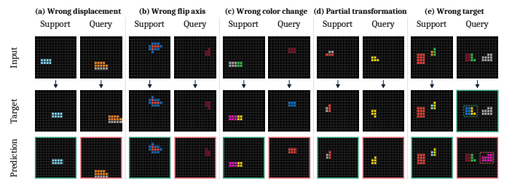
Figure 7 : Transfer failures despite exact support fit.Five failure patterns on Lv1 tasks: (a) incorrect displacement (AR), (b) incorrect flip axis (Cont-Mono), (c) two color shifts instead of one (Cont-Mono), (d) a rotation-only output when rotation followed by a flip is required (Disc-Mono), and (e) the correct color change applied to the wrong object (NEO; dashed boxes mark the changed object). Rows show Input, Target, and Prediction. Both supports are predicted correctly (one shown), but the query is incorrect; green/red borders mark correct/incorrect predictions. Examples (a–d) use Single-A/B and (e) uses Multi-A.
Original paper · CC BY 4.0The authors read these results as evidence that the learned programs fit the specific support pairs rather than a reusable transformation. NEO's compositional representation, built from a shared primitive vocabulary, is the one design direction they point to. Passing the support check doesn't guarantee the query, so the query is where these learners fail.
Target selection and higher-depth explanations
Learned programs in BabyTheorist also fail when a scene holds several objects, because the learner must pick which object a primitive changes. NEO changed the rightmost object in a query, although the task required the first object in raster order. Both selection rules agreed on the two supports but split on the query, so the predictions matched a spatial rule absent from Multi-A's selector vocabulary.
Object-centric slots don't settle which object to change, because that choice still needs a learned selection rule. Cont-Mono-OC's mean SCORE is 5.1 points higher than Cont-Mono's in Multi-B but 7.3 points lower in Multi-A, so object structure alone doesn't guarantee better transfer.
Higher-depth phenomena pose a second problem, because a learner must capture the combined effect of several primitives. Some models explain only part of the required change, reproducing a single step while missing the rest. Disc-Mono's output matched a rotation alone, although the phenomenon required a rotation followed by a flip. On depth-two tasks, NEO reached 88.2% query accuracy, compared to 61.6% for Disc-Mono.
Applied in sequence, these step-wise theories gave correct query outputs for the cases in Figure 8, so the models can represent each step. Learned primitives also sometimes produced inconsistent effects during execution in NEO, even with a compositional representation. NEO's state-grounding loss is meant to reduce these inconsistencies, but the authors call for further study of its formulation and tuning.
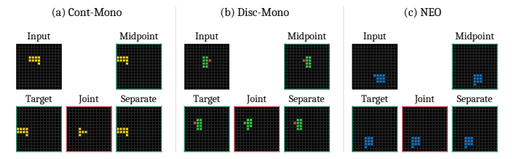
Figure 8 : Step-wise inference succeeds where joint inference fails.Joint predictions are wrong despite exact support fit. Given ground-truth intermediate supports, inferring a theory for each program step separately (Separate) yields correct intermediate and final outputs. Each step’s theory is inferred from its first support pair. This diagnostic adds supervision and changes inference, so it is not a baseline comparison.
Original paper · CC BY 4.0What the evidence does not cover
Most of the curriculum remains unsolved by the evaluated baselines, so the benchmark leaves a lot of room for future work. The findings therefore hold only inside this controlled setting, and the authors don't claim they carry over to richer scenes.
The paper also doesn't test any real-world observations, since every observation is a synthetic 15×15 colour grid.
Paper info
- Authors
- Doojin Baek, Junyeob Baek, Mingyu Jo, Hosung Lee, Taegu Kang, Gyubin Lee, Sungjin Ahn
- Venue
- arXiv · Preprint
- First published
- 2026-11-5
- Added
- 2026-11-7
- Updated
- 2026-11-5
- Version
- v1
- arXiv
- 2611.08177
- Category
- cs.AI
- Original paper terms
- CC BY 4.0
- What we show
- Paper info, commentary and permitted figures from the original paper
AI commentary is a separate explanation from the original paper and may contain errors. The original paper and figures follow each source's terms of use and any rights noted separately.
Abstract
How would we know whether a machine truly understands the world? We argue that one key capability is \textit{observational theory learning}: acquiring reusable theories from pure observations and applying them to new situations. Current visual reasoning benchmarks focus primarily on the latter, presenting each task as a few-shot puzzle grouped by a common rule. We introduce BabyTheorist, a benchmark for controlled training and evaluation of observational theory learning. BabyTheorist generates continual streams of before-after visual observations from hidden compositional programs; during training, learners see only the resulting transitions, with no program labels, task identities, or support sets. To support theory learning and evaluation, BabyTheorist controls the program language, a curriculum over program complexity, recurring frequent subprograms, and a continual train-test protocol with level skipping. Seven representative baselines plateau well below ceiling, with the gap widening as the curriculum advances---evidence that BabyTheorist isolates a capability current program-learning approaches do not yet address.
Quote from the paper
Doojin Baek, Junyeob Baek, Mingyu Jo, Hosung Lee, Taegu Kang, Gyubin Lee, Sungjin Ahn (2026). BabyTheorist: A Benchmark for Learning to Theorize the World from Observation Alone. arXiv:2611.08177v1. https://arxiv.org/abs/2611.08177v1
BibTeX
@misc{baek2026babytheorist,
  title = {{BabyTheorist: A Benchmark for Learning to Theorize the World from Observation Alone}},
  author = {Doojin Baek and Junyeob Baek and Mingyu Jo and Hosung Lee and Taegu Kang and Gyubin Lee and Sungjin Ahn},
  year = {2026},
  eprint = {2611.08177},
  archivePrefix = {arXiv},
  url = {https://arxiv.org/abs/2611.08177v1}
}