Paper commentary
What Roles Do System Prompts Really Assign? Validating and Steering Occupational Role Vectors in LLMs
Validation checks show whether system prompt role vectors can be trusted and steered
- Problem Role judgments have relied on model outputs, which cannot show whether a stored direction reliably represents the role. Output checks only test the effect, so the stability and separability of the activations behind a system prompt role stay unexamined.
- Method The authors extract a role vector by subtracting the default-prompt activations from the role's activations on the same questions. They check it for stability, separability and domain consistency, then inject it into the residual stream during generation.
- Results On Qwen at temperature 1.0, steering raised the success rate from 9.3% to 32.0%, but it did not slow the role's decline over 30 turns.
Why output checks miss the role
Applications assign a role through a system prompt, and that instruction shapes the answer before any user turn. Role judgments so far rely mostly on what the model outputs, while the activations that carry the role are seldom examined. Output checks can't show whether a stored direction reliably represents the role, because the test is only the effect.
The authors therefore ask a prior question: is the direction stable, separable from its neighbours and consistent across domains?
A deployed role has to meet three demands: stability, separability from close roles and persistence over the interaction. Stability asks whether the role survives repeated runs and sampling temperatures rather than one stochastic generation. Separability is hardest for roles that share knowledge, such as an M&A lawyer and a corporations law professor.
So the study checks the vector at the activation level and the role at the behavioral level, through two lenses.
Building the role vector by contrast
A role vector is the difference the system prompt makes to the activations, not the raw role activations. The authors compute it by contrast, subtracting what the model computes on the same input under its default prompt. Every role answers the same fixed questions, so differences between roles come from the role rather than the questions.
The question set mixes in-domain and out-of-domain questions, and out-of-domain questions make up 83% of it. The judge, gpt-4.1-mini, scores each response's adherence from 0 to 3 and its coherence from 0 to 100.
A response joins the activation sample only if its adherence is at least smin, its coherence clears a fixed threshold, and it isn't degenerate. Each activation is indexed by role r, question i, layer l and run s, with d as the model's hidden dimension. The pipeline keeps these activations for all layers and stores each one's adherence score alongside it.
Step one subtracts the default-prompt activation for the same question from the role's activation, as in Equation (1). This subtraction removes the question content and the model's default response tendencies, which would otherwise appear for every role. Step two weights each retained response by its score, with smin set to 2, so higher-scored responses count for more.
Step three builds an in-domain vector and an out-of-domain vector, then averages them with equal weight, as in Equation (2).
Checking stability and separability of role vectors
The authors test stability with cosine measures across repeated extractions and across random halves of them. On Qwen at temperature 1.0, same-role pairwise cosine ranges from 0.915 to 0.977 across roles and layers. At temperature 0.0, the extractions are near-copies, with cosine of 0.995 or above on both models. Averages built from two random halves of the extractions agree at cosine 0.993 or above on both models.
Every extraction is assigned to its own role's centroid when its run is left out, in all 100% of cases.
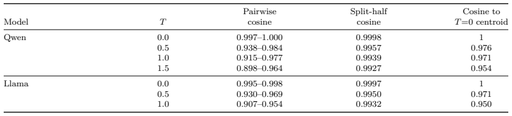
Table 1 : Stability of the role vectors at the injection site (Qwen layers 19 to 21; Llama layer 12), 30 extractions per role, six roles. Pairwise cosine: mean cosine between every two of a role’s extractions, lowest and highest over roles (and Qwen layers). Split-half cosine: mean over 200 random half splits of the cosine between the two half centroids, lowest over roles and layers. Cosine toT = 0.0centroid: lowest over roles and layers (1 at T= 0.0by definition). Leave-one-run-out assignment is 100% in every setting.
Original paper · CC BY 4.0For separability, the authors measure the angle between role centroids, starting with the M&A lawyer and corporations law professor pair. At temperature 1.0, that angle is 48.8 to 53.1 degrees on Qwen and 37.1 degrees on Llama. The general professor and corporations law professor pair sits further apart, at 54.4 to 58.1 degrees on Qwen and 41.9 degrees on Llama.
Llama's centroids are less widely separated than Qwen's, but each of its extractions still goes to its own role. The nearest-role margin for the three roles in the designed pairs is 0.337 to 0.397 on Qwen and 0.197 to 0.244 on Llama.
For domain consistency, the authors build each extraction once from in-domain questions and once from out-of-domain questions. The 15 in-domain and 75 out-of-domain questions are weighted equally, so the 83% out-of-domain share can't dominate the vector. At temperature 1.0, the mean cosine is 0.79 for same-role pairs and 0.37 for different-role pairs on Qwen.
On Llama, the same comparison gives 0.77 for same-role pairs against 0.55 for different-role pairs. The authors compare the centroid with the in-domain average, which gives cosine 0.96 on both models at temperature 1.0.
Injecting the role vector during generation
The authors add the role vector to the residual stream at the injection layer, once for every generation step after the prompt. The prompt passes through unchanged, so the first generated token responds to the unsteered prompt. Only the tokens produced after that first token are steered. The vector is rescaled to a fixed size relative to the model's typical activation size at that layer, not to a fixed raw magnitude.
This keeps the injected strength comparable across layers and models.
Five conditions are compared: unsteered, prompted, steered, prompt plus vector, and a random direction of the same size. The random-direction control checks whether any effect comes from the specific role direction or from adding any vector of that size.
Success requires full adherence of 3 out of 3, a coherence score of at least 75 out of 100, and no degenerate text. Because a general rise in fluency could also lift success, the authors score each answer against all six roles' rubrics. A judge that doesn't know the intended role asks which of the six roles an answer sounds like. Persistence is read from the decline rate, the slope of judged adherence across turns, against the prompted baseline.
That rule selects Qwen at T = 1.0 and Llama at T = 0.0. On Qwen at T = 1.0, steering alone declines at a rate that isn't distinguishable from prompting, with p = 0.071.
Does steering express the role in single answers?
On Qwen, steering at temperature 1.0 and strength 0.3 lifts the success rate from 9.3% to 32.0%. A random direction of the same size leaves success indistinguishable from unsteered, so the gain doesn't come from adding any vector.
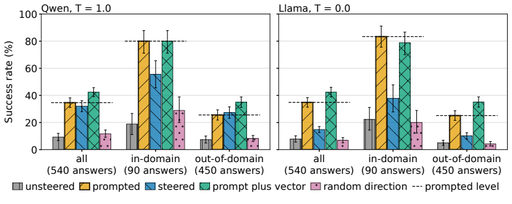
Figure 1 : Success rate by condition over all 540 answers, the 90 in-domain answers and the 450 out-of-domain answers, 95% question-cluster intervals; dashed line: the prompted level. Left: Qwen,T = 1.0(steered 0.3, prompt plus vector 0.15). Right: Llama,T = 0.0(steered 0.5, prompt plus vector 0.25). An answer succeeds if judged adherence 3 of 3, coherence at least 75 of 100, and not degenerate.
Original paper · CC BY 4.0 · Jose L. Sampedro Mazon, Ilmi Yoon, Nadim Saad · What Roles Do System Prompts Really Assign? Validating and Steering Occupational Role Vectors in LLMs · Original paper figure · Extracted the figure area from page 8 of the original PDF.Against the role prompt, steering alone doesn't do better.
Adding a low-strength vector to the role prompt gives the strongest role expression among the conditions tested. The combination's gain isn't a general effect of longer answers, though on Llama it is partly driven by length. The cost is coherence: on Qwen at temperature 1.0, mean coherence falls from 95.3 to 91.7.
Does steering keep a role across 30 turns as well as a prompt does
Persistence is measured here by the decline rate, the per-conversation slope of judged adherence over turns. A Wilcoxon signed-rank test gives the p-values for the slope differences. On Qwen at T = 1.0, every condition declines over the conversation. That window was chosen after the first Qwen results, which is why the lead is only suggestive.
On Llama at T = 0.0, steering alone stays below prompting over turns 1 to 30, by -8.5 pp. Its slower decline (p = 0.049) starts from 11.1% success at turn 1, compared with 44.4% for prompting. The kept-history condition reuses the key-value cache from earlier steered answers.
Cut-off turns count as failures, and they hit prompted turns more: 35.0% versus 8.9% of turns 21 to 30 on Qwen. The authors ran each condition on 18 conversations, so the comparisons have limited power. Neither model shows steering making the role more persistent than prompting.
Why Llama's stable vectors still fail to steer
Llama's steering gain appears only under greedy decoding, at temperature 0.0 with strength 0.5. At temperatures 0.5 and 1.0, the selected strength is 0.2, and the steering gain is indistinguishable from zero. Even at strength 0.2, coherence suffers, because at temperature 1.0 8.3% of steered answers hit the 512-token limit. The unsteered rate of hitting that limit is 1.1%, and mean coherence drops from 96.0 to 85.7.
On Qwen, the same sweep produced a higher mean adherence than unsteered in 37 of 70 combinations.
Llama's vectors are stable and clearly separable, so the geometry measured in Section 4.1 doesn't explain the failure. Activation-level checks show whether the role is present, while behavioral checks show whether it reaches the output.
They didn't test a two-sided contrast or injection on prompt tokens, which could address this gap.
Limitations of the role-vector findings
The study covers two instruction-tuned models of 7 to 8 billion parameters, and six benign occupational roles in English. No harmful behavior was tested, and the authors didn't test other scales, non-occupational roles, other languages, or the tool-use and multi-agent settings. All scores come from one judge, gpt-4.1-mini-2025-04-14, with a median of three trials for adherence and coherence.
Role identification uses the same judge and shows it each role's rubric, so those measures aren't independent of the rubric-based scores. Role identification ran at one temperature per model, Qwen T = 1.0 and Llama T = 0.0.
The human check is one author labeling 50 Qwen answers at temperature 1.0, at the adherence 3 versus 2 boundary. That check reached 77.6% agreement, with a 95% interval of 63.4% to 88.2%. There was no second rater and no human check on Llama or on multi-turn answers. Success requires adherence 3 under the distinctiveness gate, coherence of at least 75, and no degenerate text.
The authors didn't test how sensitive the results are to the gate or to a looser threshold.
Llama's vectors steer only under greedy decoding, at +7.0pp with T = 0.0 over 540 answer pairs. The chosen prompt-plus-vector strength of 0.15 was the lowest grid value in most settings, so lower doses remain untested. No strength passed the coherence floor at Qwen T = 1.5 or Llama T = 1.0.
Multi-turn conditions have 18 conversations of 30 turns each, at one temperature per model, so the comparisons have limited power. The authors didn't check multi-turn answers for this self-naming. On Qwen the role prompt replaces the native identity line, so the vector may partly encode that absence. Single-turn intervals are percentile bootstrap intervals, and no multiple-comparison correction is applied.
Paper info
- Authors
- Jose L. Sampedro Mazon, Ilmi Yoon, Nadim Saad
- Venue
- arXiv · Preprint
- First published
- 2026-11-11
- Added
- 2026-11-13
- Updated
- 2026-11-11
- Version
- v1
- arXiv
- 2611.15989
- Category
- cs.CL · cs.AI · cs.LG
- Original paper terms
- CC BY 4.0
- What we show
- Paper info, commentary and permitted figures from the original paper
AI commentary is a separate explanation from the original paper and may contain errors. The original paper and figures follow each source's terms of use and any rights noted separately.
Abstract
Applications built on large language models assign the model a role through its system prompt, intending to shape how it responds for their use case. We introduce a validation framework for extracting and injecting occupational role vectors, activation-level directions that capture how someone in a given occupational role would distinctively respond to a task or question. We validate these vectors through two complementary lenses, on Qwen2.5-7B-Instruct and Llama-3.1-8B-Instruct. The interpretability lens asks whether each vector is a stable, separable, domain-consistent representation of its role: extracted vectors are highly reproducible across repeated runs and sampling temperatures, remain separable even for very similar roles, and agree more with themselves across in-domain and out-of-domain questions than with other roles' signal. The control lens asks whether injecting a role vector during generation makes the model express the role, and sustain it over a conversation, as well as a role prompt does. On Qwen, injecting the vector alone makes the model express the intended role substantially more often than unsteered, but at best matches a role prompt; on both models, adding the vector to the prompt strengthens the role in single answers but did not slow the role's decline over 30 turns. Together, the two lenses show why both are needed: out of domain the role is expressed only subtly, yet the activations still encode it; and a vector that is stable and separable can still barely steer the model's behavior.
Quote from the paper
Jose L. Sampedro Mazon, Ilmi Yoon, Nadim Saad (2026). What Roles Do System Prompts Really Assign? Validating and Steering Occupational Role Vectors in LLMs. arXiv:2611.15989v1. https://arxiv.org/abs/2611.15989v1
BibTeX
@misc{mazon2026what,
  title = {{What Roles Do System Prompts Really Assign? Validating and Steering Occupational Role Vectors in LLMs}},
  author = {Jose L. Sampedro Mazon and Ilmi Yoon and Nadim Saad},
  year = {2026},
  eprint = {2611.15989},
  archivePrefix = {arXiv},
  url = {https://arxiv.org/abs/2611.15989v1}
}