Paper commentary
RL Post-Training in Diffusion Transformers Is Activation Steering
A constant shift in diffusion transformers recovers most RL post-training gains
- Problem Diffusion transformers gained text rendering and composition from RL, but the gains were thought to need input-dependent weight changes.
- Method The authors add one fixed vector to each block of a frozen pretrained model, fit to match an RL-tuned model's velocity with no reward.
- Results Fixed vectors, identical for every prompt, recover 90.0% to 96.3% of the reward gains of six RL-tuned image models.
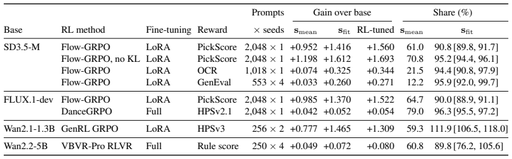
Table 1 Steering vectors recover most of each RL-tuned model’s reward gain. Gains are raw reward points over the base model. Shares are of the RL-tuned model’s gain, with the 95% interval of thes fit share in brackets.
Original paper · CC BY 4.0 · Tuna Han Salih Meral, Kaan Oktay, Alec Helbling, Atakan Kara, Duen Horng Chau, Pinar Yanardag · RL Post-Training in Diffusion Transformers Is Activation Steering · Original paper figure · Extracted the figure area from page 5 of the original PDF.Why RL gains look input-dependent
Reinforcement learning lifts the quality of text rendering, object composition and human-preference scores in visual generators. Such gains are usually produced by changing the weights, either through LoRA adapters or through full fine-tuning. Those weight changes act on each token's input, so two prompts or two tokens can receive different shifts.
The natural assumption is that capabilities such as rendering requested words need these input-dependent transformations.
The authors question that assumption, because a constant change looks too blunt for skills that vary with every prompt. They ask whether input dependence is actually needed to obtain the gains of RL post-training.
Fixed vectors fitted to a velocity
The idea is to freeze every pretrained weight and add one fixed vector to each block output. Each vector is selected by the block, the guidance pass, the step bin and the token stream, and it is then added to every token. The steered block output is \[ \tilde h_{\ell,i}^{\mathrm{str}} = h_{\ell,i}^{\mathrm{str}} + \alpha\, s_{\ell,p,k}^{\mathrm{str}}(t) \] for every token i.
Fitting and all main results use α = 1, and the sampler splits its steps into two bins at a fixed boundary τ = 0.75.
Fitting runs both models on the same noisy states along the RL-tuned model's sampling trajectory. The loss is the squared gap between the steered base velocity and the RL-tuned velocity, \[ L(s)=\mathbb{E}\big\|v_{\theta,s}(x_t,t,y_p)-v_{\theta_{\mathrm{RL}}}(x_t,t,y_p)\big\|^2 \] and only the vectors s are updated.
How much of the gain the vectors recover
Table 1 sets the averaged baseline against the fitted vectors for each RL-tuned model. On the SD3.5-M PickScore model, the mean-difference vectors gain +0.952 points, the fitted vectors +1.416 and the RL-tuned model +1.560. The gap shows that matching the velocity captures far more than copying the average activation change that RL induces.
Across the six image models the fitted share runs from 90.0% to 96.3%, and the two video models reach 89.8% and 111.9%.
A same-size LoRA fitted the same way shows no detected advantage on SD3.5-M, VBVR-Pro and FLUX.1-dev, since the paired interval includes zero.
Side effects carry over too, since the steered base model keeps color energy at 0.542 while the RL-tuned model with KL keeps 0.550. So the vectors reproduce a visible change in the images, not only the reward number.
Can RL find the vectors directly?
The authors next freeze SD3.5-M and run Flow-GRPO with only the vectors trainable, starting from zero. The trained vectors reach 104.6% of the OCR-tuned gain and 103.6% of the PickScore-tuned gain. So the reward alone can find a constant shift that matches what the weight-based RL found.
The steered images won 60% to 65% of comparisons against the base model and matched the RL-tuned models at 50% to 52%. The authors note that the part of the gain the fitted vectors miss comes from the fitting, since the trained vectors exceed both RL-tuned gains.
The route through joint attention
The text-stream vectors shift only text tokens, and the velocity is read from the image stream, so their effect must reach the image through joint attention. In joint attention, image and text tokens read each other's keys and values.
Under that replacement the steering vectors keep only 20.5% of their OCR gain and 10.5% of their PickScore gain. The OCR-tuned and PickScore-tuned models keep 26.4% and 24.5% of their own gains, so the vectors and RL use the same route.
With all three choices together, 35,328 parameters recover 89.5% of the RL gain on OCR and 73.7% on PickScore. That set is 0.19% of the rank-32 LoRA and about 531 times smaller in parameters than it, which makes it a small intervention.
The authors also check that restoring the text keys and values through the steered base model brings back the gain. The OCR-tuned model then keeps 95.2% of its gain, against 26.4% with the unsteered keys and values.
Limitations
The authors make no claim that RL-tuned models need the steering vectors to reach their gain. Nor do they claim that RL post-training is low-rank, since vectors with few parameters don't imply a low-rank RL update.
A same-size LoRA recovers more in that setting.
Paper info
- Authors
- Tuna Han Salih Meral, Kaan Oktay, Alec Helbling, Atakan Kara, Duen Horng Chau, Pinar Yanardag
- Venue
- arXiv · Preprint
- First published
- 2026-11-19
- Added
- 2026-11-23
- Updated
- 2026-11-19
- Version
- v1
- arXiv
- 2611.26627
- Category
- cs.CV · cs.LG
- Original paper terms
- CC BY 4.0
- What we show
- Paper info, commentary and permitted figures from the original paper
AI commentary is a separate explanation from the original paper and may contain errors. The original paper and figures follow each source's terms of use and any rights noted separately.
Abstract
Reinforcement learning (RL) post-training substantially improves the visual quality, text rendering, and compositional accuracy of diffusion transformers. Because capabilities such as rendering requested text or composing multiple objects are inherently prompt-dependent, a natural hypothesis is that improving them requires learning complex, input-dependent transformations. To isolate how much of these gains an input-independent shift explains, we probe each RL-tuned model with a deliberately simple parameterization: a fixed set of steering vectors added to the block outputs of the frozen base model. On SD3.5-M, these vectors hold 65x fewer parameters than the RL-tuned LoRA (0.29M against 18.8M). We fit them to match the velocity predictions of public RL-tuned checkpoints, with no reward in the objective. Although the vectors are identical for every prompt, token, and sampling seed, they recover 90.0-96.3% of the reward gains of six RL-tuned image models, and 89.8% and 111.9% on two RL-tuned video models. Initialized at zero and trained with online RL, the vectors alone exceed the reward gains of weight-based RL on text rendering (OCR) and human preference (PickScore) on SD3.5-M. A constant shift thus suffices for most of the gain of policy-gradient RL post-training: without new input-dependent transformations, it steers the pretrained generator toward what it can already compute.
Quote from the paper
Tuna Han Salih Meral, Kaan Oktay, Alec Helbling, Atakan Kara, Duen Horng Chau, Pinar Yanardag (2026). RL Post-Training in Diffusion Transformers Is Activation Steering. arXiv:2611.26627v1. https://arxiv.org/abs/2611.26627v1
BibTeX
@misc{meral2026post,
  title = {{RL Post-Training in Diffusion Transformers Is Activation Steering}},
  author = {Tuna Han Salih Meral and Kaan Oktay and Alec Helbling and Atakan Kara and Duen Horng Chau and Pinar Yanardag},
  year = {2026},
  eprint = {2611.26627},
  archivePrefix = {arXiv},
  url = {https://arxiv.org/abs/2611.26627v1}
}