Paper commentary
PersonaChatBench: Evaluating Chat Assistants with Diverse Simulated Users
Benchmark tests chat assistants by swapping in simulated users with different personas
- Problem Aggregate scores average over users, so they hide how an assistant handles the same task when the user changes. Single-user evaluations give little insight into reliability across different personas.
- Method PersonaChatBench keeps each task fixed and varies only the simulated user. Each user follows a private persona card the assistant never sees, and task outcome, persona-needs fulfillment and simulator fidelity are scored separately.
- Results Across 20 language models in six domains, task performance and needs fulfillment vary by persona and domain. Claude Opus 5.5 led the task average at 80.53, while GPT-6 Astra led needs satisfaction at 91.27.
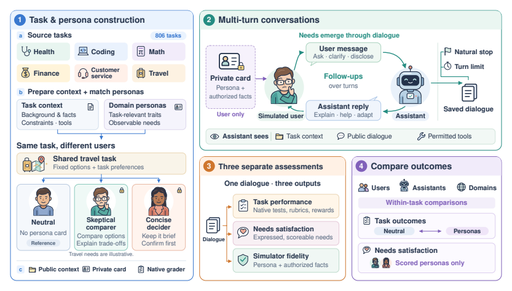
Figure 1 :Overview of PersonaChatBench.The same task is evaluated with different simulated users through multi-turn conversa- tions, with task performance, persona-needs satisfaction, and simulator fidelity assessed separately.
Original paper · CC BY 4.0 · Extracted the figure area from page 2 of the original PDF.Why one average score isn't enough
A single aggregate score averages over users, so it hides how the same task goes when the user changes. The same request can call for very different help from different people.
Simulated users let the authors hold the task fixed and vary only the user under controlled conditions. That setup brings its own requirement, because a simulator must behave faithfully enough to support evaluation. PersonaChatBench therefore assesses native task outcomes, fulfillment of expressed persona needs, and simulator fidelity as separate measurements.
Its authors don't merge these three measures into a single score.
Averages can look healthy while an assistant still fails particular kinds of users. Task performance in the paper's five-domain comparison moved by 7.02 points in Health and 8.98 points in Customer Service across persona conditions. Strong task performance also doesn't necessarily translate into satisfying individual needs. The authors want to make those hidden gaps measurable rather than leave them inside the average.
A fixed task with a hidden persona card
PersonaChatBench holds each task fixed and changes only the simulated user, so outcome changes can be traced to the user. Each simulated user follows a private persona card that the tested assistant never sees. Because the assistant doesn't see the card, its adaptation has to come from the dialogue itself.
Each task is split into three parts: public context for the assistant, private facts for the user, and evaluation materials kept out of the chat. This separation lets users disclose relevant information through dialogue while hidden tests, reference answers, and grading instructions stay outside the conversation. A persona card combines a description, supporting attributes and one or more observable needs.
Needs describe potential requests rather than a mandatory script, so the simulator decides when each one becomes relevant.
Math works differently, because the simulated student generates its opening separately for each persona condition. Conversations continue until the user stops or the configured interaction limit is reached.
Each finished dialogue yields a native task result, a persona-needs score and simulator-audit findings. The paper keeps these three measurements separate and doesn't combine them into a single score.
Task and needs rankings don't match
Claude Opus 5.5 leads the five-domain task average at 80.53, ahead of GPT-6 Astra at 77.66. Astra, by contrast, ranks first on needs satisfaction at 91.27, while Opus places fifth on that measure. The task average and the needs average come from different metrics, so they don't measure the same thing. A strong task score doesn't guarantee that the user's expressed needs get met.
The authors read the GPT family's needs results as a relative strength in fulfilling expressed needs, not a general lead on every measure. GPT models take the first four needs positions and six of the top seven. Model strengths also shift from domain to domain, so no single leaderboard covers both skills.
Travel is scored only for needs, because its original reward requires a recorded choice that a user may want to defer. That exclusion keeps the task average on domains where the native reward fits the conversation. The Travel needs scores are still reported across all six domains in Table 2.
How much the user changes task scores
With the 20 models weighted equally, the gap between the best and worst persona condition varies sharply from one domain to another. Customer Service shows the widest spread at 8.98 points, with Coding at 8.14 and Health at 7.02. Math's gap is only 1.57 points and Finance's is 3.09, so the user effect is much smaller there.
Figure 3 lays out the persona means behind these gaps, and the gray leaves mark the neutral condition. In Health, the informed contributor scores 58.05 while the private, time-conscious persona scores 51.03. The receptive, informed contributor (P5) beats the private, time-conscious novice (P3) on inquiry coverage for all 20 assistants. The model-equal gap is 7.08 task points, and patient-fact acquisition widens it to 15.93 points.
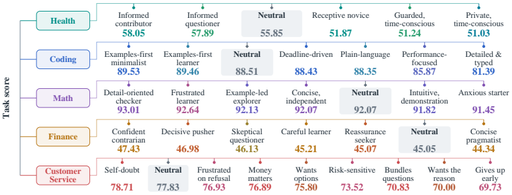
Figure 3 : Task performance across persona conditions in five domains. Branches group personas by domain; leaf values are model- equal mean task scores. Gray leaves mark the neutral condition. Repeated trials are averaged within task.
Original paper · CC BY 4.0That 17.00-point gap comes from archived judgments on the same 100 tasks. The authors attribute part of the small pooled range to near-ceiling performance on SimulatorArena-MATH.
That is a 22.73-point gap, and the authors trace it to early departures that leave required actions unfinished. The supplementary analysis links those failures to how the conversation ends, not only to the final decision.
Finishing the task isn't meeting needs
Needs satisfaction exposes cases where the required outcome is reached but the user's request is not. In Health, GPT-6 Sol and Luna reach needs scores of 98.54 and 96.53 while their inquiry scores are 41.00 and 39.69. Task coverage in that case is 26.92 versus 69.23, so responsiveness to a request doesn't recover history the user left unsaid.
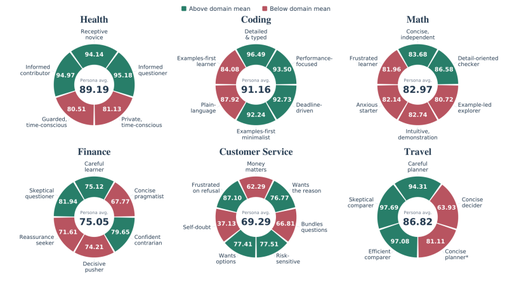
Figure 5 : Persona-needs satisfaction by domain and persona. Equal-angle sectors show model-equal mean scores on a 0–100 scale. Green and red denote scores above and below the domain’s persona mean, shown at the center.
Original paper · CC BY 4.0In Coding, a passing program doesn't validate its explanation. In Fable's walkthrough case, the program passes and the numeric answer is correct.
Math shows the same split between a correct answer and the reasoning a student wants. Demonstrations score higher for all 20 assistants, and the gap stays at 11.3 points when all six persona conversations reach correct conclusions. In the Luna case, the hint-first student gets the full setup and is left to evaluate it. Finance shows a related tension: a challenge can make the assistant drop expert-graded content.
Customer Service and Travel show the widest split between resolving a request and meeting the underlying need. Users frustrated by refusal reach 87.10 on needs satisfaction. Travel's needs satisfaction separates the skeptical comparer at 97.69 from the concise decider at 63.93, a gap of 33.76 points. Kimi seeks confirmation before completing the task and receives full credit on both measures.
What the limitations keep the results from showing
The persona panels are a curated set of domain-specific profiles, not a representative sample of users. The benchmark also focuses on individual conversations, so it doesn't test how preferences evolve over time.
LLM simulators decide how persona attributes are expressed and which authorized facts enter a conversation. The simulator audits check adherence to the intended conditions, but they don't establish that simulated users behave like humans. Across the five audited domains and 20 assistants, the simulator-audit pass rate averages 95.70%. Human-participant studies would show how these measurements relate to users' experiences.
Each persona combines several attributes, and that combination can change the subsequent information exchange. Because of this, matched persona comparisons don't isolate the causal effect of an individual trait. The largest observed gaps and selected cases reveal vulnerabilities without estimating a typical persona effect.
Paper info
- Authors
- Zheyuan Deng, Taoran Li, Jingwen Zhang, Yuante Li, Dachuan Zhao, Fulei Zhang, Yunkai Zhang, Zhikun Xu, Yajie Liao, Haichao Zhang, Haodi Hu, Cong Wang, Chen Yang, Siyang Wu, Defu Cao, Xu Hu, Haoming Li, Haixin Wang, Robert George, Weizhi Zhang, Yuchu Wang, Zhejian Peng, Yueying Li, Wanting Jiang, Shushu Liang, Zhiyuan Yu, Yifan Wang, Jintao Huang, Yijun Wang, Yuexing Hao, Xiaomin Li
- Venue
- arXiv · Preprint
- First published
- 2026-10-30
- Added
- 2026-11-7
- Updated
- 2026-10-30
- Version
- v1
- arXiv
- 2610.42060
- Category
- cs.CL
- Original paper terms
- CC BY 4.0
- What we show
- Paper info, commentary and permitted figures from the original paper
AI commentary is a separate explanation from the original paper and may contain errors. The original paper and figures follow each source's terms of use and any rights noted separately.
Abstract
Conversational assistants are expected to help people with diverse backgrounds, preferences, and communication styles. Yet evaluations centered on a single cooperative user provide limited insight into how reliably an assistant serves users with different personas. We introduce PersonaChatBench, a framework for evaluating task competence and responsiveness to diverse user needs. PersonaChatBench pairs the same underlying task with multiple simulated users, each guided by a private persona card that specifies distinct needs, preferences, and interaction behaviors. By holding the task fixed while varying the user, the framework examines how assistant performance changes across user conditions. We evaluate 20 language models across six domains, separately assessing native task outcomes, fulfillment of expressed persona needs, and simulator fidelity. Our results show that task performance and need fulfillment vary across personas and domains. Strong task performance does not necessarily translate into satisfying individual needs, and models' relative strengths in meeting those needs are not consistent across domains. PersonaChatBench makes these differences measurable, revealing gaps obscured by aggregate scores and helping identify which users an assistant serves well and where adaptation is needed. It provides a basis for evaluating consistency across users and guiding the development of assistants that better accommodate diverse needs in everyday applications.
Quote from the paper
Zheyuan Deng, Taoran Li, Jingwen Zhang, Yuante Li, Dachuan Zhao, Fulei Zhang, Yunkai Zhang, Zhikun Xu, Yajie Liao, Haichao Zhang, Haodi Hu, Cong Wang, Chen Yang, Siyang Wu, Defu Cao, Xu Hu, Haoming Li, Haixin Wang, Robert George, Weizhi Zhang et al. (2026). PersonaChatBench: Evaluating Chat Assistants with Diverse Simulated Users. arXiv:2610.42060v1. https://arxiv.org/abs/2610.42060v1
BibTeX
@misc{deng2026personachatbench,
  title = {{PersonaChatBench: Evaluating Chat Assistants with Diverse Simulated Users}},
  author = {Zheyuan Deng and Taoran Li and Jingwen Zhang and Yuante Li and Dachuan Zhao and Fulei Zhang and Yunkai Zhang and Zhikun Xu and Yajie Liao and Haichao Zhang and Haodi Hu and Cong Wang and Chen Yang and Siyang Wu and Defu Cao and Xu Hu and Haoming Li and Haixin Wang and Robert George and Weizhi Zhang and Yuchu Wang and Zhejian Peng and Yueying Li and Wanting Jiang and Shushu Liang and Zhiyuan Yu and Yifan Wang and Jintao Huang and Yijun Wang and Yuexing Hao and Xiaomin Li},
  year = {2026},
  eprint = {2610.42060},
  archivePrefix = {arXiv},
  url = {https://arxiv.org/abs/2610.42060v1}
}