Paper commentary
SciResearch-Eval: Evaluating Scientific Judgment in Autonomous Experimental Agents
Autonomous lab agents often report wrong values with overconfident intervals
- Problem Existing evaluations grade final artifacts or experiment information gain, not whether stated uncertainty is calibrated. Agents given a simulator missing physics often give ranges that miss the truth.
- Method SciResearch-Eval has an agent design heating experiments and fit a heat-conduction simulator that may be flawed, then scores each reported 95% interval against exact ground truth.
- Results On physics-wrong tasks, most models' 95% ranges contain the truth in 20% to 62% of cases, against 94% for GPT-6 Astra.
Why a good fit is not enough
A fit can look right while the parameters it returns are wrong, and this is the gap the benchmark targets. Data can be fit perfectly and still fail to determine the parameters. A misfit can also be a numerical artifact rather than missing physics. Recognizing these situations, and acting on them, is what the authors call scientific judgment.
The classic pitfalls of the laser-flash and related methods are the authors' hidden flaws. The expert also designs experiments in which the model is valid, using brief, gentle heating. When the model is not valid, the expert widens the reported uncertainty.
The environment places these situations in the task by construction and grades them exactly. The simulator the agent receives may be under-resolved, physically wrong, or adequate but fed uninformative data. Control tasks, where nothing is wrong, check that agents don't turn blanket scepticism into a strategy. Automated labs and simulation pipelines face the same situation, since their simulators are always approximations.
An overconfident wrong number is worse than an honest interval, because downstream users can't tell them apart.
Most existing evaluations grade a final artifact, or they score the information gain of chosen experiments. Such evaluations don't test whether the agent's stated uncertainty is calibrated. DiscoveryWorld and BoxingGym score investigative actions and expected information gain, but they don't grade uncertainty.
A simulator built to be wrong
The agent starts with one heating experiment and can design up to four more, choosing heater power, shape and duration. It can run and fit the simulator, then submits conductivity, heat capacity and rear heat-transfer coefficient, each with a 95% interval. It also predicts a measurement it isn't allowed to run, because the hidden target lies outside the permitted experiment range.
Figure 1 traces the loop from task generation through measuring, simulating, fitting and grading, with a glued joint hidden in the real sample.
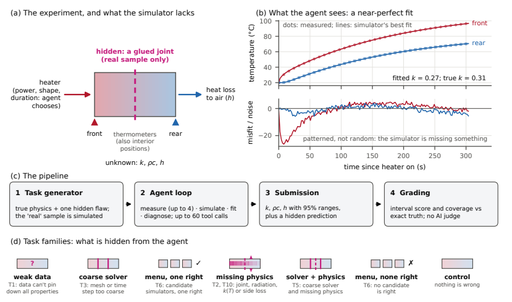
Figure 1 :The task, shown on a development task (no held-out answer is disclosed); red and blue mark the hot front and cooler rear, and magenta what is hidden from the agent. (a) A plate of unknown material is heated on its front face and loses heat to the air at its rear. The agent sees one experiment, may design four more (heater power and shape, duration, thermometer positions), and may run and fit a simulator of a one-piece plate at any resolution. It reports the conductivityk (how easily heat flows through the material), the heat capacityρc (how much heat it stores) and the heat-loss coefficienth (how fast it loses heat to the air), each with a 95% range, scored against the exact truth. Hidden from the agent, this sample has a glued joint that the simulator lacks. (b) The simulator’s best fit looks near-perfect, yet its conductivity is 12% low; the misfit (bottom) is patterned, up to about 25 times the noise: the clue that physics is missing. (c) The evaluation pipeline. (d) The hidden flaw in each task family (described in Table 2); “basic version” in Figure 3 is missing physics with nothing else wrong.
Original paper · CC BY 4.0 · Brian T. Weston, Alondra Torres Contreras, Aldair E. Gongora · SciResearch-Eval: Evaluating Scientific Judgment in Autonomous Experimental Agents · Original paper figure · Extracted the figure area from page 2 of the original PDF.The supplied simulator is a one-dimensional finite-volume conduction solver that uses theta time stepping and Picard iteration for nonlinear variants. Its free parameters are conductivity, volumetric heat capacity and rear heat-transfer coefficient. Thermometer noise is Gaussian, with a standard deviation of 0.02, 0.05 or 0.1 K.
Physics-wrong tasks hide a missing effect, such as temperature-dependent conductivity, a glued joint, radiation or side heat loss. These tasks offer no correct alternative simulator, so the agent has to work around the flaw. Control tasks contain nothing wrong, which checks that agents don't reject every simulator. About 30% of tasks are controls, and the severity of each flaw is computed rather than assumed.
Steady states of plates with a contact resistance matched exact values to 0.01%.
Each free parameter is scored with an interval score on a log10 scale, which adds the interval width to 40 times the miss distance. Lower scores are better, and a narrow interval that misses the truth is punished most of all. Coverage counts the share of true values inside the stated intervals, and an episode that never submits counts as a miss.
No score uses a language-model judge.
Default settings: procedure solved, correction not
Default-setting agents clear the procedural traps, but they don't clear the one about correcting a wrong simulator. The open-weight models trail close behind on these tasks, except on solver artifacts.
Sonnet 5.5 reaches 56% and Haiku 5.5 reaches 49%. The open-weight models land between 20% and 38%. GPT-6 Astra covers the truth 94% of the time, and Claude Fable 5.2 reaches 99%. Controls aren't the problem: every model's median interval score there is at most 0.010. On physics-wrong tasks, the score is at least 0.97 for every model except Astra and Fable.
The agents don't fail at predicting the hidden measurement. The Claude models and Astra place that measurement inside their stated range in every physics-wrong episode. Qwen reaches 96% on this check. Sonnet 4.5, Gemma and Muse reach 78%, 67% and 53%.
Across the 38 physics-wrong tasks, Fable 5.2 has the lowest interval score at default, 0.020. GPT-6 Astra follows at 0.037. Fable's interval score is 1.9 times better than Astra's, with a range of 1.3 to 2.7 times. The paired comparison separates Fable 5.2 from Astra, so the gap isn't a matter of run-to-run noise.
Why two models end up calibrated
Astra and Fable don't win by drawing wide intervals, because their estimates are simply closer to the truth. Astra's median estimate error is about 0.2%, compared to about 17% for Opus. The calibrated models are therefore accurate, not just cautious.
Naming the hidden effect is a first step that the models don't reliably take. Two language models, Claude Opus 5.5 and GPT-6 Astra, judged each conclusion blind to its author, and they agreed on 98% of 1,684 conclusions. At default effort the Claude 5.5 models diagnose the missing physics in 14% to 35% of physics-wrong episodes. Astra names it in 66% of episodes, and Fable 5.2 in 89%.
Opus pools data that the simulator cannot explain, which is the core of its failure. Its median final misfit is 21 times the noise, and it relies on a single dataset in 39% of episodes. Astra instead designs its experiments so that the simulator is valid, using weak heating in 70% of episodes against 8% for Opus. A weak experiment alone doesn't help, because Sonnet 5.5 runs one in 42% of episodes yet its final fit uses data the simulator doesn't fit.
Fable 5.2 does both, naming the missing mechanism in 89% of physics-wrong episodes. Like Astra, it runs low-power experiments in 50% of episodes, against 70% for Astra. So what matters is which data the final fit trusts, not only how much the agent reasons about the flaw.
Hints and reasoning effort
The authors asked whether a prompt hint or more reasoning can close the gap for the Claude 5.5 models. To separate not thinking to correct from being unable to, they appended one of three hints to the prompts of the three Claude 5.5 models. Hint B gives general scientific practice, hint H asks the agent to widen its ranges by the possible bias, and hint S states Astra's observed strategy.
The hints ran on 66 held-out tasks that were not at ceiling, with three runs each. Hint S was written after Astra was inspected on this split, so the authors also pre-registered a re-test on fresh tasks.
Asking for humility changes nothing: hint H leaves coverage and score unchanged for all three models. Hint B gives a small gain for Opus only. Stating the strategy helps more, with interval scores 2.5 times better for Opus, 1.6 times better for Sonnet and 1.8 times better for Haiku. Coverage barely moves, at +4, +0 and +7 points, because the estimates move closer to the truth and the ranges narrow with them.
On the fresh split the effect held for all three models, at 2.2, 1.7 and 1.7 times better.
Reasoning effort is the second lever, tested with no hint on the same 66 tasks and set through the API. Its primary hypothesis H1 says that Opus at max improves its physics-wrong interval score over its default. Against Astra at default, Opus at maximum effort shows no detectable change, with a range of 0.78 to 1.65 times. The xhigh setting gives a similar gain of 28 times better, while high gives only part of it, at 2.9 times better.
The gain costs a lot of reasoning, because Opus writes a median of 47,000 to 76,000 output tokens per episode at xhigh or max. Astra writes a median of 3,300 output tokens per episode at default for comparison. Opus's median output grows from 5,100 to 47,000 tokens between high and xhigh. Reasoning length alone isn't the skill, since Qwen3.8 writes a median of 70,000 tokens per episode yet covers the truth in 38% of physics-wrong cases.
Limitations and next steps
The authors wrote hint S after they inspected Astra on the test split. Hint S replicated on a pre-registered fresh split, but the authors supplied that strategy, and the models didn't find it. Two language models judge whether an agent names the hidden effect, and they agree on 98% of conclusions. That naming judgment is a secondary measure, so no score uses it.
The authors didn't check the naming judgment against human labels.
At maximum effort, 33 of the 198 Opus episodes reached the 600k input-token budget. Sixteen of those 33 episodes claimed a submission without making a submit call. The authors set that budget themselves, and it is the same for every model and setting. A rerun with twice the budget let 22 of those episodes submit. With that rerun, the submission rate rose to 94% and the coverage to 0.99.
Astra always exhausts the experiment budget of four, while most other models stop early. The authors didn't test other experiment budgets. For temperature-dependent properties, the authors grade the room-temperature value.
The study covers one physical domain, by design. Proprietary models may change, so the authors record access dates and keep every trace. The effort test followed a development-split pilot, so its pre-registration sits on the held-out split.
Paper info
- Authors
- Brian T. Weston, Alondra Torres Contreras, Aldair E. Gongora
- Venue
- arXiv · Preprint
- First published
- 2026-11-16
- Added
- 2026-11-18
- Updated
- 2026-11-16
- Version
- v1
- arXiv
- 2611.21541
- Category
- cs.AI · cs.LG · physics.comp-ph
- Original paper terms
- CC BY 4.0
- What we show
- Paper info, commentary and permitted figures from the original paper
AI commentary is a separate explanation from the original paper and may contain errors. The original paper and figures follow each source's terms of use and any rights noted separately.
Abstract
We introduce SciResearch-Eval, an interactive benchmark of scientific judgment built on a standard laboratory problem: measuring a material's thermal properties by heating it and fitting a heat-conduction simulator. An agent designs its own experiments, uses a supplied simulator that may be under-resolved or physically wrong, and reports each property with a 95% interval. To our knowledge it is the first benchmark to combine agent-designed experiments, a deliberately flawed simulator, and proper scoring of calibrated intervals against exact ground truth. On a held-out split (93 tasks, 9 models, 2,511 episodes), models handle procedural traps. When the simulator is missing physics, most report wrong values while stating they are 95% sure: their ranges contain the truth in 20-62% of cases, against 94% for GPT-6 Astra and 99% for Claude Fable 5.2. At default effort the failing Claude 5.5 models rarely diagnose the missing physics (Opus in 35% of episodes, against 66% for Astra), and even when they do, their ranges often miss; Astra and Fable design experiments in which the flawed simulator is accurate, such as gentle heating, which keeps Astra calibrated even when it does not name the cause. Asking for wider intervals does not help; stating the strategy improves interval scores 1.6-2.5-fold, replicated on a pre-registered fresh split, but coverage barely moves. A pre-registered effort ablation shows that the correction is latent in the Claude 5.5 models: at maximum effort Opus improves more than tenfold and is no longer detectably behind Astra at default, but only with 13-31 times more reasoning; older and open-weight models gain nothing. Fable 5.2 is the most accurate model at default effort (interval score 1.9 times better than Astra's) but writes 6 times as many tokens, and at Astra's token count it falls short. We release the environment, graders and harness.
Quote from the paper
Brian T. Weston, Alondra Torres Contreras, Aldair E. Gongora (2026). SciResearch-Eval: Evaluating Scientific Judgment in Autonomous Experimental Agents. arXiv:2611.21541v1. https://arxiv.org/abs/2611.21541v1
BibTeX
@misc{weston2026sciresearch,
  title = {{SciResearch-Eval: Evaluating Scientific Judgment in Autonomous Experimental Agents}},
  author = {Brian T. Weston and Alondra Torres Contreras and Aldair E. Gongora},
  year = {2026},
  eprint = {2611.21541},
  archivePrefix = {arXiv},
  url = {https://arxiv.org/abs/2611.21541v1}
}