Paper commentary
Toward Agentic Robotics: A Large-Scale Study of Harness Design for Robot-Use Agents
Harness design for robot-use agents depends on both the VLM and the VLA
- Problem Testing one harness design takes thousands of rollouts at high API and GPU cost, so prior work often commits to one harness.
- Method X-Harness changes one harness part at a time in controlled studies, then combines the winners.
- Results Offline evolved policy code raised π0 on WidowX Bridge from 42.5% to 87.9%.
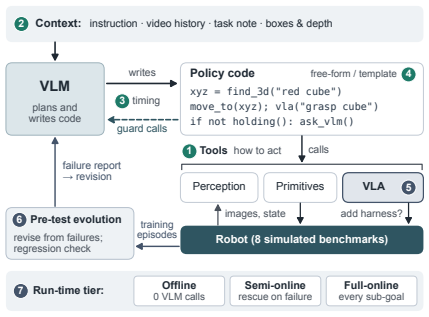
Figure 2 | Overview of the policy harness and our seven design studies.Badges mark each studied aspect, starting from VLMs (green, §4) and VLAs (gray, §5); the dashed arrow is a guardthat calls the VLM on failure.
Original paper · CC BY 4.0 · Yuxiang Lai, Jike Zhong, Yu-Jhe Li, Lan Wang, Chengzhi Liu, Youbao Tang, Ming Li, Xi Xiao, Xiaofeng Yang, Liang Zhao, Zheda Mai, Ruixi Fan · Toward Agentic Robotics: A Large-Scale Study of Harness Design for Robot-Use Agents · Original paper figure · Extracted the figure area from page 3 of the original PDF.Why harness design is hard to settle
A robot-use agent pairs a VLM, which reasons over scenes and writes code, with a VLA or WAM, which runs the motor control. The policy harness sits between them and decides what the VLM sees, whether it acts step by step or writes code, and when it is called. That layer has thousands of possible configurations, and the same VLM and policy can shift in success by tens of points depending on the choice.
Each design test is costly, because one design takes thousands of rollouts at real API and GPU expense. So prior work tends to commit to one harness, or to study one regime on one benchmark. That leaves open how to build a good harness for a given VLM and base policy.
The two halves fail in different places, which is why the choice matters. VLAs run reactive control well on demonstrations that look like training data, but they struggle once the scene shifts or the task needs memory over a long horizon. VLMs go the other way: when asked to output 3D gripper poses directly, they fail in most episodes.
How the policy harness runs
The key idea is to hold the harness fixed as a whole and change one piece at a time, so each effect can be traced to its cause. The harness has five parts: context, tools, policy code, pre-test evolution, and a run-time tier. The tools are perception calls that detect, segment, track and return depth, motion primitives that move the gripper, and the VLA itself, which takes a language sub-goal and a step limit.
Before any test, the VLM writes policy code on training tasks and then revises it from failure reports, with ten training episodes by default. At test time the run-time tier sets how often the VLM is called: Offline makes zero calls, Semi-online calls it only on failure signals, and Full-online calls it for every sub-goal. An optional guard can answer a stalled or failed step with corrective actions, or take over the episode.
Each cell pairs one task with one VLM, one VLA and one harness design, run over at least 20 test episodes. Evolution and selection see only training seeds, and the held-out test seeds stay untouched until a blind evaluation. Key comparisons use a two-level paired bootstrap with Holm correction at alpha 0.05.
Action level and depth sources
The first test asks whether a VLM should output gripper poses itself or hand motion to a VLA. Direct pose output failed in most episodes, while language sub-goals to the VLA succeeded far more often. Marking a 2D target point on the image helped most, and Flash scored 51.9% with target-marked sub-goals at default reasoning effort. The authors read this as VLMs understanding what to do without knowing how to move, so motion should be delegated.
The depth test keeps the evolved policy code fixed and swaps only the depth source. Camera depth beat monocular depth by 16.4 points, and monocular depth beat multi-view stereo by 8.5 points. The authors attribute this to the VLA buffering depth estimation noise, so a VLA call makes the code more robust to weak depth.
Rescue, evolution and transfer
The rescue test compares Semi-online with Full-online on RoboCasa365 using Awomo-0.5I. Semi-online reached 77.3%, close to the 76.8% of Full-online, while using 5.3 VLM turns instead of 8.6. So calling the VLM on failure keeps most of the accuracy at lower VLM use, which the authors put at 42% less.
Pre-test evolution matters: unevolved Offline code scored 37.8% across five shared benchmarks with zero VLM calls. After eight rounds, evolved Offline code reached 77.5% across 186 shared non-RoboDojo cells, but these are different cell sets, so the two numbers are not a paired gain. A shared tool bank evolved for four rounds reached 63.5%, compared to 63.4% for eight rounds of policy-code evolution.
So the tool bank gives a comparable result without rewriting the policy code.
Keeping VLA calls during evolution also helped: RoboDojo success rose from 24.4% to 34.2% across 10 tasks.
The gains stayed statistically significant on these fresh seeds. On SimplerEnv WidowX Bridge, Offline evolved code raised π0 from 42.5% to 87.9%. The authors' reading is that code adds most where the base VLA falls short.
Where the evidence stops
Almost every headline number comes from simulation. The physical check is supplementary: it covers one bimanual YAM robot and two memory- and state-dependent tasks.
Several scaling runs estimate depth from RGB rather than reading a sensor, and RoboDojo is pure RGB, so depth quality limits those results. The study covers six VLMs and 15 VLA/WAM checkpoints, and its results are reported for those. The unevolved and evolved Offline numbers come from different cell sets, so they don't form one controlled gain.
Paper info
- Authors
- Yuxiang Lai, Jike Zhong, Yu-Jhe Li, Lan Wang, Chengzhi Liu, Youbao Tang, Ming Li, Xi Xiao, Xiaofeng Yang, Liang Zhao, Zheda Mai, Ruixi Fan
- Venue
- arXiv · Preprint
- First published
- 2026-11-25
- Added
- 2026-11-27
- Updated
- 2026-11-25
- Version
- v1
- arXiv
- 2611.34778
- Category
- cs.RO
- Original paper terms
- CC BY 4.0
- What we show
- Paper info, commentary and permitted figures from the original paper
AI commentary is a separate explanation from the original paper and may contain errors. The original paper and figures follow each source's terms of use and any rights noted separately.
Abstract
Recent vision-language models (VLMs) can act as robot-use agents that understand diverse scenes and control robots through policy code and tools. However, they predict 3D gripper poses poorly even with extended reasoning, struggling with precise manipulation. Vision-language-action (VLA) and world-action (WAM) models are the opposite: they execute fast, smooth control on trained tasks, yet fail under domain shifts or when tasks require long-horizon memory and reasoning. Agentic robots therefore combine VLM reasoning and perception with precise VLA/WAM control through a policy harness. Yet harness design spans thousands of configurations, shifting success by tens of points with the same models. Moreover, testing even one design takes thousands of rollouts at high API and GPU cost, so prior works often commit to a single design chosen from few alternatives. To guide harness design, we evaluate over 470,000 rollouts across eight simulation benchmarks, six VLMs, and 15 VLA/WAM checkpoints. Seven controlled studies show effective harnesses must adapt to both VLM and VLA/WAM capabilities. Our findings specify what structure the VLM's policy code needs, where VLA manipulation needs help from tools and policy code, and when to involve the VLM at test time. The reference recipe X-Harness shows that these findings compose without weight updates, lifting base policies up to $+42.8$ points across memory, reasoning, and domain shifts.
Quote from the paper
Yuxiang Lai, Jike Zhong, Yu-Jhe Li, Lan Wang, Chengzhi Liu, Youbao Tang, Ming Li, Xi Xiao, Xiaofeng Yang, Liang Zhao, Zheda Mai, Ruixi Fan (2026). Toward Agentic Robotics: A Large-Scale Study of Harness Design for Robot-Use Agents. arXiv:2611.34778v1. https://arxiv.org/abs/2611.34778v1
BibTeX
@misc{lai2026toward,
  title = {{Toward Agentic Robotics: A Large-Scale Study of Harness Design for Robot-Use Agents}},
  author = {Yuxiang Lai and Jike Zhong and Yu-Jhe Li and Lan Wang and Chengzhi Liu and Youbao Tang and Ming Li and Xi Xiao and Xiaofeng Yang and Liang Zhao and Zheda Mai and Ruixi Fan},
  year = {2026},
  eprint = {2611.34778},
  archivePrefix = {arXiv},
  url = {https://arxiv.org/abs/2611.34778v1}
}