Paper commentary
When the Simulator Fails, Not the Policy: Auditing Contact Artifacts in Simulated Robot Benchmarks
SIMUGUARD replays simulated robot episodes to separate simulator faults from policy failures
- Problem Simulation benchmarks count every failed episode against the policy, even when the simulator's contact handling caused the failure. Success rates alone cannot show why an episode failed.
- Method SimuGuard is an auditing plugin that records every physics step and flags objects that move faster than contact or gravity explain. It replays episodes exactly and reruns them with one simulator parameter changed.
- Results On RoboTwin, an engine constant that discards small triangles caused ejections. Repairing it raised LingBot-VA's container task success from 89% to 98%.
Why a success rate can blame the policy for simulator faults
Simulation benchmarks such as LIBERO, RoboCasa and RoboTwin fix the tasks and the protocol, and they treat the simulator as faithful physics. A success rate tells you which episodes failed, but it doesn't tell you why. So a failure that comes from how the simulator handles contact counts exactly like a failure the policy caused. The authors found this often on RoboTwin 2.0, where a policy sets an object down correctly and the simulator then throws it out.
One episode makes the mechanism concrete: in Place Can Basket, LingBot-V A (Li et al., 2026) places a can inside the basket and the gripper releases it. After 0.28 s, within a single 4 ms physics step, PhysX reports a contact that the can and basket geometry doesn't support. Figure 1 shows this sequence and the failure it produced: the can is ejected and the benchmark records a failure.
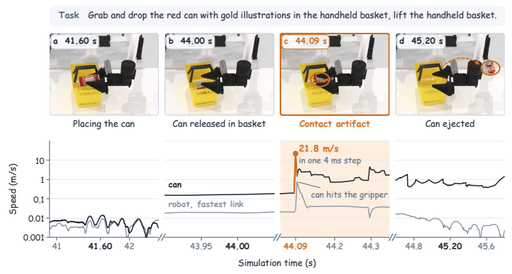
Figure 1 :A contact artifact turns a correct placement into a failure.After LingBot-V A places the 10 g can in the basket on Place Can Basket (a, b), the can’s speed rises from 0.2 to 22 m/s within one 4 ms physics step, a gain of 2.4 J of kinetic energy, while no robot link touches it and the fastest link moves at under 0.1 m/s (c); the can is ejected from the basket and the benchmark records a failure (d). The time axis has four linear segments, one under each frame.
Original paper · CC BY 4.0Figure 3 shows why the outcome can't settle the question on its own.
Testing this question requires a record of every physics step and a way to rerun the episode with one change. SIMUGUARD records the actuation, object states and contacts, and it flags an object that starts moving faster than the robot's contact or gravity account for. Prior work adds metrics to the success rate or measures how solvers depart from physics, but neither ties an anomalous contact to the outcome of its rollout.
Replaying each episode to test one cause
A suspicious contact becomes a hypothesis here, and the authors test it by running the same episode again with one thing changed. SIMUGUARD attaches through an adapter to the benchmark's own evaluation script, so the evaluation itself doesn't change.
The replay step reconstructs the episode from the recording, so it can serve as a control before any change is made. The reasoning is that if the outcome flips when only the contact response changes, the contact decided the episode rather than the policy. Figure 2 summarises the audit from recording and detection through to scoring with the benchmark's own success check, with reported 89.0% and replay 97.0% for LingBot-VA.
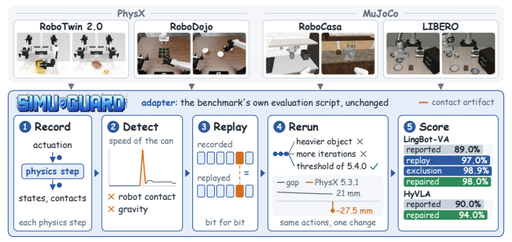
Figure 2 :SIMUGUARDaudits a simulated evaluation without changing it.Attached by an adapter to the benchmark’s own evaluation script, SIMUGUARDrecords every physics step, detects contact artifacts, replays the episode exactly, reruns it with the same actions and one change, and scores the rerun with the benchmark’s own success check. Rerun: a heavier object or more solver iterations leave the artifact; the triangle threshold of PhysX 5.4.0 removes it. Inset: the two pieces that start the ejection of Figure 1 are 21 mm apart, and PhysX 5.3.1 reports them 27.5 mm deep; with the threshold of 5.4.0 it reports no contact. Score, five container tasks in closed loop (Table 3): as run (gray), estimated from LingBot-V A’s recordings (blue, Section 3.6), and measured in the repaired engine (green).
Original paper · CC BY 4.0 · Alex Zhou, Junhao Wu, Xueyang Zhou, Yixiao Huo, Hongcheng Gao, Di Zhu, Zhenghao Zhang, Yongchao Chen · When the Simulator Fails, Not the Policy: Auditing Contact Artifacts in Simulated Robot Benchmarks · Original paper figure · Extracted the figure area from page 2 of the original PDF.The rerun changes the simulator, not the policy, so the same actions meet a different contact response. Rerun changes include a heavier object, more solver iterations and the PhysX 5.4.0 threshold, and the threshold removes the artifact. Figure 3 shows two episodes whose outcome flips: a LingBot-VA rollout and one of RoboTwin's scripted demonstrations.
Prior work adds metrics to the success rate or measures how solvers depart from physics, but doesn't connect an anomalous contact in a rollout to that rollout's outcome.
Tracing the false contact to a distance threshold
The engine reports a contact that the geometry doesn't have, and the authors check this against the pieces themselves. In 35 episodes, the two convex pieces behind that report were a median 15 mm apart when the step began. The reported normal pointed from the can into the basket in 34 of them, while the other contacts between the same bodies one step earlier pointed the other way.
The can moves under 1 mm in that step, so the motion itself doesn't explain the report.
The authors locate the error in the GJK distance computation that PhysX 5.3.1 runs inside SAPIEN 3.0.0b1, which RoboTwin uses. That threshold is a fixed number in meters, so it doesn't scale with the geometry. PhysX 5.4.0 squares the threshold, which is the change the authors test.
Inside the simulator, the same change cut artifact episodes in the scripted demonstrations from 18 to 1 on Place Can Basket and from 6 to 0 on Stack Bowls Three. Table 2 lists these contact checks.

Table 2 :One constant.False: the 20 onset contacts we traced (4 on Place Can Basket, 16 on Stack Bowls Three) whose two pieces do not intersect, recomputed outside the simulator from the recorded poses.Real: 4 onset contacts whose pieces do intersect.Expert: RoboTwin’s scripted demonstration on 60 seeds per task inside the simulator, episodes with an artifact and episodes that fail after a valid plan.
Original paper · CC BY 4.0Three other settings change how a false contact becomes an ejection, but they don't cause it. A contact offset of 10 mm makes every shape generate contacts from 10 mm away, so each step holds 25 to 90 pairs of pieces. With the offset at 1 mm, 4 of the 37 Place Can Basket episodes still kept an artifact. Limiting the depenetration speed to 1 m/s slows the object, but 26 of the 37 episodes still kept an artifact.
They didn't test whether the threshold change alone removes every ejection on other platforms, since the RoboDojo cause lies on a different path.
Whether the fix changes the success rate
In the repaired engine, LingBot-V A succeeded in 98 of 100 closed loop episodes on the five container tasks. In the benchmark's engine it succeeded in 89 of 100, and 12 of those episodes contained an artifact. With p = 0.11 the success difference is not significant on its own, although the artifact difference is much clearer.
Where the engine can't change, the authors estimate the rate from recordings, replaying the flagged episodes with the limit switched on. On the larger audited runs, replay gave 91.9% for LingBot-V A against 83.1% reported, and exclusion gave 98.0%. The replay estimate loses 9 of LingBot-V A's 19 successes with an artifact. A smaller run gave 98.9% under exclusion and 97 of 100 under replay, since 8 of the 10 failures pass.
Together these estimates support the range from 75.8% to 98.5% around the reported 83.1%.
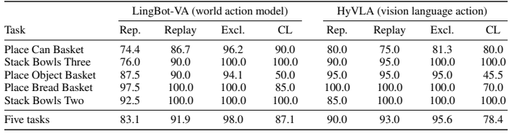
Table 1 :Success rates on RoboTwin 2.0under the four scores of Section 3.6, in percent.Rep.: as run.Replay: Equation (1), every episode with an artifact replayed with the limit switched on before it.Excl.: rate over the episodes without an artifact.CL: new closed loop rollouts with the limit on; as run rate on the shared seeds 81.8% (LingBot-V A) and 90.7% (HyVLA). Counts and the tasks outside the five: Table 22.
Original paper · CC BY 4.0HyVLA's five-task count rose from 90 to 94 successes in the repaired engine, and its artifacts fell from 10 to 1. Keeping the limit on for whole rollouts changes the task itself. Place Object Basket fell from 90.0% to 50.0% under that setting, yet it stayed at 20 of 20 in the repaired engine. Slowing the removal of depth is therefore not a repair.
Other platforms and how far the artifacts reach
RoboDojo runs Isaac Sim with PhysX, and seven of its 40 XR-1 episodes contain contact artifacts. All seven of those episodes are failures, and the fastest object reaches 6.30 m/s. A depenetration limit of 1 m/s brings that tube down from 4.31 to 1.88 m/s.
Fourteen steps earlier, that point sits 6.8 to 7.6 mm from the tube's hull, and no contact is reported there. The authors haven't located the faulty step, because the threshold of Section D.1 plays no part on this GPU path.
On MuJoCo, artifacts are few: 2 of 400 LIBERO episodes and 5 of 300 RoboCasa episodes contain one. None of these MuJoCo artifacts goes above 1.6 m/s. On LIBERO, the mug leaves the gripper at 1.57 m/s in the one episode the authors examined, and that episode fails. On RoboCasa, the fastest artifact reaches 1.19 m/s, when an object leaves a drawer.
Among the other 40 RoboCasa tasks, a baguette hits a toaster oven door at 0.61 m/s.
They judged 37 of 40 Place Can Basket clips centered on detected events physically implausible. That gives a precision of 0.925, and none of the 20 hard negatives was judged that way.
What the evidence does not yet cover
The closed loop result in the repaired engine rests on two policies, five tasks and 20 seeds per task. On LingBot-V A's 83 shared seeds, the gain in success isn't significant on its own, at p= 0.11. The artifact counts differ far more clearly than the success counts do, which is why the authors lean on them.
The authors changed one constant inside PhysX 5.3.1 and didn't run RoboTwin on a complete later version. The steps after the faulty distance computation stay unchanged, so the repaired numbers isolate that one constant. On Stack Bowls Three, 4 of the 21 deep contacts traced are real penetrations, and one isn't reproduced outside the simulator.
On the HyVLA repaired run, one episode still has an artifact: a bread leaves another bread at 2.4 m/s.
On RoboDojo, the authors traced the false contact to a tube 11 mm inside a rack wall, but they haven't located its cause. The rack contact sits 7.6 mm outside the tube's convex hull, on a path the threshold fix doesn't enter. The 1 m/s depenetration limit slows that tube from 4.31 to 1.88 m/s, which treats the symptom rather than the source.
HyVLA's successes on its six other tasks weren't checked for artifacts, so the audit of those tasks is incomplete. HyVLA wasn't run on the remaining 39 tasks, so the RoboTwin coverage stays partial.
Paper info
- Authors
- Alex Zhou, Junhao Wu, Xueyang Zhou, Yixiao Huo, Hongcheng Gao, Di Zhu, Zhenghao Zhang, Yongchao Chen
- Venue
- arXiv · Preprint
- First published
- 2026-10-30
- Added
- 2026-11-3
- Updated
- 2026-10-30
- Version
- v1
- arXiv
- 2610.41857
- Category
- cs.RO
- Original paper terms
- CC BY 4.0
- What we show
- Paper info, commentary and permitted figures from the original paper
AI commentary is a separate explanation from the original paper and may contain errors. The original paper and figures follow each source's terms of use and any rights noted separately.
Abstract
Simulation benchmarks score robot policies by success rate, and every failed episode counts against the policy. Many of these failures are the simulator's fault, not the policy's; we find the cause and fix it. Testing a vision language action model and a world action model in simulation, we find that the policy often places the object and the simulator then ejects it, and that the benchmark's own scripted demonstrations fail the same way. We present SimuGuard, an auditing plugin for LIBERO, RoboTwin, RoboCasa and RoboDojo. It leaves the evaluation unchanged. At every physics step, it records the state and flags an object that starts moving at a contact faster than the robot's contact or gravity account for. It replays a recorded episode bit for bit, and it reruns the episode with one simulation parameter changed. With it we trace these episodes on RoboTwin to the collision detection of the physics engine: for geometry one to two centimeters apart, the engine reports a penetration of about two centimeters, and the solver throws the object out at several meters per second. The cause is one constant: the distance algorithm discards triangles below a fixed area threshold, which valid triangles fall below at the centimeter scale. With that constant changed and nothing else, episodes with an artifact fall from 12 in 100 to none, and the success rate on five container tasks rises from 89% to 98%. Success rates in simulation thus count failures that the simulator causes. Benchmarks on PhysX 5.3.1 or earlier should rerun in a repaired engine. Where the engine cannot change, they should report the success rate together with the range it spans when every flagged episode fails or passes: 75.8% to 98.5% around a reported 83.1% for LingBot-VA.
Quote from the paper
Alex Zhou, Junhao Wu, Xueyang Zhou, Yixiao Huo, Hongcheng Gao, Di Zhu, Zhenghao Zhang, Yongchao Chen (2026). When the Simulator Fails, Not the Policy: Auditing Contact Artifacts in Simulated Robot Benchmarks. arXiv:2610.41857v1. https://arxiv.org/abs/2610.41857v1
BibTeX
@misc{zhou2026when,
  title = {{When the Simulator Fails, Not the Policy: Auditing Contact Artifacts in Simulated Robot Benchmarks}},
  author = {Alex Zhou and Junhao Wu and Xueyang Zhou and Yixiao Huo and Hongcheng Gao and Di Zhu and Zhenghao Zhang and Yongchao Chen},
  year = {2026},
  eprint = {2610.41857},
  archivePrefix = {arXiv},
  url = {https://arxiv.org/abs/2610.41857v1}
}