Paper commentary
VICTR: Value-Informed In-Context Learning for Vision-Language-Action Models
VICTR retrieves robot demonstrations by task progress instead of visual similarity
- Problem Retrieval-based in-context learning for robot policies picks demonstration chunks by visual similarity. Visually similar observations often sit at different execution stages, so the retrieved action is wrong.
- Method VICTR uses IC-VFE, which estimates task progress from the current observation, instruction and a reference demo video. It then retrieves the stored chunk nearest in progress, instead of nearest in visual appearance.
- Results On unseen real-world manipulation tasks, VICTR raises success from 6.2% for a fine-tuned pi0.5 baseline to 23.8%.
Why appearance picks the wrong demonstration stage
Retrieval-based in-context learning only helps when the retrieved chunk matches the action the robot needs next. The vision-only variant follows the RICL recipe and ranks stored chunks by the distance between DINOv2 embeddings of the current and stored observations. That shortcut breaks down because visually similar observations often sit at different execution stages.
Figure 5 shows the circle-on-peg task, where DINOv2 retrieves a chunk the authors call suboptimal. They suspect the retrieval leans too heavily on scene geometry. On the wipe the plate task, IC-VFE retrieves a chunk at a nearly identical stage of execution.
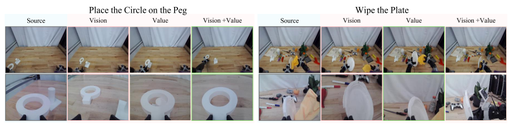
Fig. 5 .Examples of retrieved context across retrieval signals.The leftmost column on both sides “source” represents the query for the retrieval signal (and only the top camera is used during retrieval). For the circle-on-peg task, DINOv2 retrieves a suboptimal chunk, likely due to over-reliance on scene geometry. On the “wipe the plate” task, IC-VFE retrieves a context chunk at a nearly identical stage of execution.
Original paper · CC BY 4.0 · Luca Macesanu, Tianluo Zhang, Aditya Patil, Archit Sharma, Kevin Angers, Christopher M. Clark, Chen Feng, Juexiao Zhang · VICTR: Value-Informed In-Context Learning for Vision-Language-Action Models · Original paper figure · Extracted the figure area from page 6 of the original PDF.Appearance is also sensitive to task-irrelevant changes in the environment. This evaluation alters distractor objects and local background between data collection and evaluation, which changes the features that retrieval uses. Progress picks examples by the robot's stage within the demonstrated task, not by appearance.
On out-of-domain tasks, the fine-tuned π0.5 baseline reaches 6.2% success and 28.9% progress. RICL without interpolation, which retrieves by visual similarity, improves to 15.0% success and 42.1% progress. VICTR, which retrieves by progress, reaches 23.8% success and 55.5% progress. Fusing visual similarity into the progress signal gives 21.2% success and 47.8% progress, so it doesn't beat VICTR.
The authors suspect equal weighting lets noisy visual similarity override the progress alignment.
Progress as the retrieval key
Progress can replace appearance as the retrieval key, because it ranks demonstration chunks by how far along the task they are. The authors shift that scale to [0,1], which gives a unitless task-relative progress that stays comparable across tasks of different lengths. The estimate then drives retrieval at inference instead of optimising the policy.
RECAP's estimator is conditioned only on the current observation and language instruction, with no reference demonstration. A new task therefore depends on the estimator's prior knowledge of the new instruction. The authors make progress estimation itself an in-context problem, so IC-VFE also conditions on a reference demonstration video.
The reference demonstration supplies execution information that a language instruction alone doesn't carry, for the task goal and how it unfolds. Both models' weights remain fixed at deployment, so the progress estimate needs no task-specific fine-tuning.
Because the estimator is trained on pseudo-labels, the authors use Robo-Dopamine's General Reward Model as a privileged teacher. That teacher uses each episode's final frame as a goal image, so it can't score observations online. IC-VFE is trained on these teacher targets, but at rollout it sees only the current observation, instruction and reference demonstration.
The authors check the pseudo-label quality against independent human progress annotations, which they report under Q4.
How IC-VFE turns context into a progress value
IC-VFE takes the current observation, the instruction and a reference demonstration, and outputs one progress value in [0,1]. The reference is the shortest demonstration in the pool, because it serves as the clean expert execution for progress.
To keep the context short, the reference views are compressed into 16 summary tokens per view by two successive 2×2 patch-merging layers. The current observation keeps all 256 detail tokens per view and adds its own 16 summary tokens, so it preserves fine detail while matching the reference format. Both visual representations are mapped to the 640-dimensional embedding space of the Gemma 3 270M decoder, and a separate MLP turns each proprioceptive state into one token.
IC-VFE concatenates the K reference context blocks in chronological order, then the current-observation block, the instruction embeddings and a learnable value-query token. An 18-layer Gemma 3 270M decoder processes this sequence, and within most layers each context block attends only inside itself. At layers 6, 12 and 18, block-causal attention lets each context block read the blocks before it, so information accumulates across the demonstration.
A learned block-index embedding tells the decoder where each context block sits in the reference sequence. The current-observation and instruction tokens attend to all valid context blocks, while context blocks can't attend to the query, and padding tokens are masked.
An MLP head followed by a softmax maps the final state of the value-query token to a distribution over 201 discrete bins. The bin supports are spaced uniformly from −1 to 0, and the scalar progress is 1 plus the probability-weighted sum of those supports. Because this shifted scale lies in [0,1], the output reads as task-relative progress.
Retrieval then compares these scalars directly, through the absolute difference between the query's progress and each chunk's progress.
Training IC-VFE on Robo-Dopamine teacher labels
Manual progress labels are costly to collect at scale, so the authors use Robo-Dopamine's General Reward Model to generate pseudo-labels. That teacher takes each completed episode's final frame as a goal and produces frame-aligned progress estimates. Because it reads the future final frame, the teacher can't score observations online, so it serves as a privileged signal for training only.
IC-VFE then learns to predict these teacher targets from the current observation, the instruction and a pre-execution reference demonstration. TOPReward is set aside because its values increase with elapsed time regardless of the task progress.
The teacher's percentage is clipped to 0 to 100 and divided by 100, which gives a value between 0 and 1. That value is assigned to the nearest of B = 201 bins, with bin index round((B − 1)vt). Training minimizes categorical cross-entropy between the predicted bin distribution and the target bin, averaged over a minibatch of N examples. For each query frame, the reference demonstration comes from a different episode of the same task, so it never comes from the query's own episode.
The teacher's labels give IC-VFE dense per-frame supervision, so the training data needs no extra manual progress labels. Under Q4, the authors check these pseudo-labels against independent human progress annotations on their own dataset.
From retrieved chunk to predicted action
Each pool chunk is stored as a key-value entry, keyed by its estimated progress and its DINOv2 embedding. At each inference step, IC-VFE estimates the current progress, and VICTR keeps the single chunk with the smallest progress distance. The shortest demonstration serves as the reference, because its clean expert execution gives a stable progress scale for the whole pool.
For comparison, vision-only retrieval ranks chunks by the L2 distance between the current DINOv2 embedding and each stored embedding, following RICL. The fused variant z-normalizes both distances across the candidate pool and adds them, with a small constant guarding the division. The authors hypothesize that equal weighting lets noisy visual similarity override progress alignment.
As a result, the fused variant doesn't improve on progress retrieval alone.
The retrieved chunk's tokens go ahead of the current query, so the policy receives the input sequence [ct, ot, ℓ]. The context block carries three camera views and proprioception, followed by FAST tokens of the action chunk. Block-causal attention lets query tokens read the demonstration block, while demonstration tokens can't read the query.
During training, the context chunk is sampled using oracle progress values from a held-out set with no overlap with the evaluation pool. At deployment, IC-VFE supplies the query progress, so its estimation errors can shift which chunk gets retrieved. The IC-VLA starts from the official π0.5 checkpoint and trains its action expert with the flow-matching loss.
Both models' weights stay fixed at deployment, so adaptation happens only through the retrieved context.
Out-of-domain gains on real robots
The authors test a bimanual robot on 8 in-domain tasks and 8 out-of-domain tasks, with 10 rollouts per task. Each out-of-domain task departs from training in one controlled way: novel objects, composed skills, or a semantically similar unseen task. The authors collected their own dataset of 28 tasks and 1,180 episodes totaling 7.5 hours, since neither LIBERO nor DROID is organized around a seen/unseen split.
Only 30 minutes of those demonstrations form the pools for the 16 evaluation tasks, and IC-VFE and the IC-VLA never train on the out-of-domain tasks.
The fine-tuned π0.5 baseline reaches 6.2% success and 28.9% progress on out-of-domain tasks. RICL without interpolation, which retrieves by visual similarity, lifts those numbers to 15.0% success and 42.1% progress. VICTR, which retrieves by progress distance alone, reaches 23.8% success and 55.5% progress. That is a gain over RICL's 15.0% success and 42.1% progress, so progress-based retrieval beats visual similarity on unseen tasks.
The progress gap is wider than the success gap, which the authors read as stage-aligned context carrying the policy further even when it doesn't finish.
VICTR +vision adds visual similarity to the progress signal by normalizing both distances and summing them. It reaches 21.2% success and 47.8% progress on out-of-domain tasks. That is below VICTR, so the fused signal doesn't improve on progress alone. The authors hypothesize that equal weighting lets noisy visual similarity override progress alignment, and they leave a better combination to future exploration.
All of them also achieve high success in-domain, so the retrieval signal matters less when the training distribution covers the task. The authors argue that the choice of retrieval signal matters most when the policy must generalize beyond its training distribution.
Choosing the RICL baseline for visual-similarity retrieval
RICL's interpolation layer blends the policy's predicted action with the action from the retrieved demonstration chunk. RICL was developed on π0-FAST, so the authors ported it to π0.5 as RICL-π0.5. They also built RICL-π0.5,nointerp, which removes the action interpolation from the original RICL.
The interpolation variant transferred poorly to this setting, reaching only 0.5% success. Every method starts from one base π0.5 checkpoint, fine-tuned for 40k steps on the training data. All methods then receive an additional 10k training steps, so every method gets the same extra training. The authors also run an ablation of the interpolation choice on LIBERO, reported in Appendix A.
During training, the RICL variants retrieve context with DINOv2 visual similarity. VICTR instead uses Robo-Dopamine progress annotations to supervise IC-VFE and provide a stable retrieval signal for IC-VLA training. At deployment, VICTR retrieves with the progress that IC-VFE estimates. A VICTR +vision variant adds visual similarity to that progress signal.
Across 10 rollouts per task, the non-ICL π0.5 baseline reaches 6.2% success on out-of-domain tasks. The no-interpolation RICL baseline reaches 15.0% success and 42.1% progress on the same tasks. VICTR, which retrieves with task progress, reaches 23.8% success and 55.5% progress.
How closely IC-VFE tracks human progress
Human progress curves follow a fixed per-task milestone rubric, and each milestone value is eased in with a smoothstep curve. Each candidate estimator is scored against the reference curve with Pearson correlation r and Kendall τb. On out-of-domain tasks, IC-VFE reaches Kendall τb 0.52 and Pearson r 0.65 against human progress curves. RECAP reaches 0.43 and 0.57 on the same tasks, while zero-shot Robometer falls to 0.27 and 0.38.
Fine-tuned Robometer improves to 0.33 and 0.46, but it still trails IC-VFE by a clear margin.
In-domain, IC-VFE also leads, with Kendall τb 0.51 and Pearson r 0.62 against RECAP's 0.48 and 0.60. Removing the reference context drops out-of-domain agreement to Kendall τb 0.38 and Pearson r 0.49. That drop puts the no-context variant below RECAP, so the estimator relies on the demonstration rather than on the query alone. Dropping the block-index embedding gives 0.37 and 0.45 out-of-domain, and the authors credit the embedding with an additional improvement.
IC-VFE is trained on Robo-Dopamine progress targets, which use the episode's final frame as a goal image. These comparisons are offline, so they measure agreement with human curves rather than control performance. The next question checks whether these estimator gaps carry over to the policy's task performance.
Does estimator quality reach the policy
The authors kept the IC-VLA backbone fixed and swapped only the value estimator that supplies the retrieval signal. The comparison covered IC-VFE, Robometer, Robometer FT and π0.6 RECAP, each used as the retrieval signal. With IC-VFE supplying the signal, VICTR reaches 62.7% out-of-domain progress rate, against 29.2% for the best alternative.
The authors say this ordering is consistent with the offline evaluation in Table I.
In Table I, IC-VFE reaches an out-of-domain Kendall τb of 0.52, above RECAP at 0.43 and zero-shot Robometer at 0.27. Robometer FT reaches 0.33 out-of-domain Kendall τb, which is higher than its zero-shot version. Yet fine-tuning Robometer on the robot's data degraded its out-of-domain performance in control.
All estimators are evaluated with the same IC-VLA backbone, and Robo-Dopamine annotations supervise training. The Figure 6 caption says IC-VFE yields substantially higher out-of-domain progress than the alternative online estimators. The authors read these results as showing that improved progress estimation translates to improved retrieval-conditioned control.
Pool size and matched retrieval signals
VICTR's demonstration pool holds 10 context demonstrations per task, and the authors vary the pool size over 1, 3, 5 and 10. For a pool of size k, the authors select the k shortest demonstrations. Success rate generally improves as the pool grows and saturates around five demonstrations. The authors explain this by larger pools providing more candidate chunks to retrieve relevant context from.
The second ablation asks whether training and deployment must share the same retrieval signal. The authors take VICTR and RICL-π0.5,nointerp and test each with IC-VFE value and with DINOv2 visual similarity. Both policies still show meaningful performance when the signal is swapped at deployment. Figure 8 shows that matched signals beat mismatched ones across the board.
A matched signal doesn't fully compensate for a poor retrieval signal at deployment time.
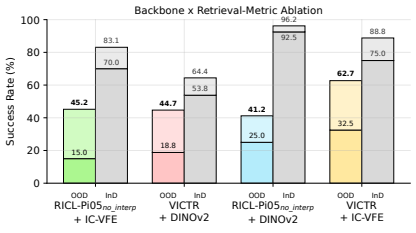
Fig. 8 .Retrieval ablation: retrieval signal at training vs. deployment. Labels at the bottom represents:the method at training“+”the retrieval signal at deployment. While policies evaluated with the same retrieval signal they were trained with perform better across the board, it is not enough to overcome a poor retrieval signal at deployment time.
Original paper · CC BY 4.0They suggest that this training distribution may shape how the policy interprets its context. They didn't test this hypothesis directly in the paper. VICTR's training samples its context chunks with oracle progress values, while IC-VFE supplies the progress at deployment.
Where the evidence for VICTR stops
The authors report out-of-domain success of 25.0% in the contribution list, which marks how far the method still falls short. Their main real-robot evaluation gives 23.8% success for VICTR on the out-of-domain tasks, so the two figures differ. The authors see a wide gap before in-context adaptation becomes practically dependable for real deployments.
All data collection and evaluation happen in a single physical environment, so the tests never reach a truly new setting. The authors vary objects and their placement, but they say these local appearance changes don't amount to evaluation in a genuinely novel environment.
The IC-VFE's context length becomes a bottleneck when it encodes the reference demonstration. Fitting a full demonstration video into context requires aggressive spatial pooling, which sacrifices spatial resolution. The authors point to efficient attention or test-time training [16] as ways to relax the IC-VFE context budget.
The authors also plan to extend reference conditioning to human demonstration videos [34]. Progress-informed retrieval across more diverse environments remains future work in their account. They argue that porting progress-informed retrieval to other VLA backbones is a natural next step, since VICTR's contribution isn't tied to π0.5.
Paper info
- Authors
- Luca Macesanu, Tianluo Zhang, Aditya Patil, Archit Sharma, Kevin Angers, Christopher M. Clark, Chen Feng, Juexiao Zhang
- Venue
- arXiv · Preprint
- First published
- 2026-11-5
- Added
- 2026-11-9
- Updated
- 2026-11-5
- Version
- v1
- arXiv
- 2611.08698
- Category
- cs.RO
- Original paper terms
- CC BY 4.0
- What we show
- Paper info, commentary and permitted figures from the original paper
AI commentary is a separate explanation from the original paper and may contain errors. The original paper and figures follow each source's terms of use and any rights noted separately.
Abstract
Recent advances in robot foundation models have highlighted the potential of in-context learning (ICL) for adapting robot behavior from demonstrations without further fine-tuning. Previous work has used retrieval-based post-training to equip pretrained vision-language-action (VLA) models with the capability for ICL by teaching them to condition action predictions on retrieved visually-relevant demonstration chunks. However, the effectiveness of retrieval hinges on selecting context relevant to the current execution stage, which visual similarity alone may not capture. We introduce VICTR, a framework enabling in-context learning in VLAs via progress-informed context retrieval built around an In-Context Value Function Estimator (IC-VFE). IC-VFE conditions on a reference demonstration video, a language instruction and the current observation to estimate task-relative progress. By conditioning progress estimation on a reference demonstration, IC-VFE can align the current state with a demonstrated execution even for tasks unseen during training. VICTR uses the estimated progress to select demonstration chunks at corresponding stages of execution and supplies them to a $π_{0.5}$ policy post-trained for in-context action generation. On unseen out-of-domain real-world manipulation tasks, VICTR raises the success rate from 6.2% for a fine-tuned $π_{0.5}$ baseline to 23.8% and more than doubles the task progress rate, from 28.9% to 55.5%. Project page with code, data and videos: https://ai4ce.github.io/VICTR/
Quote from the paper
Luca Macesanu, Tianluo Zhang, Aditya Patil, Archit Sharma, Kevin Angers, Christopher M. Clark, Chen Feng, Juexiao Zhang (2026). VICTR: Value-Informed In-Context Learning for Vision-Language-Action Models. arXiv:2611.08698v1. https://arxiv.org/abs/2611.08698v1
BibTeX
@misc{macesanu2026victr,
  title = {{VICTR: Value-Informed In-Context Learning for Vision-Language-Action Models}},
  author = {Luca Macesanu and Tianluo Zhang and Aditya Patil and Archit Sharma and Kevin Angers and Christopher M. Clark and Chen Feng and Juexiao Zhang},
  year = {2026},
  eprint = {2611.08698},
  archivePrefix = {arXiv},
  url = {https://arxiv.org/abs/2611.08698v1}
}