Paper commentary
Mind the Band: The Hidden Frequency Variable in Geometric RoPE
Frequency band choice can reverse rankings among geometric RoPE encodings
- Problem Geometric RoPE methods take their frequency band from 2D RoPE defaults or let it grow with head size. Nobody standardizes this band, so benchmark rankings can flip without anyone reporting the setting.
- Method The authors set each band in image coordinates and sweep its top frequency. They also test stop-gradient on the highest frequencies to separate forward smoothing from backward gradients.
- Results RayRoPE trails the strongest baseline by 1.2 dB in the 25M model with 48-channel heads. Widening its band to 243x with four frequencies recovers 0.9 dB of that gap.
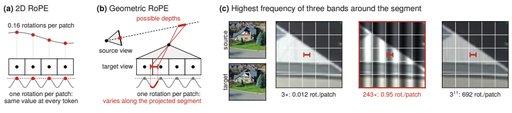
Figure 2 .From discrete patch indices to continuous projected segments.(a) In 2D RoPE, tokens sit at integer patch centers, where a frequency of one rotation per patch gives every token the same phase. (b) Across cameras, geometric RoPE projects a token’s 3D viewing ray into the other view: the reprojected position is continuous, and unknown depth spreads it along a segment. (c) Target crop around the projected segment (0.45patches, red) for a±15%depth interval of the marked source pixel, overlaid with the top frequency of three bands: 3×barely varies across patches,243×separates sub-patch offsets, and3 11 turns∼300times inside the segment (drawn77×coarser).
Original paper · CC BY 4.0 · Seonghyun Jin, Youngmin Kim, Jong Chul Ye · Mind the Band: The Hidden Frequency Variable in Geometric RoPE · Original paper figure · Extracted the figure area from page 2 of the original PDF.Why the band is a hidden variable
Geometric RoPE rotates query and key channels by camera-derived coordinates, not by integer patch indices. Reprojected points, however, can land anywhere inside a patch, so the band has to separate sub-patch offsets across views. Depth uncertainty also spreads each projection along a segment, so very fast frequencies cancel along that segment.
Yet the implementations disagree on how wide the band should be.
URoPE and WorldRoPE keep the 2D ceiling of 0.16 rotations per patch, while RayRoPE, CRePE and G-ray fix the lowest frequency and multiply by three per channel pair. A benchmark can therefore reward or penalize a frequency setting that nobody reported.
Two ways a band can fail
The central idea is that a frequency band fails at both ends, for different reasons. A band that is too narrow leaves neighboring patches with nearly the same rotation, so attention loses local contrast. A band that is too wide fails through the backward pass rather than the forward one. Blocking only the gradients from the high frequencies into predicted depth recovers 90–93% of the lost PSNR.
Take the default 3× band, whose fastest frequency is 0.012 rotations per patch. Averaging the cosine terms over the n frequencies of a coordinate gives \(K(\delta)=\frac{1}{n}\sum_{k=0}^{n-1}\cos(\omega_k\delta)\), and with such a slow top frequency this kernel stays almost flat between neighboring patches. The positional signal then adds little contrast, so fine alignment falls on token features and rendered views blur.
RayRoPE averages rotations uniformly over the predicted depth interval [µ−∆, µ+∆]. That average is \(\Phi(\mu)=\frac{1}{2\Delta}\int_{\mu-\Delta}^{\mu+\Delta} e^{i\omega x}\,dx=e^{i\omega\mu}\frac{\sin(\omega\Delta)}{\omega\Delta}\), so its magnitude falls as \(1/(\omega\Delta)\) when ω∆ is large. Forward, the fast frequencies therefore barely reach the attention output.
Differentiating with respect to the center µ removes that 1/ω factor, because the exponent contributes an iω, which leaves \(|\partial_\mu\Phi|=|\sin(\omega\Delta)|/\Delta\). That derivative does not decay as ω grows, since the oscillations inside the interval cancel and only the two endpoints move.
Band sweeps on RealEstate10K
The authors used the public WorldRoPE framework on 256×256 RealEstate10K with 8×8 patches. The backbones were a 25M model with 48-dimensional heads and a 47M model with 144-dimensional heads. Single-ray RayRoPE at 3× performed no better than the three-ray default, which rules out the ray count as the bottleneck.
Figure 4(b) sweeps the top image-plane frequency for the three encodings.
Varying the head count at fixed 25M width sets d to 48, 96 and 192. The authors read this as band sensitivity rather than head-size sensitivity.
Depth, attention and design-choice checks
RayRoPE scored 23.76 at d = 144 and 22.40 at d = 48.
Cross-view attention on verified SIFT correspondences gives a second, independent read. This measurement uses 25M models averaged over heads and the last three layers, on 20 test scenes.
Blocking depth gradients at 3^11
The authors test the mechanism with stop-gradient, which detaches the projected coordinates from the computation graph. Its forward pass is unchanged, so any recovery comes from removing the gradient into predicted depth.
With stop-gradient on the six highest frequencies, the same 3^11 model scored 26.47.
Stopping only the top three frequencies already recovers about 80%. The authors read this as forward smoothing not guaranteeing backward stability.
Limitations
The half-precision coordinate rounding affects only the official codebase.
The paper leaves open how the plateau scales at higher resolutions and on video, and how ω0 should be set.
Paper info
- Authors
- Seonghyun Jin, Youngmin Kim, Jong Chul Ye
- Venue
- arXiv · Preprint
- First published
- 2026-11-24
- Added
- 2026-11-25
- Updated
- 2026-11-24
- Version
- v1
- arXiv
- 2611.32171
- Category
- cs.CV · cs.AI
- Original paper terms
- CC BY 4.0
- What we show
- Paper info, commentary and permitted figures from the original paper
AI commentary is a separate explanation from the original paper and may contain errors. The original paper and figures follow each source's terms of use and any rights noted separately.
Abstract
Geometric rotary position encodings (RoPE) incorporate 3D camera geometry into multi-view attention by rotating token features according to viewing rays, depths, and reprojected image coordinates. Each coordinate is rotated across a progression of frequencies--its frequency band--yet existing implementations leave this band to inherited defaults, either retaining standard 2D RoPE's top frequency or letting the frequency span grow exponentially with the attention head dimension. We show that this unstandardized setting can reverse benchmark rankings. In novel view synthesis on RealEstate10K, RayRoPE matches the strongest baseline in the 47M model (144-channel heads), yet trails by 1.2 dB in the 25M model (48-channel heads), and exhibits the same reversal when varying head size alone at fixed model width. Populating a 243x range with four frequencies instead of the 3x default at 48 channels recovers 0.9 dB of that gap. Across view synthesis and two-view depth estimation, overly narrow bands consistently blur correspondence, whereas all three projection-based encodings perform reliably when their top frequency lies within 0.3--3 rotations per 8-pixel patch (10--90 rotations across 256x256 RealEstate10K). At the opposite extreme, overly wide bands degrade RayRoPE through a forward-backward asymmetry: averaging rotations over a predicted depth interval damps high frequencies in the forward pass, yet leaves their gradients with respect to predicted depth undamped. Blocking only those high-frequency depth gradients recovers 90--93% of the lost PSNR, showing that forward smoothing does not guarantee backward stability. Guided by this analysis, we distill practical guidelines--setting bands in image coordinates, populating spans in small heads, and avoiding unconditional same-view damping--and advocate reporting and matching frequency bands in future multi-view benchmarks.
Quote from the paper
Seonghyun Jin, Youngmin Kim, Jong Chul Ye (2026). Mind the Band: The Hidden Frequency Variable in Geometric RoPE. arXiv:2611.32171v1. https://arxiv.org/abs/2611.32171v1
BibTeX
@misc{jin2026mind,
  title = {{Mind the Band: The Hidden Frequency Variable in Geometric RoPE}},
  author = {Seonghyun Jin and Youngmin Kim and Jong Chul Ye},
  year = {2026},
  eprint = {2611.32171},
  archivePrefix = {arXiv},
  url = {https://arxiv.org/abs/2611.32171v1}
}